Designing movement or insurrection?

Various factors converged during the week to prompt my thinking on mentoring Millennials – an age group of the population roughly defined as those being born around 1980. The RSA Journal that I get had three articles on this generation in one copy:

  • Restless, bylined with, "Owen Jones writes that highly creative but deeply frustrated, young people today have the potential to make or break our society's future."
  • Portrait of a Generation which notes that 'fourteen years ago, a UK-wide survey identified self-determination and entrepreneurial ambition as the core characteristics of the so-called Millennial Generation. Today, against a much tougher economic backdrop, how do the views of young people compare with those of their predecessors?'
  • A Time for Heroes reports that "What begins to emerge is a picture of a [Millennial] generation that is more comfortable with taking risks and whose appetite for enterprise is both driven and hampered by economic circumstance. Through research, engagement and practical innovation, the RSA's project seeks to understand how we can harness and enhance this promise and capabilities and the contribution they will make to pulling us out of the current crisis. As Tapscott argues, unless we understand the Net Geners, we cannot begin to understand the future or how they can shape our world."

Then as I was preparing for my IFMA talk next week on communicating change I came across a three minute video from the Advisory Group on leadership in times of flux. Suggesting that leaders need much the sort of skills that Millenninials tend to have.

My own research on this group (part of my TEDX Future of Work talk) threw up more points on Millennials and leading in chaos:

  • Most organizations which have performance management systems, job descriptions, career paths, grades, older senior people, expectations around level in the hierarchy (even while some described themselves as 'flat' organizations) all leave Millennials feeling alienated. One said to me the other day "I've reached the point that I just going to come in to work, do a job, and take my talents and skills into a side business where I can feel in charge of my own destiny."
  • Millennials are juggling insane demands on their personal lives – in the US particularly they tend to have huge student loan debt. Across the western world they may be looking for a committed relationship, rearing young children, be looking after older parents, be trying to get a foot in the housing market, and so on. A couple of months ago Bagehot in the Economist wrote a telling piece on Generation Xhausted in which he says "Researchers of well-being have established a fairly clear pattern, across different cultures and countries, in which happiness dips in the 30s and 40s before recovering in the 50s.
  • At the same time as these 30 somethings are bearing the brunt of life stress they are also trying to advance their ability to either move up a conventional up-the-career-ladder and/or earn enough money to support themselves through their final third of life (now in the age range of 60 – 90+). This adds to their stress for, as Bagehot says, "Like a middle-distance athlete on a bend, anyone who wants to run something in his 40s needs to position himself for supremacy a decade earlier. In a big company, that might mean taking charge of a division or a region."

But 'positioning for supremacy' is a whole endlessly changing ball game for both organizations and individuals as they operate less in fairly stable situations and more in chaos. Chaos being like the weather, which you can, at times, predict well for the next 15 days or at other times can only forecast for a couple of days, or at other times can't even predict the next two hours.

This leading in a time of chaos is also discussed in two Fast Company articles. The first This Is Generation Flux: Meet The Pioneers Of The New (And Chaotic) Frontier Of Business.
The second Secrets of the Flux Leader argues well the case for very different forms of leadership and organization designs based around managing paradoxes like "efficiency and openness, thrift and mind-blowing ambition, nimbleness and a workplace that fosters creativity".

SIDEBAR The article also repeats the reassuring (to me anyway) notion that Generation Flux describes the people who will thrive best in this environment [of chaos]. "It is a psychographic, not a demographic–you can be any age and be GenFlux. "

During this reading and research period I met with some Millennials to forward an idea I'd had following one of them sending me an article How the economy upended young architects' hopes. This article talks about people who graduated from architecture schools in 2006/2007 and working in architecture firms feeling for the most part, as one reported "underutilized, underpaid, underappreciated, undervalued, and invisible most of the time."

Knowing that the company I work for has many Millennial employees and being curious as to whether they are feeling this frustration I suggested that we meet with them to talk about the issues including how do we help the organization recognize that Millennials are potentially current and certainly future leaders in times of flux/chaos, and how do we help Millennials change the traditional organization and use the talents they bring. I got an interesting response back, "I'm not sure how widespread the issue is among young[er] designers. I also am not clear how we could have a healthy group discussion without fostering insurrection."

So now I am beginning to see a cycle that looks something like this:

  • Traditionally led organizations that are not rapidly adapting their mindsets, systems, processes, expectations to develop leaders for chaos, are likely to fail.
  • Working with Millennials to develop organizational leading in chaos skills is not going to be easy for senior people who don't grasp the need to lead differently, or don't want to, and who might be hanging on to their own jobs as they now have to work more years than they thought they would have to.
  • Millennials who can't show what they're capable of because the existing systems preclude it, and because they are stressed by all kinds of other life things, will become presenteeists in order to keep a job when it's so difficult to find one. To raise questions about the traditional way of doing things might lead to "insurrection" (involvement in which I'm assuming is seen as a career limiter).
  • Millennials who have the circumstances in which they can be entrepreneurial, self-employed and creative (the type of people who can lead through chaos) will leave established organizations which will then fail. (Rendering other Millennials employed in those companies jobless).

What to do? I've been pondering this on my various running outings during the week. My current thoughts are as follows:

  • To design, with a range of age group representatives, a mentoring scheme that addresses both the traditionals and the Millennials and develops both their abilities, by learning from each other, to lead in chaos, without either groups feeling threatened. But this feels a somewhat traditional and counter chaos approach.
  • To design a meeting on the topic "Movement or insurrection: how do we make our mark in the organization?" open only to Millennials, or maybe held in a location and at a background noise level that would deter traditionalists, as a subtle way of not contravening the diversity policy. But that would exclude me and I want to be involved in what they come up with. Also in my organization the bulk of the people are at one site but there are others at other sites. How would we include them in the discussion?
  • To open an all-company hackathon on the topic of how to start a movement to develop leaders for flux from the Millennial generation. The hackathon would take much the same form as the MIX did with Getting Performance without Performance Management. The aim there was to "lead a conversation about what should replace performance management in a Management 2.0 world. How do we replace the "control" that the term performance management implies with something better?" That hackathon was held between September 21 and October 22 and seems to have some good suggestions.

SIDEBAR: Windows 7 Word does not recognize 'hackathon'. I wonder if it is included in the Windows 8 dictionary.

I'm leaning towards the third idea and will consult with my Millennial colleagues on how to set it up. If you have other ideas on the topic I'd love to hear them.

FAQs on Organizational Structures

This week a consultant sent me an email with some questions on organizational structures (aka what you see on as an organization chart). And a line manager from another organization sent different questions but on the same topic. This sparked in me the idea of answering the 10 common FAQs I get about structures – so here they are with some answers. Feel free to challenge, add, comment on.

1 What are the emerging organizational structures?
Various structures are emerging both in theoretical literature and in application. These include network structures, formal versus informal organizing structures, state capitalist structures , open source structures, (see The Rise of State Capitalism), and co-operatives (not new but gaining ground).

2 What are the models, theories and concepts that underpin these emerging structures from a technical/operational perspective?
These tend to come out of organization theory, social science, social psychology, behavioural science and economics. Theorists in the field include:

Siobhan O'Mahony from Boston University and Fabrizio Ferraro from IESE Business School (University of Navarra) have individually and together investigated, as Ferraro explains, "the emergence of novel institutions, such as Open Source Software, Sustainability Reporting and Responsible Investing, the evolution of global corporate networks and architectural changes in industries."

O'Mahony is interested in how people create organizations that promote innovation, creativity and growth without replicating the bureaucratic structures they strive to avoid. She has done a delightful study of Burning Man and Open Source communities,finding that:

"Both communities sought to differentiate their organizations from reference groups … We found that the ability to pursue a differentiated strategy was moderated by environmental conditions. By exploring the organizing decisions that each community made at two critical boundaries: one defining individuals' relationship with the organization; the second defining the organization's relationship with the market, we show how organizing practices were recombined from the for-profit and nonprofit sectors in unexpected, novel ways. This comparative research contributes a grounded theoretical explanation of organizational innovation that adjudicates between differentiation and environmental conditions."

Carliss Baldwin at the Harvard Business School. She studies the process of design and its impact on firm strategy and the structure of business ecosystems. See a recent article of hers in The Journal for Organization Design (Vol. 1, No 1, 2012) Organization Design for Business Ecosystems.

Jay Galbraith an Affiliated Research Scientist at the Center for Effective Organizations at the University of Southern California and Professor Emeritus at the International Institute for Management Development (IMD) in Lausanne, Switzerland. has an article in Vol. 1. No 2 of the same journal The Evolution of Enterprise Organization Designs predicting organization designs of the future. In his words

"International expansion leads to organizations of three dimensions: functions, business units, and countries. Customer-focused strategies lead to four-dimensional organizations currently found in global firms such as IBM, Nike, and Procter & Gamble. I argue that the next major dimension along which organizations will evolve is emerging in firms which are experimenting with the use of "Big Data.""

3 Are the models and new structures appropriate for all environments?
No any organization should think about the appropriate structure in relation to its environment, the uncertainty it faces, its legacy and history (some government organizations, for example, have a legislated structure), how it wants to specialize/differentiate, how it wants to integrate (i.e. the linking mechanisms).

Having said that structure choices involve tradeoffs and there is no one best way for a specific organization to structure. Generally speaking, people can work in any structure. I came across a structure manifesto on a wall in a nightclub in Newcastle on Tyne once. I wrote it down immediately. It read:

  • One can work within any structure
  • While one can work within any structure some structures are more efficient than others
  • There is no one structure that is universally appropriate
  • Commitment to an aim within an inappropriate structure will give rise to the creation of an appropriate structure
  • Apathy, i.e. passive commitment within an appropriate structure will effect its collapse
  • Dogmatic attachment to the supposed merits of a particular structure hinders the search for an appropriate structure
  • There will be difficulty in defining the appropriate structure because it will always be mobile, i.e. in process
  • Within any structure it is always essential to act with responsibility and consider the impact of the structure on people, their minds, and other living things.

I thought these were valid points. I wonder if the manifesto is still there?

4 Should we be thinking about roles, posts or individuals as we develop the structure?
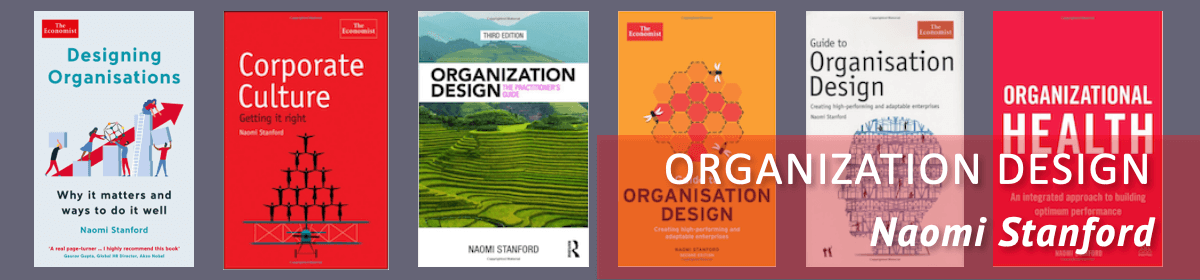
When I work with organizations I look at the work that has to be done and develop the structure in line with estimated work volume, work flow, handoff and interdependencies, and then the benefits of one type of structure over another. See Chapter 3 in my book Guide to Organisation Design: Creating high-performing and adaptable enterprises (Economist Books), for a discussion on the characteristics, advantages and disadvantages of different types of structure.

In reality individuals start to intrude when the structure with roles has been developed and it is evident that there is no place for, say, Jim who then has to be slotted in somehow. That's when I find the political jockeying begins.

5 What is the relationship between business process maps and organizational structure? (And do we need to do current business process maps?)

I have found that detailed current process maps are rather a waste of time and effort when doing a restructure. However identifying the business purpose of the organization (or part of it that you are working with), agreeing the core business processes that deliver the purpose and then mapping at a high level the ideal process flow (not the current) with handoffs and interdependencies, is the way to go. I then encourage people to 'bundle' the work across the core processes in different ways and then develop the structure from these bundled options. As I said in last week's blog I am re-writing my first book on organization design and am going into much more detail in the second edition on the methods and testing of these 'bundled' options that lead to proposed structures.

6 Who are the various players in developing an organization structure?
Usually it is a leader either of the whole organization or the part of the organization that is being restructured who initiates the work. I advocate for representatives of different levels of the organization to be involved in re-structure work to get full insight into the work that is done. In the Hoshin Kanri program I attended last week we were reminded that Taiichi Ohno (father of Toyota's lean manufacturing system) refused to read more than the first page of written reports. Instead he'd say "let's go and see" and make people "get the facts" at the workplace.

7 What are their roles?
Generally I set up a restructure as a project with a steering group, design team members, and a different transition team. The tool for October on my website is a design team member profile. I also work with specialists usually from HR, IT, Corporate Real Estate, who can provide expert information on the consequences of the structure options generated. Transition team members are different from design team members and are responsible for project implementation.

8 How do you audit/review a structure to see if it is contributing to efficiently and effectively achieving the business purpose and simultaneously providing a good customer/employee experience?
Ideally, you will have in the original project charter (there is a template on my website) or business case the measures of success. Use this as a start point for review.

9 How can we strike a balance between helping managers to conceptualise a complex process, and making it look so simple that they dive into the actual structure design stage too quickly?
My tack on this is to ask managers what the risks and consequences are of diving into the structural design too quickly. The risks are numerous – you need to have a good series of questions that will surface these. Once they recognize risks and consequences then they are usually happy to spend a bit of time thinking things through using a systems model that shows the relationship between structure and other organizational elements.

10 I have worked in and around this area successfully for a few years now but mainly on a small scale department basis. The thought of taking on a whole organisation feels somewhat scary. Is it the same process?
Briefly, yes it is the same process. You are just scaling it up and there will be more to keep an eye on. Very good programme and project management helps on this. I invariably have a qualified project manager working alongside me in the work that I do.

As I said, feel free to challenge, add, amend, comment and/or submit other questions.

The second edition

The first edition my book Organization Design: the Collaborative Approach was published in 2004. I've now started writing the second edition that will come out in summer 2013 (assuming I write to schedule). I find it staggering to look back and see how much has changed in a bare eight years, and from what I see the changes are continuing apace and they all have a significant impact on the way organizations function. Changes I've noted so far include:

1. Accelerating swift and wide-ranging information and communication technology (ICT) changes that are impacting organizations. Since 2004 social media has burst upon the scene, cloud computing has become the norm, and business intelligence software is getting increasingly sophisticated. All these have huge impact on the traditional organization of enterprises.

2. Increasing requirements for 'sustainability' including carbon footprint savings, 'greening' the enterprise and so on. This again requires looking at the way work is done through a new lens.

3. Intensifying demands, brought about by fiscal and political conditions, to do more for less – smarter, more efficiently, more effectively. Just look at the impact the financial crisis of 2007 – 2009 had on governments. Worldwide they were and continue to be faced with the challenge of offering better citizen services with vastly reduced budgets. No organization can keep pace with this type of demand without looking at its design.

4. Increasing involvement of architecture and design firms in the application of their world's design principles into the world of business operations and organization. This confluence of two disciplines is intriguing and perplexing, giving rise to questions like 'Should can HR compete or collaborate with real estate?' 'At what point do facilities and HR mesh?' 'How relevant is space design to business performance?' 'What can the two disciplines learn from each other?'

5. Building steam for creating better work life balance coming particularly from people in their 20s and 30s in the US and Europe. The introduction of flexible working, family friendly policies, remote and virtual working all contribute to organizations having to take another look at the way they operate their people processes.

6. Emerging tensions around competition as companies seek to extend their range into new areas – both geographic and products/services. This gives rise to all manner of cultural and internal competition

7. Changing global demographics that are leading to high youth unemployment and an increasing trend towards people over 65 staying in the workforce.

8. Heightening skills shortages in specific disciplines – engineering and computer sciences in the US and Europe, for example.

9. Developing understanding of networks, 'organized complexity', neuro-science , and biology that are changing the way we think about organizations. Moving us away from thinking of them less as bounded systems, and more as complex, adaptive organisms.

10. Advancing product technologies that are changing the jobs landscape – many jobs previously done by humans are being done by robots, or by other technologies: self-checkout in supermarkets is an example, digital wallets are on the way and both are human job replacements.

To my mind these phenomenally fast moving changes require three things from organizational leaders

  • To think very differently about the way their organizations are structured: a growing number are thinking of their enterprises as networks with dependencies and interrelationships rather than fixed hierarchical bounded structures.
  • To create a flexible, agile, adaptive, sustainable organization: one that continues to perform well and provide decent work (as defined by the ILO)
  • To seek expert support in creating and maintaining this type of responsive organization and not feel they can go it alone. Design work is not for the layman as findings from a survey done in 2012 found. It reported that about half of surveyed organisations viewed their organisation design as only moderately successful, and none of them viewed themselves as very successful at organisation design. (This nugget comes from an interesting piece of happening as a collaboration between the University of Westminster Business School and Concentra, email Mair Powell on: orgdesignresearch@orgvue.com if you would like more information)

This is where the second edition of the book comes in. Its primary purpose is to:

  • Provide the tools and techniques to enable HR/OD professionals to develop confidence and competence in organisation design (and development)

Its secondary purposes are to:

  • Give line managers an overview of the design process, their role in it, and what support they can expect from their HR/OD colleagues
  • Suggest how HR/OD and the line can work most effectively together on design projects
  • Provide insights into ways of handling the kind of on-going change that all enterprises face and often find troublesome

I'm taking this approach as I see from facilitating organization design courses that HR/OD professionals need the skills and technical expertise to guide, coach, and support line managers through organization design and development. It is clear that capability in this respect is now a 'must have' one. A 2012 quote from a local government line manager illustrates.

In a context of increased pressure on resources within the governmental institutions (10-15% of staff cuts over 5 years in average) the current mainstream message within these institutions is that staff need to "do more with less". We of course all understand that this is difficult to achieve and may lead employees to being in unbearable situations. Organizational design and development is therefore becoming central as we look for new ways of working, being together, learning to do better differently and finding the way to make the "less that is actually more".

It's also notable that three things have occurred, since the first edition of this book, to help HR/OD staff develop their organization design and development competence:

a) The UK's Chartered Institute for Personnel and Development (CIPD) has added organization design to its HR Profession Map, requiring demonstrated competence in this discipline from HR Practitioners. The CIPD is now offering certification in organization design and several universities are including organization design as a module in their HR programs.

b) The US based Organization Design Forum has opened chapters in both Europe and the Middle East/Africa. And other chapters are planned.

c) Software programs have been developed (and it is highly likely that more are in the works) that take a 'big data' approach to organization design drawing on an organization's multiple data sets to facilitate organization design visualization, scenario planning and delivery

So what I'm doing is extensively updating the original book in the light of the context outlined above and grounding it in a further eight years of my own experience of:

  • Consulting with organizations of all sectors, sizes and business models, on their design issues
  • Leading public and tailored organization design programs in Africa, China, US, Europe, and UK
  • Writing and researching in the field.

Reflection on what I've learned during that period five things stand out that help guide me in my work:
1. Unless you are clear on what the design is for (what it is supposed to do) you don't stand a chance of delivering something that works
2. There is no one right way for doing organisation design
3. Even using a systematic approach organisation design is an evolving iterative process which usually feels messy and complicated
4. Faced with design options take the one that makes most sense at the time
5. The design you come up with is not one which will last forever (or even for very long)

I'm planning for the book to be practical and pragmatic, systematic but flexible. It will be more of a 'how to' guide than a textbook so it won't be academic or theoretical although sometimes I'll give way and mention theory or research to clarify or illustrate. I'm thinking that each chapter will be organized in the following sequence:

  • What you will learn: the purpose and outcomes of the chapter
  • Input on the chapter topic: discussion, information, interspersed with reflective questions
  • Where people go wrong: the pitfalls in this point in the design process
  • Tips for getting it right: how to avoid the pitfalls and make this stage of the process work
  • Tool: something that will help you in your organization design practice
  • Summary: the key points covered in the chapter

I'd love to hear whether this is the sort of book you'd be interested in reading and if you have any ideas on what specific topics you'd like to see covered.

The future of work TEDX script

Below is the script for the talk I planned to give at TEDX Columbus on Friday (Oct 5 2012). Inevitably, it came out somewhat differently on stage. (The videoed on-stage version will be on You Tube in the next week or so). And this is the last installment of TEDX stuff.
=====
The poet, Ben Okri, commands the workers of the world to 're-make the world', 'delight the future', and 'create happy outcomes'. Wouldn't it be lovely if we could 'delight the future' and create happy outcomes in working for pay? Let's consider the likelihood of this and see what we would need to do to achieve that outcome.

First though let's look at what we think of as 'work'. Some think of it as paid employment because we need to earn our living, while others think of it, more generally, as an activity that requires effort. And many activities can fall into either category. For example if you do the ironing then it's unpaid 'work' and if you pay someone to do it for you it is that person's paid employment.

The focus in this discussion is on paid employment – money earned by working. I'll cover three types of work and give one example of each plus an associated trend. I'll move on to look at three age groups in the workforce, and suggest three capabilities for each that will help these workers meet their work futures confidently given that trends are not predictions and we cannot say what the future will actually be.

First, think about work in three categories, albeit overlapping ones.

• Routine work: repetitive, assembly line sorts of things
• In person work: like doctors, teachers, shop assistants
• Data manipulation: like problem solving, information analysis, coding.

Routine work. When I was 18 I spent a summer in France working on an assembly line where bottled fruit in cognac came down the line and my task was to wrap and knot a gold thread around the neck of the bottles. I could not have predicted that assembly line work like this would be increasingly mechanized to the point that now we're seeing the accelerating use of robots to do this type of work. What does this increasing roboticization mean for assembly line workers? Trends suggest new types of jobs emerging that involve machine human supervision and interaction, requiring completely different skill sets from those required in the past and those currently required.

In person work is similarly changing – for much of my life I've been a teacher or trainer. This used to mean being with people face to face in a classroom. It still does but things are rapidly changing. For example, I now teach for Capella University. It is totally on line and the people I teach I've never met face to face. I talk with them on the phone, I email them, work with them in a virtual classroom, and grade their assignments. Increasingly the face of traditional education is changing. Trends here suggest many different forms of self-education, free education, and on-line collaborative education – this means a dramatic change in jobs related to teaching and learning.

The third form of work – data manipulation of all types has also seen massive changes. When I started work the internet did not exist. Data manipulation for me meant learning shorthand, looking at physical encyclopedias, and getting very excited when I got a calculator to replace my slide rule. Now we are flooded with data and manipulating what is called 'big data' has become big business. Again trends suggest that this whole field of data availability and new jobs associated with emerging fields will grow exponentially.

So back to the question is it possible for workers of the world to remake it, delighting the future, and creating happy outcomes where trends are suggesting very different and rapidly changing work. Given the impossibility of accurately predicting the jobs let's consider what capabilities people need to develop to meet more or less any future of work.

I'll talk about three different age groups and what capabilities the members of each need to continuously meet the future of work.

Luke, aged 11, is typical of his age group. He enjoys playing Minecraft. It's a data manipulation game and can involve interaction with other players – though not in-person. He's been playing it a couple of years now and is getting progressively more skilled at it. His father, however, is continuously on at Luke to do his regular homework. But, is there an argument to suggest that playing Minecraft might teach skills more suited to future work, than traditional schoolwork? I think so and people who will enter the workforce in 8 or so years from now are going to need all the skills they can muster.

Look at current figures: 81 million unemployed youth worldwide, 3 times more likely to be unemployed than adults, of the employed youth a quarter earn less than $1.25 per day. It doesn't seem that it's going to be easy to create a happy future out of this situation even with the new types of jobs that are likely to emerge. The future of work for the world's youth looks bleak – what will enable them to have some hopes of creating the happy outcomes? From my experience helping young people develop resilience, resourcefulness, and responsibility will take them a good way in the future. Coincidentally these are attributes that many of the serious computer games help build, but I'm not sure whether a traditional school education does – perhaps a controversial view but worth examining.

Women in their thirties are another interesting group to look at. Traditionally clustered in in-person work – when I was entering the workforce I was more or less choosing between nurse, teacher, or secretary. Things have changed in that women are represented in a much broader range of jobs but the expectations of employees in the workforce have not changed that much. It is still the case (although a luxury for some) that women are more or less deciding between a family and a career. It is incredibly hard to balance a career up a traditional corporate ladder with child rearing. Current figures illustrate. Of US women in the workforce 28% hold senior management positions, 14% hold seats on executive committees, and 3% are CEOs. Of these the women are much more likely to be single and much less likely to have children than their male counterparts.

Sadly, right now this hasn't changed much since I was in my thirties making the decision to have children whilst keeping a career going. In my case, and in particular circumstance, I made the agonizing decision to leave my children with my now ex-husband. In the face of all social norms of the time I became the weekend parent and he the single parent.

However, for women in their thirties today there are grounds for optimism – they may well be able to delight the future and create happy outcomes. How? Well, enabled by the opportunities digitization, technology, and the internet offer the trends are towards women owning their own careers – rather than trying to fit into a corporate mold -self-employment, and flexible working. And they're aided in this by men who also want to be a part of their children's daily lives, and are similarly seeking more work autonomy and a better work life balance than usually found in organizations. So I do see the work of current thirty somethings as having a positive effect on the future of work, albeit outside the world of traditional organizations.

But what capabilities do they need to keep going on this track? In my experience three stand out: a really clear definition or redefinition of their values: what matters to them. A willingness to challenge norms, and perseverance. All three are enduring capabilities and necessary to create a future of happy outcomes.
The third group I'd like to look at are the 60+ – those of pensionable age. Many of these, for various reasons, are rejecting notions of typical retirement – that is giving up paid employment to play golf, garden, or just sit in a chair. My father was typical of this age group. He died aged 85 still working – not for high pay but for a stipend. He was one of the founders of the Native Prairie Association of Texas and he founded the Dallas Nature Center, now run by the Audubon Society as the Cedar Ridge Preserve.

He was in the vanguard as the numbers of older people in the workforce started to increase. Current figures show that in 2010 3% of the UK workforce was over 65, and of these 63% have been with their employers more than 10 years, 66% work part time, while 50% work for companies which employ fewer than 25 people. This is more or less the situation of my father. Although in the US, he worked part time for a small organization and had been there over 20 years when he died.

The numbers of pensionable age people staying in the workforce looks set to continue to increase into the future. Will this be a delight and create happy outcomes? It's a double edged sword – for older workers maintaining a reasonable income is essential – pensions are not necessarily enough to live on. But there is an argument that in some countries older workers staying in the workforce preclude younger workers from getting jobs. For organizations keeping the knowledge gained over, say ten years, is often a big plus, particularly when methods of knowledge sharing are weak. But salaries can be an issue – an older full time worker may be much more expensive than a younger one which can make older people vulnerable to lay-off.

What capabilities will people over 60 have to hone to keep themselves earning as work changes. Three stand out: staying in the world, that is being curious, learning new things, keeping up with technology. Living with precarity – elders are often in precarious situations economically, health-wise, and socially Staying fit. The fitter someone is the easier it is to hold onto work.

As discussed and illustrated the trends emerging show the future of work looking like:
• New jobs and new types of work in all three aspects of routine, in-person, and data manipulation
• New work patterns in terms of work-life balance, self-employment, and flexible working
• High tension between young people trying to enter the workforce and those of pensionable age trying to stay in it.

So can we workers today remake the world, delight the future, and create happy outcomes? I think so but with a caveat – we can develop ourselves to do so and as I've shown this preparation includes each of us developing certain capabilities. But as well as this it will take the majority of our educational, corporate, and political systems to make parallel major changes in their design and operation – and this is I contend is a bigger challenge . So I close with the question; what can and should we workers of the world do, beyond developing our own capabilities, to delight the future and create happy outcomes?