Hierarchies and networks

View at Medium.com

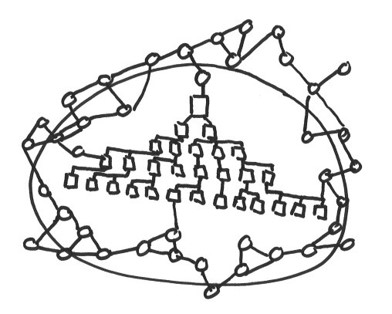
Oday Kamal observes that ‘The tension between hierarchy and networks is fundamental in charting the course of the future of work.’ And then asks several questions: ‘How can beneficial networks be nurtured in organizations? Where does a legacy hierarchical structure and a nascent network intersect and support each other? How can we determine if our organizations are choking the life out of potentially beneficial networks before they can really make a positive impact?’

He doesn’t answer these questions but they’re relevant to an introductory session I’m running this week on organizational hierarchies and networks and how work gets done, and I’ve been ruminating on them.

We seem to be moving towards the idea that networked structures are ‘a good thing’ in an age where hierarchies and ‘power over’ organizations seem to have had their day.

Amy Edmundson and Michael Lee describe hierarchies as being based on two principles a) A hierarchy of authority where individuals report to managers who have the authority to direct and prioritize the execution and allocation of tasks, review performance, and in many cases, hire and fire; b) A hierarchy of accountability—that is, work accountabilities roll up from direct reports to managers who hold ultimate accountability for the work of all those below in the organization chart.

They imply, as does Deloitte in the 2017 Human Capital Trends, that these organizational hierarchies are not fit for our digitized, networked age and that a more appropriate design is one thatradically decentralizes authority in a formal and systematic way throughout the organization,’

Networks fall into this category.  Jessica Lipnack and Jeff Stamps describe them as configurations ‘where independent people and groups act as independent nodes, link across boundaries, to work together for a common purpose; it has multiple leaders, lots of voluntary links and interacting levels.’  They’re based on the principles that

  • Authority is not from a hierarchy but from individual’s recognized knowledge and skill
  • Links are between people and teams across conventional boundaries (e.g. departments and geographies)
  • Members and structures adapt to changing circumstances
  • Management has a sense of mutual responsibility
  • People explore ways to work effectively
  • Teams are readjusted or disbanded needed

Can the very differently principled networks and hierarchies co-exist in one organization and would this resolve the tensions Oday Kamal observes?

John Kotter suggests so.  In his article Hierarchy and Network: Two Structures, One Organization, he tells us that:

The successful organization of the future will have two organizational structures: a Hierarchy, and a more teaming, egalitarian, and adaptive Network. Both are designed and purposive. While the Hierarchy is as important as it has always been for optimizing work, the Network is where big change happens.  … My idea of the Network is a system of teams with representatives from all divisions and all levels, who leave formal titles at the door to participate in a decidedly anti-hierarchical forum.  (See also his HBR article Accelerate)

But, not obvious in either the principles or the discussions of formal hierarchies and networks are the informal networks that exist within them – of friendship, influence, knowledge, etc. (Unless this is what Kamal means by ‘beneficial network’).

Organizational network mapping, of the type Rob Cross does, clearly shows us that informal networks of social connection and interaction are strong in all types of organizations and they can be very powerful influencers – beneficial or not –  of individual, team and organizational performance. (Watch the TED talk on the hidden influence of social networks.)

There may be tensions between hierarchies and networks, and they may be resolvable by having both present in one organization but only if the strength of the informal social network ties are identified and factored into the design thinking.  (Here’s a helpful Oxfam blog on getting started in social network mapping).

The informal, social networks are what make organizations work and they can’t be designed.  How can knowing more about them help us decide how to configure the formal hierarchies and networks either as independent forms or as integral forms?  Let me know.

Image Jakob Wolman

Maybe, I’ve left it too late

A one-hour introduction to design thinking can’t be designed in 5 minutes or in an hour.  I’m feeling the pressure, with very little time to go before I have to facilitate the session and only the barest outline of what to cover that is high-quality, engaging, informative, useful and quick to design.  Maybe, I’ve left it too late to do a good design job.

Years ago, when I first got involved in the world of computer based training I read somewhere that it took 40 hours of designing to get 1 hour of instructional material ready to deliver.  Now, with so many channels of delivery – omni-channels, even – has this estimate increased or decreased?  I don’t know, and thinking about it is taking away from the time that I have – closer to 40 minutes than 40 hours –  to design the one hour I am facilitating next week.

So, what to do? How can I accelerate the design of my workshop in the time I’ve got on the train, where there is very limited internet access to pull up resources?  I definitely do not have the time to go through the 5-step design thinking process – empathize, define, ideate, prototype, test – that will result in a brilliantly designed session.  Not good role-modeling here.

Maybe I can do a 60-minute version of the 90-minute Stanford D-School virtual crash course in design thinking? It’s got a facilitator guide, video and worksheets.  Presumably the course has been through the design thinking process itself.

And that takes me to Natasha Zen’s argument that ‘Design thinking is bullshit’.  She makes the case that formalising and commoditising a 5-step process that has underpinned design work over ages is limiting. As the blurb says, ‘In her provocative 99U talk, Jen lobbies for the “Crit” over the “Post-It” when it comes to moving design forward.’

She has a point on this.  ‘Design thinking’ could be on the verge of being dismissed as a fad as it has been hyped so much in the last few years.

Perhaps going down a ‘principles’ approach would be more fruitful?  That avoids the predictability of following a 5-step process and there are some interesting design principles to critique.  I already have them on my laptop which makes things easier.  Dieter Rams’s, John Maeda’s and the Global Agenda on Design Council’s.  We could critique them in relation to some objects participants have with them in the room – a pen or a pencil?

I’m still undecided.  I’ve now got several ideas, and others have just landed in my in-box via LinkedIn’s Design Thinking Community.  Someone is looking for some good tips on ‘quick, 5 min fun activities or games that could be conducted to introduce design thinking to a diversified audience (divided into very small clusters, as small as 1-3)’, and others have weighed in with suggestions.   I like the piece on questions from Mastermindset.

Good, I’m forming a bit of a sequence and an outline.  I can start off with a definition of design, then do a short activity where they critique an object against one of the sets of design principles.

I’ll then move on to a short video on design thinking.  There are two I’ve used before that give good summaries: one Design Thinking by Daylight Design, a 4 minute intro video and the other a trailer for a film Design & Thinking.

From this we can go into the 5-phase method and do a variant of the crash course when the participants design something relevant to them as users.  The thing that springs to mind is a better room booking experience – maybe because I’ve just been bumped from a booked room with no warning or explanation.

I’ll ask a couple of colleagues if they think that will work, give it a go as a minimum viable product, and learn from what happens.

How would you design an hour’s introduction to design thinking?  Let me know.

Image from: Margaret Kagan, Open Law Lab

Metaphors and a speak up culture

Last week the UK’s Institute of Business Ethics (IBE) published a Good Practice Guide, Encouraging a Speak Up Culture.  They are clear that is it not only about whistleblowing – explained by Gov UK as:

You’re a whistleblower if you’re a worker and you report certain types of wrongdoing. This will usually be something you’ve seen at work – though not always. The wrongdoing you disclose must be in the public interest. This means it must affect others, e.g. the general public.

But,  IBE says,  also about ‘speaking up’ – a language shift that ‘can mark the beginning of fostering an open culture’.  The guide tells us that:

‘managers at all levels are responsible for nurturing a Speak Up culture – a culture of integrity and openness – where ethical dilemmas are discussed and debated and employees feel supported to ask questions and raise concerns.  A healthy, trustworthy culture is the basis of a sustainable organization in the long-term’.

In this it extends ‘speaking up’ beyond the bounds of whistleblowing into the arena of ‘employee voice’ which the UK’s CIPD, says is  ‘the means by which people express their opinions and have meaningful input into work-related decision-making.

(As one of their seven layers of workplace productivity Acas has ‘strong employee voice:  informed employees who can contribute and are listened to.’)

A speak up culture embraces both whistleblowing and employee voice and, as Courageous HR suggests,  ‘Maybe the way forward is to work with organizations and managers in particular, to treat whistleblowing as an aspect of employee voice.’

That’s a laudable suggestion, but is still treating the concept of speaking up in constrained, organization as machine, terms – with policies, formalities, forums, and what the CIPD in their Factsheet actually calls the Mechanisms of Employee Voice, explaining, ‘There’s a range of different and often complementary mechanisms for employee voice. We distinguish two groups: upward problem-solving and representative participation.’

Trying to address issues and opportunities of whistleblowing, employee voice, and a speak up culture from a machine metaphor is not getting us very far.  A 2013 UK survey of UK businesses’ whistleblowing ‘found that despite over 90% of companies adopting formal whistleblowing policies, 1 in 3 think their whistleblowing arrangements are not effective.’

Typically, and perhap unconsciously, we use the organization as machine metaphor in many of our organizational constructs, (e.g. employees being ‘cogs in wheels’, concepts of efficiency, pipelines, toolkits, etc).   If we used a different metaphor, from the machine one, to encourage a speak up culture then maybe we’d come up with a different, more effective, approach to designing one.

Gareth Morgan, in his book Images of Organization offers eight metaphors of organization – one of which is the machine. The others are brain, psychic prison, political system, flux and transformation, instrument of domination, living organism, and culture.

Supposing, for example, we explored the brain metaphor to consider a speak up culture – where would that lead us? Morgan, in his 2011 article,  says:

‘When you view organizations as brains, you find yourself thinking about information  processing systems, learning capacities and disabilities, right and left brain intelligence, holographic capacity distribution, and a host of images that can take brain-like thinking beyond the spongy mass of material that comprises an actual brain.’

For a moment forget about whistleblowing and employee voice and just consider a typical business meeting where usually only a handful of people present speak – why are the others not?  Using the brain metaphor raises interesting questions, for example: Are some participants having difficulty processing the discussion? Are they picking up signals of micro-inequities that constrain them?  Have they learned that the views of those with hierarchical power win or dominate, regardless of other views?   Is their cognitive capacity diminished by being in a small group, or their perceived lower status in the group?  On this last see some fascinating neuro behavioural research.  (Or if you want the easy version look here)

Perhaps if we understood, via the brain metaphor, why people did or did not speak up in meetings which are part of the daily operation of organizations, we might get some insight into why they do or do not speak up about ethical and moral concerns, which takes equal or more courage than speaking up in meetings.

Viewing the problem of not speaking up from a different metaphor could well lead to new ways of encouraging a speak up culture and yield innovative ways to do this.

What other ways are there of encouraging a speak-up culture beyond the mechanistic ways, or using metaphors?  Let me know.

NOTE: See also the CIPD publication Alternative forms of workplace voice: positioning report (September 2017)

Speed the what

I subscribe to number of email updates – each day of the week I get around 45 – they’re from various organizations I visit on my travels through the internet in the course of my work.  In a way, they’re like ‘the olden days’ postcards, friendly reminders of what’s happening from a different part of the world in that moment and many of them pique my interest.

Yesterday I got one from ‘The Ready’.  I was immediately intrigued by their listing of Yves Morieux’s ‘TED talk on how an overload of rules, processes and metrics prevents us from doing our best work.’

It’s a topic that I’m working on and I’d already spent an hour or so reviewing an organizational policy,.  As an antidote I listened to Morieux’s view.   He boldly tells us that:

 ‘the holy trinity of efficiency: clarity, measurement, accountability. They make human efforts derail.’ He makes the strong point that ‘All the human intelligence put in organization design — urban structures, processing systems — what is the real goal? To have somebody guilty in case they fail. We are creating organizations able to fail, but in a compliant way, with somebody clearly accountable when we fail. And we are quite effective at that — failing. … And as performance deteriorates, we add even more structure, process, systems. People spend their time in meetings, writing reports they have to do, undo and redo.’

 And so on.  You get the picture.   (See the Bain brief ‘Four paths to a focused organization’ for a similar perspective).

 As an alternative to clarity, measurement, and accountability which lead to organizational failure (in his view), he offers ‘co-operation’.  He proposes that where it is in people’s personal interest to cooperate then they will do so.  In situations where clarity, accountability and measurement focus on individual performance they will not co-operate. He urges us to:

‘Remove the interfaces, the middle offices – all these complicated coordination structures. Don’t look for clarity; go for fuzziness. Fuzziness overlaps. Remove most of the quantitative metrics to assess performance. Speed the “what.’

 His analogy was a relay race and passing the baton.

I was quite taken with this thinking – in any business process flow the handover points are the most vulnerable to failure.  I run a whole masterclass on boundaries and linkages at handover points – the baton passing moment in a relay race.  It started me wondering if it was a workable analogy that I could use.

It turns out that ‘the relay race is often won in the exchange zones, so drills to increase a team’s baton-passing efficiency are vital to success in the sprint relay.’ That sounds sensible and translatable into an organizational context.  As I just said, in organizations, it’s at the handover points – between parts of organizations, between IT systems, between in-tray and next-step that things go wrong.

Knowing that the handover points are vulnerable is the first step to making them less so – in relay circles by having coaches who ‘select their relay runners with an eye for athletes who can exchange the baton smoothly, and at full speed, in addition to being strong sprinters.  Then the coach must train the team, through its drills, to hone its passing technique into a smooth-running operation.’

Additionally the team must know the rules of the race e.g. the baton has to be passed within the yellow ‘exchange’ box, and the terms of optimum co-operation e.g. runners have to agree the handoff process.They also have to practice, practice, practice.  Even so there can be mistakes and errors which they use to learn from, without blaming an individual.

Translating the relay race to an organizational context suggests that to get good handovers we need to work on:

  1. Having and developing a very highly skilled workforce with each person being able and willing to be a fully contributing team member, to be coached for improvement, and to have the capacity to keep on practicing ways and means of improving, especially at the handovers.
  2. Introducing and maintaining a reward system that develops and sustains co-operation, trust and a collective aim for excellence (rather than individual competitiveness) both at the handover points and along the value chain or process cycle.
  3. Being clear and simple on the rules, measures and accountabilities of co-operation.  Here I disagree with Morieux’s video statement, ‘Don’t look for clarity; go for fuzziness. Fuzziness overlaps. Remove most of the quantitative metrics to assess performance.’  Relay teams and team members are clear on what they have to do, they are assessed on performance, and they are accountable for both their individual and their collective actions.

I do go along with his underlying premise that in many organizations the reporting and compliance requirements mean that ‘employees are often misdirected and expend a lot of effort in vain.’ And on this, in a different article,  Morieux offers six rules to reduce complexity and encourage co-operation.

Do you think that handover points are the vulnerable ones in organizations?  If so, how would you design them to work?  Let me know.

Image: Relay race