Scrambling to respond to change

The question of the week is: ‘I’m dealing with rapidly shifting needs and priorities, while working with limited resources.  The traditional change management approaches don’t seem to recognise this.  What are the must do things I need to support my team in this situation?’

I got the impression from this manager that she’s in a constant scrambling to respond to changing situations – rather like being in a small ship at sea in a storm with critical equipment failing, and the crew flagging under pressure.

This thought led me to look at what sailors do in that situation and ask can we take any lessons from them?  First, I looked at Yachting World’s piece ‘15 things you should know when planning an Atlantic crossing’, it says ‘In most cases, the crossing is the culmination of years of planning and preparation’, this is exactly what traditional change management seeks to do – plan the change, then deliver the change, then embed the change.  Or as Prosci says Prepare for Change, Manage Change, Reinforce Change.

This is precisely what the questioner says is not workable in her situation – she has no time for planning and she is in a continuously turbulent environment where she has to deliver change at a moment’s notice, and then deliver the next change without any embedding of previous change.   So, drawing on that article didn’t work too well.  Except for one point:

‘A smart crossing is all about consistent speed, 24 hours a day. The key is not to have downtime.’  Well I agree change is all about consistent speed, but not with the point about no downtime. Downtime for people in changing situations is critical to give space for review and reflection.  Read this article Resilience Is About How You Recharge, Not How You Endure.

However, I was already immersed in Yachting World, and in danger, of drifting aimlessly through its blogs, articles and offers when I spotted info on what can go wrong crossing the Atlantic: ‘We issued the 290 yachts sailing in the 2016 ARC and ARC+, transatlantic rallies with a survey to detail their breakages and solutions’.

It has some interesting stats: ‘The first thing you notice from the results is that there were few empty columns for yachts without problems. In total, 167 yachts, or nearly 60 per cent of the fleet, had a breakage.’   Taking an organisational equivalent to ‘breakage’ e.g. relationships breaking down, equipment failures, wrong decisions, financial loss, sudden context shifts, risk aversion, or any of the myriad things that happen that managers have to deal with in our VUCA world and 60% seems like quite a low number.

Reading on, I found many useful ideas to help the questioner:

‘Problems are of course to be expected, but breakages can spoil voyages. One of the best ways to avoid them is to learn from others’ mistakes.’   On dry land, Torben Rick has a list of 20 change management mistakes we can learn from. Several of them are to do with lack of employee involvement – a mistake I see being made over and over again.

‘The most common casualties were ripped sails and breakages caused by chafe – which, going on past feedback, is nothing new.’   I checked the work ‘chafe’ and found that ‘Chafing is irritation or damage caused by friction – friction is resistance caused by rubbing.  Chafing worsens with excessive pressure.’   Isn’t ‘caused by chafe’ a terrific phrase to describe the way people feel in changing situations – irritable, resistant to pressure, torn or damaged?  Managers who are alert to signs of chafe in their workforce can take some steps to curb it.

‘Thirteen yachts had batten problems or breakages (mainly from flogging in light winds) … The simple message coming from the majority of these cases is to carry spares!’  I hope there’s not too much organisational equivalent of ‘flogging in light winds’ but there’s a warning there to not drive employees too hard in business as usual work – aim for good enough, so there’s spare goodwill and capacity/energy for dealing with the ongoing changes.

‘There were multiple failures to preventers, blocks, and furling lines … The trend here showed a lack of routine maintenance’.  I stopped to think on this one.  There are multiple things in office life that fail because of lack of routine maintenance – photocopiers, staplers without staples, lifts, people unthanked, team spirit, etc.  Community Toolbox has a very good resource on Day-to-Day Maintenance of an Organization together with a checklist.  Making sure the routine maintenance is in place will help in turbulence.

‘The gooseneck bolt broke “Nothing alarming or special happened during that moment or just before. The grinding and wear and tear had somehow loosened the nut on the bolt and then the bolt dropped off its position. … the biggest take-home lesson is “to inspect critical points more often.”  Another good point for managers in stressful times – identify the critical points and keep an eye on them.’   Each fast-paced change context is likely to have different critical points for maintaining delivery, but typically critical points are: enough skilled people (have you got cover if people move on/get sick?), few but sufficiently good metrics to provide actionable info, frequent/truthful communication that builds trust and involvement.  Project Laneways offers a course in Rapid Agile Change Management that appears covers the typical critical points. (Only available in Australia?).

‘Both the gooseneck and vang mast fittings broke aboard the 72ft Southern Wind Far II Kind. Skipper Will Glenn said in hindsight they should have checked that the riggers did what was asked of them properly – and that they should have trialled the boat in stronger winds.’ Another good point for managers – have you checked people’s capacity to learn and change, are you progressively trying out and developing their skills to deal with more complex or even faster-paced change, and trying these skills out?  There are five suggested ways for doing this in the blog 5 Ways Leaders Strengthen And Prepare Their Teams For Change.

‘What would you do if hardware, hatches or fittings ripped out of the deck or rig? When the mainsheet track car broke on Harmony 38 Oginev, the crew was quick to jury rig solutions.’  (Jury-rig = makeshift repairs made with only the tools and materials at hand). Most of us have to be able to find ingenious solutions to problems we face in everyday organisational life with no extra or special resources to do so, often they are called ‘work-arounds’.  The HBR Working Paper,  ‘Fostering Organizational Learning: The Impact of Work Design on Workarounds, Errors, and Speaking Up About Internal Supply Chain Problems’ has ideas on how to develop both work-around skills and the skills/designs for having to work-around in the first place.   (There are some interesting examples of community action jury rigging here)

Thanks to Yachting World I now have 8 points that could help the manager with ongoing change turbulence, summarising these:

  1. Allow reflection and review time – it’s worth the investment
  2. Learn from other’s mistakes – in particular make sure you involve your workforce in the change decisions/work
  3. Do routine maintenance
  4. Be alert to signs of chafe in your workforce
  5. Aim for good enough
  6. Inspect critical points often
  7. Develop people’s capacity to learn and change
  8. Develop both work-around/jury-rigging skills (and the skills/designs for not having to do work-arounds in the first place).

Looking at the list, it’s more about ensuring you get the context for change right.  Then, even though it may not be all plain sailing, at least you will have the ability to handle what comes up.

What advice would you give the manager who doesn’t have time to plan change but just has to do it?  Let me know.
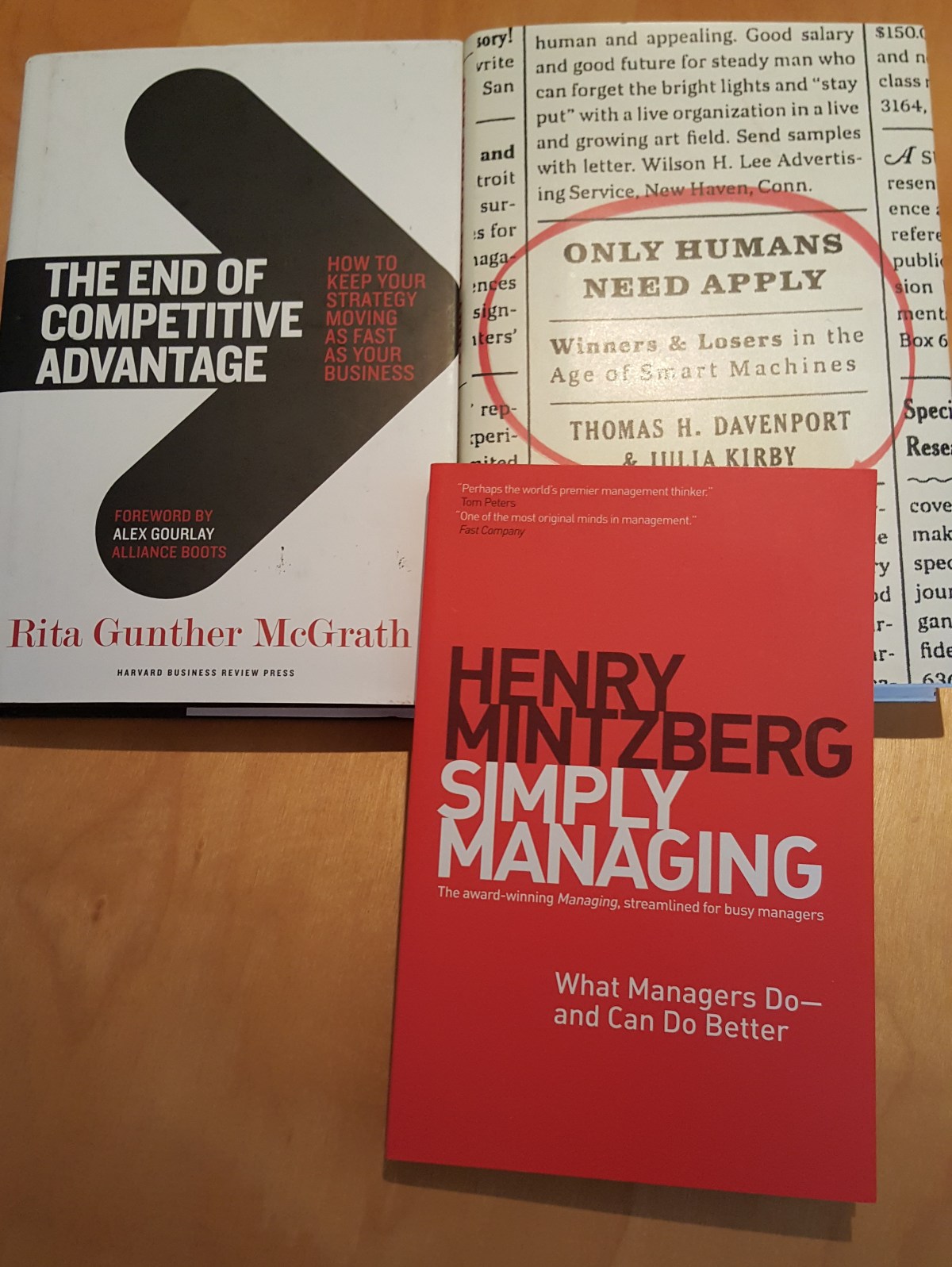
Image: Whitbread Round the World Race

Davenport & Kirby, McGrath, Mintzberg

Somewhat before Christmas 2018, I took a free, online Coursera course – Bridging the Gap Between Strategy Design and Strategy Delivery.  It’s managed by the Brightline™ Initiative ‘a coalition led by the Project Management Institute together with leading global organizations dedicated to helping executives bridge the expensive and unproductive gap between strategy design and delivery’.  (See my blog on it)

I can’t now remember how I found the course, or what was going on at the time that prompted me to enrol on it.  However, I was in the first cohort of participants.   A few weeks after completing, I got a cheerful email from the Brightline Initiative, saying ‘as a token of appreciation for successful completion of the course Turning Ideas into Results: Bridging the Gap Between Strategy Design and Delivery. You can win three books authored by leading strategy experts – some featured in this course! Brightline is covering the cost of the books and shipping.’ The way of ‘winning’ was to fill in a form saying which books you wanted to receive.  No contest involved.

I’m not sure of the money and motivation behind this largesse but this week my three chosen books arrived: Only Humans Need Apply, The End of Competitive Advantage , Simply Managing.  All I have to do now is read them.

But before doing that I took a look at what they have in common.  Superficially, they have a colon after the main title followed by an explanatory phrase.  They are written by well-known American academics over the age of 60.  They have a detailed reference list.  They have ‘how to’ sections.

I decided not to go down the route of addressing the questions that these observations led me to – Why do book titles go for a colon? Are these books American centric?  How does the experience of academics over 60 inform current thinking?  Which of the references should I pursue?  Should I adopt any of the how-to suggestions?  And so on.  I can’t remember (and the list is no longer available to look at) if there were any non-American, non-academic writers on the list of books to choose from, but another question would be ‘why did I choose these three books?’

Turning to the books’ content, what follows is a bit about each, not from a detailed reading, but from a couple of hours spent flicking through them, landing on various pages and seeing what I found out ‘how to …’.

Davenport & Kirby (2016) ‘Only Humans Need Apply: Winners and Losers in the Age of Smart Machines’.  Davenport and Kirby’s primary idea is based on the question how to take seriously the threat of ‘computers coming after your job’.   They tell us that ‘instead of asking what work will machines take away from us next, we need to start asking what work will machines enable us to take on next?’  This type of work they describe as ‘augmentation of human work by machines … in which humans and computers combine their strengths to achieve more favourable outcomes than either could alone.’  They say that ‘augmentation spots the human weakness or limitation and makes up for it … without pain to the worker.’   (Take a look at the test at Ford of exoskeletons)

In the chapter ‘Don’t Automate, Augment’, they advocate five strategies – stepping up, stepping aside, stepping in, stepping narrowly, stepping forward – for ‘humans who are willing to work to add value to machines, and who are willing to have machines add value to them’.  They illustrate the five steps by looking briefly at how insurance underwriters, teachers and financial advisors are taking them, before moving to a full chapter on each step.  They argue that complacency in the face of machines is not an option. ‘But despondency isn’t required either’:  there is a role for individuals to take decisions on how to deal with advancing automation, and a role for ‘governments, other convening bodies, and the experts who advise them’ to do similarly for society.  This is an upbeat book and I’d like to believe that the dedication their book opens with comes to fruition.  ‘Both us dedicate this book to our kids’ – Julia’s ‘who will make the world a better place’ and Tom’s who will ‘continue to find interesting and useful work’. We all need to help them make it so.  I’ve learned how to feel a bit more optimistic about automation.

Mintzberg, (2013), Simply Managing: what managers do and can do better This book is a ‘substantially condensed and somewhat revised version’ of Mintzberg’s 2009 book Managing. It’s in large print with wide line spacing, lots of sub-headings and bold type sentences that ‘summarize the key points in this book and so serve as a running commentary throughout’.  So excellent for someone who doesn’t really want to (or have time to) read much. Fortunately (or unfortunately depending on your point of view) the sections do not have an estimated read time.

There are 6 chapters covering: managing beyond the myths; managing relentlessly; managing information, people, action; managing every which way; managing on tightropes; managing effectively.  I felt exhausted just skimming the chapter headings.  However, I plunged into the section ‘The Enigma of Order’ (in the chapter on tightropes) which considers the conundrum, stated in bold type, ‘How to bring order to the work of others when the work of managing is itself so disorderly?’ Mintzberg’s advice is that managers deal with this ‘by nuancing its two sides.  They have to weave back and forth between letting the chaos reign and reigning in the chaos.’  OK good.  Mintzberg briskly moves on to the next section.  ‘The Paradox of Control’.  I turn to McGrath’s book.  I’ve learned how to convert a thorough book into a soundbite book.

McGrath (2013), The End of Competitive Advantage.  The opening pages of this are devoted to 11 people (10 men/1 woman) praising the book.  Point taken, it must be worth reading.  McGrath ‘takes on the idea of sustainable competitive advantage’ in its place she offers ‘a perspective on strategy that is based on the idea of transient competitive advantage’ together with ‘a new playbook for strategy’.  Wisely, she tells us that ‘The ability and willingness to seek out actual information, confront bad news, and design appropriate responses is critical’… ‘The learnability principle emphasises continual investment in people, even if one doesn’t know exactly what they will be doing.  And combating the tendency to seek only positive news that confirms existing assumptions is critical’ (too).

She is of the view that we need to rethink all the assumptions we hold around organisations being ‘long-lived and their advantages sustainable’.  She offers practical advice to individuals who agree with her that we are in a ‘transient-advantage’ economy.  Take a look at her checklist for preparing yourself for the transient-advantage economy.  It appears as a quiz in her book, along with a discussion of the questions.   If you don’t want to read the book, you can listen to a 60-minute webinar of her talking about it.  I’ve learned more on how to question organisational assumptions around sustainability and got some helpful tools/resources to do this as well.

Have you read any of the three books?  What’s your view of them?  Let me know.

Tribalism

‘Britain is Merging BOAC and BEA as a Giant Airline’, read headlines in 1974. More than 15 years after that merger, I joined British Airways. Even after all that time people described themselves as ‘I’m BEA’ or ‘He’s BOAC’ as if that explained more or less anything – good or bad.  I was struck by that loyalty to … well, what exactly?  And I’ve seen it a lot in organisational life. Over the years, I’ve come to think of it as tribalism.

Kevin deLaplante, in a video ‘The Dangers of Tribalism’ describes a tribe as ‘a group of people that feel connected to each other in a meaningful way because they share something in common that matters to them. The connection can be based on just about anything kinship, ethnicity, religion, language, culture, ideology favourite sports team whatever.

What matters is that this connection binds individuals into a group that allows them to make a distinction between us members of the group and those who are not members of the group. When we talk about tribalism what we’re really talking about is a pattern of attitudes and behaviours that human beings tend to adopt when we come to identify with our tribes. In a nutshell we use the us/them distinction defined by tribal boundaries to make normative judgments: we’re good, they’re bad, we are right they’re wrong.’ (deLaplante’s video is excellent and he has an extensive list of references on the topic on his blog).

Tribal members share (or have shared in the past) a ‘collection of habits, practices, beliefs, arguments, and tensions that regulates and guides [them]’. Guidance comes from many sources ‘narratives, holidays, symbols and works of art that contain implicit and often unnoticed messages about how to feel, how to respond, how to divine meaning.’ (The quotes are from David Brooks, The Social Animal) the members benefit in some way – intrinsically or extrinsically – by virtue of their participation in the groups.

I see many tribes in organisations. They include profession tribes, team tribes, social group tribes, interest group tribes and prior organisation tribes. Often members indicate their tribal affiliation through symbols like lanyards and lapel pins. In some organisations ‘tribe’ is part of the vocabulary – look at Spotify’s Squads, Tribes, Chapters model. Like deLaplante, Mary McCrae, of the Tavistock Institute, notes that tribe membership brings many positives – ‘a sense of belonging, comfort and security for its members.  Those who belong commit themselves to the beliefs and values of the tribe.  Loyalty to the tribe stems from the sense of belonging to a familiar, like minded, and caring group’.

We touched on tribes and tribalism last week in a workshop I was facilitating. Afterwards a participant, emailed me, saying he thought tribalism was a particular issue in the organisation ‘because we have brought together different tribes and are trying to create one organisation’ (The organisation I am currently working with was formed from a mash-up of parts of various other organisations, plus a lot of newcomers who have no experience of the other organisations that now form part of the mix).

The discussion highlighted the downsides of tribalism which McCrae sees as ‘competition between groups for power and control over resources, roles of authority, boundaries, and policies that govern institutions.’ These are the ‘particular issues’ that the person who emailed me had in mind. It’s not an option to ignore these, neither is trying to form one organisation if that means aiming to eradicate tribes.

Robert Kovach, writing in the Harvard Business Review lists four downsides to tribalism:

  • Rock-throwing. Where teams are blaming each other, unjustly criticizing the others’ work or continually throwing rocks at one another.
  • Blaming the customer. Blaming the customer or end consumer occurs all too frequently, and can be another sign that inter-team rivalry is spiralling out of control.
  • Pushkin did it.” In Russia, when you don’t know who did something it is common to say “Pushkin did it.” The Dutch have something similar with the saying, “It was the dwarves.”
  • Refusal to work together. This is perhaps the most severe case of tribalism. When whole departments or organizations refuse to cooperate with one another.

I’ve also noticed

  • Turf defending. This is described brilliantly in Annette Simmon’s book, Territorial Games. I have a handout I use in workshops listing the 10 territorial games she discusses. I ask people to discusses whether they play that game, whether their peers do, whether their boss does, and if they’ve been a victim of someone playing that game on them. Games include ‘Information Manipulation’ and ‘Shunning’, that is ‘subtly (or not so subtly) excluding an individual in a way that punishes him or her; orchestrating a group’s behaviour so that another is treated like an outsider.’
  • Polarization. That stems from perceiving differences between tribes. This can lead to a (false) sense of superiority, and sometimes exclusion, bullying and discrimination.

Rosabeth Moss Kanter asks if the negative aspects of tribalism are inevitable and is optimistic that they are not, saying ‘Tribes are a source of identity, but when people belong to many overlapping groups, they are more likely to think broadly, as cosmopolitans. When they work together in mix-and-match structures and depend on the performance of people from other groups for their own success, they are more likely to empathize with differences rather than mistrust them. … Tribalism is not inevitable. We can civilize tendencies toward discrimination. But leaders must make it a priority.’

She offers some suggestions on how they might do this:

  • Make structural changes that eliminate silos, and non-diverse groups. (Watch the video A Tale of O on diversity)
  • Foster cross boundary interdependence ‘a shared task that all parties care about replaces tribal instincts with other motivations.’
  • Encourage cross-tribe coalition building in order to combine resources for mutually-beneficial initiatives, and a flow of people across them, so that everyone in the organization has multiple affiliations and has worked on numerous cross-sectional teams.
  • Find a common purpose that is inspiring and motivating, helping people transcend their differences. When backed up by incentives for achieving common goals, a sense of community helps override selfish interests.
  • Establish codes of conduct specifying community norms that should not be violated regardless of local traditions.
  • Encourage identification across the widest possible range of tribes/groups, rather than focused on a small closed group: think about how ‘products or pronouncements will be experienced by diverse constituencies and multiple ethnicities. It is hard to remain tribal when trying to be national, regional, and global.’

What’s your experience of tribalism in organisations? Is it something we should resist, eradicate, work with or embrace? Let me know.

Image: Tribalism

Leadership and culture

Thanks to a chance conversation I had in the week, someone pointed me towards Edgar Schein talking about ‘cultural islands’.  Schein says,

‘To help leaders deal with multi-cultural teams … two things need to happen – leaders have to become much more humble and learn how to seek help, because the subordinates under them will be much more knowledgeable than they, and secondly leaders will have to create cultural islands where people from differently occupational and national cultures can spend suspend some of the rules and talk to each other more directly, for example, about how they view trust, how they view authority, or how they deal with bosses that make mistakes. If leaders can’t create those kinds of cultural islands, they won’t be able to create teams that can actually work.’

This idea was useful to me on two counts – first because I am working on a culture audit testing a hypothesis that we will find different cultures at different locations and in different functions and we need to develop an approach that honours what Schein calls the micro cultures within the macro culture.  (Schein talks about macro and micro cultures which is similar to my thinking on culture as a climate metaphor).

In the fifth edition of his book Organisational Culture and Leadership Schein says ‘I have emphasized that every organizational culture is nested in other, often larger cultures that influence its character; and every subculture, task force, or work group is, in turn, nested in larger cultures, which influence them. I have enhanced the discussion of how one can begin to work across national culture divides.  (5th edition)’

Second the idea of cultural islands was useful,  because in a workshop we were discussing organisation structures and networks, and I was showing the Rob Cross slide (see image at top of this blog) which shows the traditional organisation chart compared with its network analysis.  As Cross says, ‘Organizational network analysis (ONA) can provide an x-ray into the inner workings of an organization — a powerful means of making invisible patterns of information flow and collaboration in strategically important groups visible.’

One of the group, who I was showing the image to to exclaimed ‘Cole is the leader’.   You’ll see in the ONA side of the image, as Cross points out the ‘central role that Cole played in terms of both overall information flow within the group and being the only point of contact between members of the production division and the rest of the network.’

What the workshop participant’s statement did was start a discussion on leaders.  I think the implication in Schein’s book is that leaders are those with positional/hierarchical power.  Schein remarks,  ‘In an age in which leadership is touted over and over again as a critical variable in defining the success or failure of organisations it becomes all the more important to look at the other side of the leadership coin – how leaders create culture and how culture defines and creates leaders.’ (3rd edition)

I may be wrong, because I see he’s written another book (2018) Humble Leadership – which I haven’t yet read, that tells us ‘The more traditional forms of leadership that are based on static hierarchies and professional distance between leaders and followers are growing increasingly outdated and ineffective.’ He calls ‘for a reimagined form of leadership that coincides with emerging trends of relationship building, complex group work, diverse workforces, and cultures in which everyone feels psychologically safe.’ But is he still talking about CEOs, senior managers, team leaders, and so on.  Or is he verging into the territory of ‘everyone a leader?

In the 1986 edition of Images of Organisation (Figure 6.2 – I have an ancient photocopy!) Gareth Morgan lists fourteen of the most important sources of power.  Formal authority is the first one.  Others are:

  • Control of scarce resources
  • Use of organizational structure, rules and regulations
  • Control of decision processes
  • Control of knowledge and information
  • Control of boundaries
  • Ability to cope with uncertainty
  • Control of technology
  • Interpersonal alliances, networks and control of ‘informal organization’
  • Control of counter-organizations
  • Symbolism and the management of meaning
  • Gender and the management of gender relations
  • Structural factors that define the stage of action
  • The power one already has

You can see each of these with an explanation, developed by Changing Minds

If we assume that leadership involves control of a power source (or having the means to control a power source) as Cole in the organisational network map may do, does that mean that there are many types of leadership power and control that influence the culture?  Isn’t it a reality that ‘leaders’ with positional power, are not the only, or even key, influencers of culture.  Culture influence is the realm of anyone who has any type of power.

Perhaps the strongest influencers of culture are those who use the power they already have (the last item on Morgan’s list) – just being in the culture wielding our behaviours and personalities could be enough to influence it.   Schein says (again 5th edition) ‘our own socialization experiences have embedded various layers of culture within us. The cultures within us need to be understood because they dominate our behavior and, at the same time, provide us choices of who to be in various social situations. These choices are only partially attributable to “personality” or “temperament”; rather, they depend on our situational understandings that have been taught to us by our socialization experiences. ‘

However Schein goes on to talk about this only in relation to ‘leadership’,  saying,  ‘I have introduced as an important element for leadership choices a description of the social “levels of relationship” that we all have learned as part of our upbringing. We can be formal, personal, or intimate and can vary that behaviour according to our situation. In that way, recognizing and managing the cultures inside us becomes an important leadership skill. (5th edition)’

If we were all more aware of the various types of power we all have access to, including our own personal power,  then we could use this (hopefully wisely) to  positively influence culture and our cultural islands.  We’d reach a position where developing healthy organisational cultures – micro and macro –  becomes everyone’s conscious responsibility and is not delegated to positional leaders.

Do you think the culture is shaped by everyone, on their different cultural islands, or by some groups over others on them?  Let me know.