Ambidexterity, dual operating models and backbone

The ILX Change Management e-learning course I’m doing talks about dual operating models in relation to Kotter’s (2007) 8-step change process.

As I’m establishing a network of change managers in an organisation this idea of a dual operating model reminded me of a possible way of making the network have impact and influence.

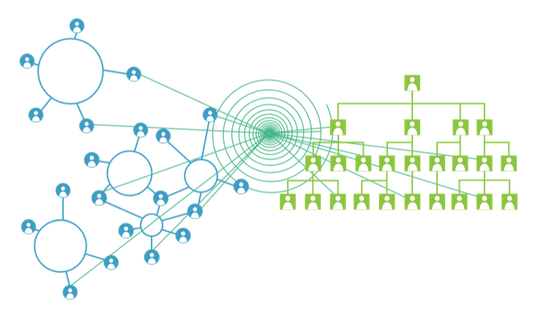
Curious, off I went to find out what Kotter himself said on this in 2012. He’s quite clear, ‘The hierarchical structures and organizational processes we have used for decades to run and improve our enterprises are no longer up to the task of winning in this faster-moving world. …  The existing structures and processes that together form an organization’s operating system need an additional element to address the challenges produced by mounting complexity and rapid change. The solution is a second operating system, devoted to the design and implementation of strategy, that uses an agile, network like structure and a very different set of processes. … The new operating system continually assesses the business, the industry, and the organization, and reacts with greater agility, speed, and creativity than the existing one. It complements rather than overburdens the traditional hierarchy, thus freeing the latter to do what it’s optimized to do. It actually makes enterprises easier to run and accelerates strategic change. This is not an “either or” idea. It’s “both and.” I’m proposing two systems that operate in concert.’

Leith Sharp, (Harvard Extension School) is also blunt on the need for a dual operating model.  She’s been asking senior leaders the question, ‘Do you think management-driven hierarchy, or the command control operating system that predominates almost all sectors, is adequate for tackling a complex adaptive challenge like sustainability? Or is it adequate for tackling our other complex 21st century challenges?’ She continues,  ‘No one is saying yes. Add to this anecdotal avalanche the empirical nugget that 70% of the US workforce is disengaged at work (Gallup State of the American Workplace Report 2013), and there you have it. Nobody actually seems to think that our predominant mode of organizing is going to get us through this century effectively.  Put simply, we are in the wrong organizational vehicle for the 21st century.’  She advocates ‘an adaptive operating system, that can be harmonized with command control to bring about a new era of organizational engagement’.

Neil Perkin, who wrote Building the Agile Business Through Digital Transformation is another in favour of the dual operating model,  noting, ‘Having a dual operating system enables you to capitalise on key needs of the modern business – executing against short-term targets and business as usual and managing existing models to be ever more efficient and predictable, whilst still solving new problems, developing new value, disrupting existing norms. One (hierarchy) is more focused on management, the other (network) on leadership, but both are needed .

Writers on ambidextrous organisations say pretty similar things.  Take this HBR article example, written in 2004, ‘We discovered that some companies have actually been quite successful at both exploiting the present and exploring the future, and as we looked more deeply at them, we found that they share important characteristics. In particular, they separate their new, exploratory units from their traditional, exploitative ones, allowing for different processes, structures, and cultures; at the same time, they maintain tight links across units at the senior executive level. In other words, they manage organizational separation through a tightly integrated senior team. We call these kinds of companies “ambidextrous organizations,” and we believe they provide a practical and proven model for forward-looking executives seeking to pioneer radical or disruptive innovations while pursuing incremental gains. A business does not have to escape its past, these cases show, to renew itself for the future.

Ambidexterity, according to Antonio Nieto-Rodriguez of the London Business School,  hangs on the concepts of both exploitation and exploration.  ‘Exploitation includes such things as choice, refinement, production, selection, execution efficiency and implementation. While exploration encompasses knowledge creation and analysis of future opportunities.’

In most cases,organisations that aim to be ambidextrous organise ‘breakthrough efforts … as structurally independent units, each having its own processes, structures, and cultures but integrated into the existing senior management hierarchy.’  (There are some org charts showing how in the HBR article)

Continuing the theme of two operating systems, in agile circles there’s talk about the need for enterprise ‘backbone’ to provide a foil for agility.  In his blog Agility Needs a Backbone Tom Graves speaks well on this saying,  ‘Agility takes place out at the edge: things happen fast there. But in so many, many cases they can only happen fast out there because the core takes care to move slowly, cautiously, providing the solid, certain backbone for the agile edge to push against. And as in living bodies, getting the right balance between them can be a literal make-or-break. A point that it’s probably wise not to forget?’

So, there are at least three similar ideas – dual operating model, ambidexterity, backbone – each advocating the need to question traditional hierarchical structures and not necessarily supplant them, but augment or support them with a more fluid structure.  All three propose the combination of two types of structures working interdependently to propose and promote change, innovation, and other things that keep the organisation transforming whilst maintaining a certain stability.

All this is well and good.  The idea of dual operation (for change, innovation, etc) is sound. It’s getting the two structures to, in Kotter’s words, ‘operate in concert’ that is more difficult to put into practice.  The idea of two systems throws up the potential for clashes not only around behavioural things – competing power dynamics, personality issues, tribalism and various cultural factors but also around system and process things – performance measures, governance, compliance, outputs v outcomes, budgeting processes, etc.

My experience in designing an implementing a dual system model is stuck in Beckett’s cycle of  ‘Ever tried. Ever failed. No matter. Try again. Fail again. Fail better’.  Looking for something that could help me break out of this, I thought Antonio Nieto-Rodriguez (mentioned above) might give some clues.  He offers a 6-pillar ambidexterity ‘execution roadmap’ which caused me to read on,  but I found he states the obvious without any substance, e.g. ‘Implementing the right connections between the change-the-business and the run-the-business activities is fundamental for the execution of the strategy.’

I turned to Julian Birkinshaw and Christina Gibson (writing in the MIT Sloan Management Review) who, also on ambidexterity, offer ‘five key lessons that emerge from our work.’ But warn, ‘We found no evidence that specific organizational levers, such as incentive compensation or risk management, were consistently linked to success. There are many ways to build an organizational context that enables ambidexterity.”

I remain optimistic that a dual operating model (whatever label) offers potential for meshing different organisational intentions in a healthy collaboration,  I’m less of a view that anyone knows how to make in work in practice over any length of time.  I’m going to give it another go hoping I, and colleagues, succeed this time around.

What’s your view of dual operating models?  Have you got any methods of making them work over the longer term in practice?  Let me know.

Image: Framework by L Sharp & R Gutter, adapted in part from J Kotter, is licensed for open sharing and adapting under Creative Commons CC BY-AS 4.0


Learning for organisation design

What I decided to do today was reflect on what I’ve learned last week and how/when/where I’ve learned it, leading on to my asking the question – is what I’ve learned  applicable to my org design work?

Why this topic?  It comes on the back of attending, last Tuesday, a meeting of the CIPD’s Learning and Development Advisory Group – we were being asked for our views on a research project on learning cultures that the CIPD is doing.

In the advisory group discussion – Kolb’s Learning Cycle and Honey and Mumford’s Learning Style Questionnaire came up.  I’m curious about whether these have stood the test of time and research, but didn’t have the opportunity to ask the ‘neuro’ expert there what his view is. However, later I did find the article ‘Are Learning Styles Just a Fallacy?’  which satisfied my scepticism on them.

It was a free-wheeling discussion which, unfortunately, I had to leave early, but even so it set me asking questions: What is learning? How do we know we’ve learned something? When do we learn?   Years ago, I trained as a teacher, ending up teaching learning theory to would-be teachers, but I’m not going down that route now.  This is more an exploration of the notion that learning is something we can’t opt in and out of, we are doing it automatically whether we are conscious of it or not.   My contention is that learning is not something that has an on/off switch in us.

What we can switch on and off is considering, or reflecting on, our continuous informal learning.   And we can also make decisions on when, where and how to participate in formal learning situations – ones that are often designed for a specific purposes.

Pondering this, I asked Google the question ‘what is learning?’ and got a variety of answers.  My preferred is:

‘Learning is a process that:

  1. is active – process of engaging and manipulating objects, experiences, and conversations in order to build mental models of the world (Dewey, 1938; Piaget, 1964; Vygotsky, 1986). Learners build knowledge as they explore the world around them, observe and interact with phenomena, converse and engage with others, and make connections between new ideas and prior understandings.
  2. builds on prior knowledge – and involves enriching, building on, and changing existing understanding, where “one’s knowledge base is a scaffold that supports the construction of all future learning” (Alexander, 1996, p. 89).
  3. occurs in a complex social environment – and thus should not be limited to being examined or perceived as something that happens on an individual level. Instead, it is necessary to think of learning as a social activity involving people, the things they use, the words they speak, the cultural context they’re in, and the actions they take (Bransford, et al., 2006; Rogoff, 1998), and that knowledge is built by members in the activity (Scardamalia & Bereiter, 2006).
  4. is situated in an authentic context– provides learners with the opportunity to engage with specific ideas and concepts on a need-to-know or want-to-know basis (Greeno, 2006; Kolodner, 2006).
  5. requires learners’ motivation and cognitive engagementto be sustained when learning complex ideas, because considerable mental effort and persistence are necessary.

The conditions for inputs to learning are clear, but the process is incomplete without making sense of what outputs constitute learning has taken place. At the core, learning is a process that results in a change in knowledge or behavior as a result of experience. Understanding what it takes to get that knowledge in and out (or promote behavioral change of a specific kind) can help optimize learning.’

In this description you can see learning both as a continuous, albeit sometimes unrecognized, process and as a conscious, formal and ‘designed’ activity.

My week held multiple examples of continuous, incidental learning – that I probably wouldn’t have noticed as such if I hadn’t been reflecting on it.  For example, while on the tube, I read an article by Lucy Kellaway, ‘The journalist turned economics teacher and founder of Now Teach on the value of switching careers’,  in her 50s she has ‘founded charity Now Teach, has since qualified as a teacher herself, and convinced more than 100 others to do the same.’ She’s an example of a learner illustrating all points of the learning description above, and I learned about Teach Now and some confidence boosting for exploring a new career. (Or, shall I go back to teaching?)

On another tube trip I read an article on how people ‘in the poor world’ are learning how to make use of the internet.  (‘Poor world’ in this context meaning India, not parts of the UK or US).   One example given was of Ms Sharma, who had ‘no particular interest in this internet thing.  But she liked the idea of learning something new.’  She and a handful of other women were each given a smartphone … ‘“First we had to learn how to turn it on and off” …  Once they had mastered that, they got down to the essentials: how to take a selfie, What’s App, Facebook, YouTube, how to search.’   Here I was, not in any conscious or formal learning context, learning about someone’s learning.  During my read, among other things in the article,  I learned a new word ‘mofussil’  and about a new Google phone app Files that ‘helps clean up space on your phone’ – something I need to do.

Having put up my umbrella many times through the week, and broken a spoke on it,  I’ve just found out how to mend it – an example of ‘as needed’ learning!   Ditto, as needed learning, I spotted that the hairdresser I go to has just got a booking app so I’ve downloaded that so I can book my next appointment.

On the formal situational ‘designed’ learning was a busy week too.  I attended the CogX conference, completed some modules of the APMG online change management course, read about a third, so far, of a book on organising workload (SuperStructured) – a kind of hybrid of Dave Allen (Getting Things Done)  and Marie Kondo (The Life Changing Magic of Tidying)  –  and attended a screening of a film on barriers to social mobility in the UK – H is for Harry.

Back to the question – what, from a week that’s involved both continuous/incidental learning and formal organised learning, has fed into improving my organisation design skills, experience, knowledge?

  1. There’s been a thread on the use of frameworks, models and theories – some which I’ve already known about but now have additional takes on and some which are new.  I’m thinking about the dual operating model which I’ll explore further.
  2. Something about building from what we ‘know’ and seeing whether and how what is new can build on what we ‘know’ and take the knowledge further (either deeper or broader or both).  CogX 2019 was a goldmine for this.
  3. Much of my learning this week was about listening, discussing, interactions with others, H is for Harry, had a video documentary, panel discussion with questions, and before and after networking/chatting  with participants. Learning with and from others on the topic has highlighted issues of designing for social mobility and the value of learning with/from others.
  4. I’ve got some practical tips that I’m already applying,  SuperStructured is good for this and I’ve got Stiernolm’s, the author’s,  resource on task sifting to hand and in use.
  5. Another continuous thread through the learning has been on automation – apps, workflow, tasks.  I’m now on high alert for opportunities to automate more aspects of my organisation design work both in the method, and in the content e.g. focusing on repetitive tasks and activities in workflow.

I won’t tackle here how I will recognise/measure any performance improvement in what I do.  (The CIPD L & D Advisory Group spent time discussing ‘what is learning for’, and ‘how will we measure outcomes of it’?)

If you consider your past week – what have you learned, when, how.  And what will you apply into your organisation design work?  Let me know.

Image:  The art of learning poster, Leon Zernitsky

Slashies – bridging generations

I’d never heard of ‘slashies’ until this week. I was chatting to someone who wants to combine cake making/org design/running own business.  She told me the word. I looked it up – it’s not quite everywhere, but it is getting there, under various labels:  ‘Call it what you want’, says one writer,  a portfolio career, diversified employment, the rise of the ’millennial multi-hyphenate’ – but rather than doing one job for life, people are actively choosing to become a “slashie” (ie. actor/blogger/author/dog walker). Or so we’re told.’

There are lots of examples of  slashies:  Emma Gannon, author of a book The Multi-Hyphen Method, gave up her job, social media editor of British Glamour,  job title and the steady salary and became a “multi-hyphenate”, working on a mishmash of different jobs and side hustles.  Emma, a 29-year-old broadcaster, blogger and author, says ‘Being adaptable, moulding yourself to different roles, adding new strings to your bow – that’s a huge advantage in today’s workplace.”

And Sam Grey, a former teacher living in Torquay UK, is currently working five different jobs. In addition to her own dog-grooming business, Toodles, Sam works as a private tutor, teaches crochet and sells patterns, works security for nightclubs and bars and works two 12-hour night shifts at a local arcade.

Sarah Liu, CEO, Gemini 3 – an Australian job-share organisation describes generation slashie as people who have more than one job in a bid to ­diversify, build skills and work in an ­industry they enjoy. Work and passion need to be something that’s not mutually ­exclusive,’ Liu says,  ‘This new generation wants to create a life that’s a reflection of their passion and expertise; it’s a move from specificity to desire. The notion of juggling jobs has changed.’

What’s good about ‘generation slashie’ is that it’s not necessarily linked to age, although many of the reports about it do focus on millennials. However,  says Liu, ‘Slashies are also older workers who are looking to diversify or work part time as they stay in the workforce longer and make the tran­sition to retirement.’   More people, whatever their age want job shares, flexible hours and roles and portfolio careers that enable them to juggle multiple roles.  Younger workers, instead of looking at linear (upwards) career trajectory, ‘are looking at a ­career canvas … building a ­career reflective of what they can do, but also what they want.’ Equally ‘older workers are diversifying because they want a change from their years dedicated to the same career’.

That’s very good news and we need to encourage that way of thinking as technology and demographics change the types of work available, particularly for older people.  A couple of weeks ago,  researching for a talk on the future of work,  I came across statistics on the aging population: The UK population is ageing – around 18.2% of the UK population were aged 65 years or over at mid-2017, compared with 15.9% in 2007; this is projected to grow to 20.7% by 2027.’

The demographic shifts and costs of aging mean that more people will have to stay in the workforce for longer, and this means a different way of designing work, ‘careers’ and ‘retirement’.  The UK Government says that, ‘To address the widening skills gap, tackle age bias in work and enable people to stay in work longer, every UK employer needs to increase the number of workers aged 50-69 in the UK by 12% by 2022. The target is aimed at supporting older people who want the same range of options and opportunities as younger colleagues, and to be recognised for their experience and expertise. In recognising the skills older people bring to the workplace, employers will benefit from the breadth and depth of their knowledge.’

Some recent research from Rest Less finds that ‘Those working into their 70s are continuing to work beyond the state pension age and we see a number of reasons for people increasingly doing so. With far fewer ‘gold-plated’ pensions around and ever-increasing life expectancy, many are actively looking to top up their pension savings while they still can. There is also a growing understanding of the many health and social benefits that come with working into retirement, such as staying active, socially connected and maintaining a feeling of fulfilment.’

It’s not just in the UK, though.  It’s a global demographic shift In China, for example, the numbers are slightly higher than the UK’s – of Chinese citizens aged 60 or above reached 241 million by the end of 2017, representing 17.3 percent of the country’s total population.

The China National Committee on Aging (CNCA) projected on Monday that the figure is expected to peak at 487 million, or nearly 35 percent, around 2050, Xinhua reports.  (See English version here).

There too, ‘Exploring various ways of living in later life is being widely encouraged as the proportion of elderly people in China grows. For instance, Liaoning Province in Northeast China published a plan in early July calling for a progressive postponement of retirement and effective use of elderly human resources.’

The rise in the number of older workers in the global workforce is driven by a number of factors – social, political, and economic.   Many countries have increased the age at which workers can draw a pension, reduced the generosity of social security and changed the terms of disability insurance have also had an impact.

But it’s not all easy those who want to be an older slashie.  In the US, for example, ‘Older workers, aged 55 and over, represent the fastest growing labor group. …  By 2024, nearly 1 in 4 people in the labor force will be age 55 or over, according to the US Department of Labor. The increased workforce participation from older workers results from both increased lifespans, and financial constraints: nearly half of households headed by someone 55 or older has nothing saved for retirement.  There   currently, 3 million older adults are looking for full-time employment.  Many individuals seeking full-time might be part-time, or in low-wage jobs with limited growth opportunities, and it isn’t easy to find work, although some argue that ‘the biggest barrier to entry for older workers isn’t a lack of skills: it’s ageism.’

Given that there will be more older workers in the workforce, that the trend is towards a slashie work pattern, and that older (and younger) people want interesting work that gives financial security what are the organisational design and development shifts that organisations could consider?  Here are five ideas:

  1. Re-think jobs and job titles, ‘Whether you like it or not, traditional job titles are quickly becoming a thing of the past. Employees no longer feel the need to attach themselves to a common job title.’
  2. Re-examine your organisational assumptions and cultural stereotypes of what older workers in your are, common ones are:  they can’t learn new things, they are less productive, they take more time off sick, they are overqualified (a bad thing!),  they are not interested in learning new things.
  3. Discourage notions of ‘upward’ careers and career trajectories and head for career canvases (this may involve re-thinking status symbols, positional power, etc).
  4. Develop your flexible working strategies.  Many people are caring for children/grandchildren and aging parents, sometimes simultaneously, and need part-time or flexible working patterns.
  5. Develop your managers to ‘ensure they have good, proactive age management practices in place to meet the needs of all staff as their workforce ages … many older workers report feeling undervalued and not respected by managers and their co-workers.

What organisation design shifts will you have to make to accommodate generation slashies (old and young)?   Let me know.

Image

Blindspots, productivity and value

Three different concepts intersected this week – blindspots, productivity and value – although it took going for a run to work out the intersect points in order to make sense of them.  The concepts came from different meetings.

Blindspots came up three times this week.  Once as a book recommendation  – I’ve downloaded a sample chapter to my Kindle.  The book is Blind Spots: Why We Fail to Do What’s Right and What to Do about It. The blurb about it says ‘When confronted with an ethical dilemma, most of us like to think we would stand up for our principles. But we are not as ethical as we think we are. … From the collapse of Enron and corruption in the tobacco industry, to sales of the defective Ford Pinto, the downfall of Bernard Madoff, and the Challenger space shuttle disaster, the authors investigate the nature of ethical failures in the business world and beyond, and illustrate how we can become more ethical.’

The second time blindspots came up was in a meeting on the future of work when we were talking about employee surveillance and some of the blindspots in recognising the upsides and downsides of it.

And the third time in relation to the concept of linkages and interdependencies between workstreams in a project.  Each of this project’s workstreams is operating as a silo. The person I was talking with had noted the blindspot around the benefits of mutual support and collaboration and was wondering how to talk about it to workstream leads. As one blog writer on the topic says, ‘When a work stream cuts itself off from the other work streams and thinks of itself as a fully autonomous independent entity, it turns into a silo. Silos are great for storing grain, but, in organizations, silos are dysfunctional.’

Productivity came up in a meeting where we were wondering how to increase it.  I wondered what our individual assumptions are around it.  How would we recognise increases in it?  And what constitutes it?  On the last, The UK Government calculates labour productivity, ‘by dividing output by labour input. Output refers to gross value added (GVA), which is an estimate of the volume of goods and services produced by an industry, and in aggregate for the UK as a whole. Labour inputs in this release are measured in terms of workers, jobs (“productivity jobs”) and hours worked (“productivity hours”).’

That’s not an easy calculation to work with if we’re thinking of redesigning an organisation to increase productivity, the calculation misses some of the complexities of it, which are  illustrated in a post  by Rick, ‘Productivity and Bad Bosses’, and his follow up one ‘Productivity: why worrry?’.  Rick mentions the Mayfield report, How Good is Your Business Really, commissioned by the UK Government.  The report notes that  ‘the UK went from having the fastest growing productivity in the years before the recession to the second slowest growing in the years since’, and says ‘We need more of our businesses learning from our high performing frontiers in the UK, thinking afresh about what they can do to make workplaces more competitive, more innovative, more high-tech and smarter, with workforces that are more motivated and ultimately more productive. A key question, then is how to create the conditions for this to happen to transform business performance in scale and, in what areas do we need to focus?’

Good organisation design is not mentioned as one of the transformation conditions, but developing management capability is.  The report notes that ‘Evidence from the World Management Survey shows that managers’ intuitive evaluations of their own business practice are often wide of the mark’ – they have a blind spot.  This is picked up in a speech by Andy Haldane, Chief Economist, Bank of England, who says that ‘not only is there a long tail of [of low-productivity non-frontier] companies, but that many are unaware of that fact. For the same reason most car-owners believe they are above-average drivers, most companies might well believe they have above-average levels of productivity.  In fact, we know most companies have below-average levels of productivity and a large fraction of them have seen no productivity improvement for several decades.’

But some companies do measure productivity. The third concept ‘value’ came up when we were discussing employee engagement and voice.  Someone mentioned an article about Amazon where reportedly ‘fulfillment center workers face strenuous conditions: workers are pressed to “make rate,” with some packing hundreds of boxes per hour, and losing their job if they don’t move fast enough. … productivity firings are far more common than outsiders realize. … Critics see the system as a machine that only sees numbers, not people.’   We wondered if Amazon, in its drive for productivity, has a blind spot around the value of people. See also the 996 organizations that appear to value productivity over human value – is this ethical? What blindspots are in that equation?

We debated how to balance the Amazon-type tension between productivity and human value moving on to discuss what constitutes organisational ‘value’ anyway.  If we are thinking that value is about productivity – what is the ‘product’?  There are endless papers and arguments about this.  The World Economic Forum offers five measures that are better than GDP (the standard measure of productivity) and veers into value territory: Good jobs, well-being, environment, fairness, health.   While the Bank of England’s definition of GDP  makes the point that ‘some things have a lot of value but are not captured in GDP because no money changes hands. Caring for an elderly relative would be one example of this. As Einstein once said, “Not all that can be counted counts”.

Others link productivity (doing more with the same) with efficiency (doing the same with less). For example, The Economist makes the point that ‘A better measure [for productivity growth] is multi-factor productivity (also called total factor productivity) which tries to capture the efficiency with which inputs of capital as well as labour are used. If workers are given better machines and equipment, this will automatically boost output per man-hour, even if there is no gain in overall economic efficiency once the extra capital spending is taken into account.’

Roger Martin picks up some of this in an HBR article The High Price of Efficiency.   He says ‘Smith, Ricardo, Taylor, and Deming together turned management into a science whose objective function was the elimination of waste—whether of time, materials, or capital. The belief in the unalloyed virtue of efficiency has never dimmed. … Eliminating waste sounds like a reasonable goal. Why would we not want managers to strive for an ever-more-efficient use of resources? Yet as I will argue, an excessive focus on efficiency can produce startlingly negative effects.’   (Another HBR author argues for productivity over efficiency).

All of this has left me asking whether organisation designers have blindspots around  sufficiently considering and discussing how their designs impact and relate to value and productivity.  I’m wondering if we make assumptions around the concepts and what we’d learn if we opened debate on the topic.  What’s your view on designing for value and productivity, do you think we have blindspots around it?  If so, what are the ethical implications of that? Let me know.

Image: Baseball tee