
Leaders and decision-making

Recently I got this email:  ‘I think our leaders make poor decisions because although accountability demands it, our world is too complex for those at the top to really grasp all of the information they need. Are you aware of any organisations employing range of different methods of collective decisions?’

I answered the following day, with :

‘Good to hear from you.  Do you know Cynefin Framework, take a look at David Snowden’s work (his article, A Leader’s Framework for Decision Making, attached)?  Without going into any detail, there’s a lot of work going on about complexity, leadership and decision making.  Also attached is an interesting article, Taking Organisational Complexity Seriously, by Chris Rodgers.

Briefly, many organisations are stuck in a model (in my view) where hierarchical leaders a) think they should know the ‘right answer’ b) that there is a ‘right answer’.  Complexity doesn’t work like that.  In order to make soundish decisions you have to have a very diverse range of perspectives/expertise/hierarchical levels in the room (and listen to them/work with them).’

Answering your question more specifically, take a look at this blog that mentions several companies making decisions a different way.’

Having answered the question, I continued to think about it. It made me think further, because there isn’t any easy way to answer it, without tackling several aspects:  decision making processes, accountability, complexity, information flows/availability/reliability, individual v collective decisions, context for the question, context for the decision making.   Even tackling those aspects doesn’t make any usable answer much easier to arrive at.

Looking at Harvard Business Review, it seems that decision making is a topical discussion.  Since December 2017 there’s been:

How Systems Support (or Undermine) Good Decision-Making, by Ron Carucci, Feb 2020

Navigating imposed innovation: A decision-making framework by Amir Bahman Radnejad and Oleksiy Osiyevskyy, January 2020

10 Ways to Mitigate Bias in Your Company’s Decision Making by Elizabeth C. Tippett October 21, 2019

Keeping Humans in the Loop: Pooling Knowledge through Artificial Swarm Intelligence to Improve Business Decision Making by Lynn Metcalf, David A. Askay, Louis B. Rosenberg August 2019

Organizational Decision-Making Structures in the Age of Artificial Intelligence, by Yash Raj Shrestha, Shiko M. Ben-Menahem, Georg von Krogh August 2019

What AI-Driven Decision Making Looks Like, by Eric Colson, July 2019

Briefing Sheet on Common Biases in Group Decision Making, by Hannah Riley Bowles, Logan Berg, Alyson Gounden Rock, Sam Skowronek June 2019

Avoiding Disruption Requires Rapid Decision Making, by George Stalk Jr., Sam Stewart, April 2019

A Good Meeting Needs a Clear Decision-Making Process, by Bob Frisch, Cary Greene, March 2019

Why AI Will Shift Decision Making from the C-Suite to the Front Line,  by Alessandro Di Fiore, August 2019

Artificial Intelligence and the Future of Work: Human-AI Symbiosis in Organizational Decision Making, by Mohammad Hossein Jarrahi, July 2018

3 Ways to Improve Your Decision Making, by Walter Frick, January 2018

A CEO’s Decision Making Is Shaped by Whether Their Parents Were Immigrants, by  Duc Duy Nguyen, Jens Hagendorff, Arman Eshraghi, March 2018,

When to Decentralize Decision Making, and When Not To, by Frederic Wirtz, Herman Vantrappen, December 2017

In roughly the same period McKinsey offers eight articles on decision making.

Good decisions don’t have to be slow ones, May 2019, by Iskandar Aminov, Aaron De Smet, and Dan Lovallo

Want a better decision?  Plan a better meeting, May 2019, by Aaron De Smet, Gregor Jost, and Leigh Weiss

Three keys to faster, better decisions, May 2019, by Aaron De Smet, Gregor Jost, and Leigh Weiss

Effective decision making in the age of urgency, (Survey) April 2019

Decision-making: how leaders can get out of the way, June 2018,  by Iskandar Aminov, Aaron De Smet,  Kanika Kakkar

Keys to unlocking great decision-making,  April 2018, by Aaron De Smet, Gregor Jost

Decision making in your organisation: cutting through the clutter (Podcast) January 2018, Aaron De Smet, Leigh Weiss.

Untangling your organization’s decision making, June 2017, by Aaron De Smet, Gerald Lackey, and Leigh M. Weiss

I didn’t go beyond these two journals/sites, but I’m guessing that, in that time frame, there are hundreds of other blogs, articles, points of view, etc on decision making.

Clearly, you can read, listen, and watch a lot about decision making but does that help answer the original question I was posed?  The HBR and McKinsey approaches are generally looking for a 3-keys-type easy response.  (I quickly glanced at MIT’s Sloan Management Review list of decision making articles which are much the same as HBR and McKinsey’s)

I’m not convinced by this desire for an easy response, but I decided to follow suit and sifting through the above seems to reveal three themes that might be worth pursuing (none of them go far down the complexity route which is a failing):

  • Leaders aren’t always best placed to make the decisions
  • AI could be used as a decision support tool
  • Biases influence decisions made

Leaders aren’t always best placed to make the decisions.  In the piece Decision Making How Leaders Can Get Out Of The Way, the point is made that  ‘Layers of management often can slow actions with special initiatives, unnecessary upward reporting, status updates and the like. … In organizations where competent people possess clarity of intent, maintaining control only slows decision-making and limits agility. Senior leaders should focus on what only they should do, such as setting intent, making strategic choices and removing roadblocks.’   To support effective decision making we could ask – are the right people making the decisions with the good information to hand?

AI could be used as a decision support tool – yes, and beware the seductive sellers of AI decision making systems, As Kyle Dent in Techcrunch (among many others) points out, ‘AI developers make decisions and choose trade-offs that affect outcomes. Developers are embedding ethical choices within the technology but without thinking about their decisions in those terms. … The most basic assurances of algorithmic accountability are not guaranteed for either users of technology or the subjects of automated decision making.’  To support effective decision making we could ask – are we putting too much faith in our automated organisational decision-making processes (e.g. cv sifting)?  What is our response when they are challenged or questioned?

Biases influence decisions made – yes, both human biases and AI biases.  See a research article on this Cognitive bias, decision styles, and risk attitudes in decision making and DSS, ‘Humans often make less than optimal decisions from a rational viewpoint … decision aids can reinforce biases or improve the way that a person thinks about a situation. … The way that information is presented and the way that analyses are conducted also impact the amount of cognitive resources and information gathering that a person requires in a situation’.   To support effective decision making we could ask – how do we recognise and over-ride our own cognitive biases?

How would you answer the question on leadership and decision making?  Let me know.

Image:  The Myths of Decision Making, Joi Murugavell

Job crafting: is it about fitting in and getting on?

A couple of weeks ago I was in a meeting where we were talking about job crafting.  An excellent article, by Catherine Moore, drawing initially from Berg et al 2007, explains that ‘Job crafting is about taking proactive steps and actions to redesign what we do at work, essentially changing tasks, relationships, and perceptions of our jobs. …   . The main premise is that we can stay in the same role, getting more meaning out of our jobs simply by changing what we do and the ‘whole point’ behind it. ‘

Part of our discussion was on the nature of job descriptions and whether all jobs are, in fact, crafted by the job holder to a greater or lesser degree.  We wondered whether we, as job holders are consciously or unconsciously crafting our jobs, to make them ones where, in Moore’s words, ‘we still can satisfy and excel in our functions, but which are simultaneously more aligned with our strengths, motives, and passions.’   She says that, ‘Unsurprisingly, it [job crafting] has been linked to better performance, intrinsic motivation, and employee engagement’.

As we were talking, I was reminded of my PhD thesis ‘Fitting in and getting on: a study of the organisational socialisation of senior managers joining an organisation’.  The research was sponsored by British Airways who, as the abstract says ‘had noted a number of business costs associated with senior managers who joined the organisation from outside. The aim was to find a way of reducing the costs and improving the joining experience for these individuals in a way which got them to high performance quickly.’

The outcome of the study, summarised in a leaflet I produced (see cover above) to explain it, ‘provided evidence that the relationship between fitting in (socially) and getting on (high-performance) was strong, confirming results of previous studies. However, this study extended previous academic research by finding that the relationship is not straightforward. It is complex, contingent on a range of factors, and continuous throughout a person’s membership of an organisation.’

My PhD came to mind, I think, because it was about how people successfully shape their roles and how the roles shape them in order for them to fit in and get on.  Essentially, how they job craft.

Out of the research I produced a series of twenty checklists, all addressed at senior new joiners to an organisation (not those promoted from within).   Here’s an example of one – ‘New Joiner: fitting in and getting on’ that I found by Googling.   Other titles included ‘Developing your network’, ‘Handling the politics’, Making an impact’, ‘Handling workplace relationships’ and ‘Adjusting your style’.  Ten were published by the Chartered Management Institute (CMI), who I see in 2013 updated them.  I’m not sure if they’re still available from – I’m finding out.  In today’s language the checklists were designed to help them job craft.

However, when I was researching, the term ‘job crafting’ was not around.  It seems to have originated in 2001 in a paper by Amy Wrzesniewski and Jane Dutton,  Crafting a Job: Revisioning Employees as Active Crafters of Their Work, published when I was already writing up.   Wrzesniewski and Dutton discuss three aspects of job crafting: task – shaping what you do, relationship – shaping your interactions, cognitive – shaping your attitudes.

Going back to the job-crafting discussion.  It triggered three thoughts for me:

  • Job crafting – all three aspects – is part and parcel of today’s work world, it’s not just for new joiners.
  • It’s not only the job holder doing the crafting in response to things, but also things crafting the job for the job holder.
  • Job crafting would bring more all-round benefits if it was integral to performance management discussions.

Job crafting is part and parcel of today’s work world.  New joiners are almost by default crafting their roles, as my research found.   But I don’t think it is just new joiners who are job crafting.  Particularly around the task aspect of jobs, almost everyone is crafting – new technologies, new products and services and new ways of doing things all require people to re-think the ways they do their jobs.

Or maybe not, read the story of one Amazon warehouse operative and see how little ability he has to craft the task or the interactions. Even the possibility he could craft his attitudes to the job is sharply limited by the apparent lack of choice to be doing it in the first instance.  The story illustrates the effects of an inability to job craft on someone’s motivation and mental/physical health.  (See a related story of Phil, a train cleaner).

It’s not only the job holder doing the crafting in response to things, but also things crafting the job for the job holder.  In a report, on new CEOs BCG notes that ‘In today’s turbulent, globalized, and high-tech business world, large organizations have acquired complexities unimaginable to earlier generations.’  The report offers 5 things CEOs should be doing, in effect to craft effective jobs.  The thing is that this turbulence is not just affecting senior executives, new or otherwise, but almost everyone.

Take an example from this week  ‘JCB, the British digger maker, has cut working hours and suspended overtime for 4,000 UK employees after the coronavirus outbreak prompted a shortage in parts coming from China.’  The external context is having a significant impact on the JCBs jobs – they are being crafted by default.

Technology changes also act to craft jobs differently, but read the case of a journalist who took a proactive approach of asking the question of some technology companies ‘What could their technologies do to automate me?’ She ends the article saying, ‘It’s not that workers have nothing to fear from automation, but rather that companies will have a fair amount of choice over what they want to do with the extra efficiencies that technology will bring. …  You have to use technology to do what you want to do.  … The more you know how to use the technologies and the more you understand what you want, the better the world will end up being.”   I read the article as being a case study in thinking through how technologies can to help craft meaningful jobs.

Job crafting would bring more all-round benefits if it was integral to performance management discussions.  An article from QZ this week  – The Performance Review of gets its annual performance review’ is scathing on the once a year approach that many companies still take to performance reviews.   It says, ‘Arguably, the most daring and effective reinventions make so many changes that the original tradition is unrecognizable. … I would advocate to retrain the Performance Review for the role of Weekly Check-In, [which has] lower stakes and [is] strategically more appropriate for today’s fast-changing business environment, the Weekly Check-in is five times more likely to produce meaningful feedback for employees, says Gallup. Its subjects are also three times more likely to feel engaged at work.’ Enabling an employee to discuss their job in a weekly check-ins, allows for a discussion of crafting it in a way that makes individual and context sense.

How is your job being crafted?  What room do you have to craft it?  Is job crafting part and parcel of today’s work world enabling you to fit in and get on while feeling engaged and productive?  Let me know.

Mergers and identity theft

LONDON, Jan. 23 1973 ‘A merger of the British Overseas Airways Corporation and British European Airways into a new airline was announced today by the British Airways Board. The board, which runs BOAC and BEA, both state‐owned, said it was going to phase out their names and replace them with the single name of British Airways.’  New York Times

It’s a curious thing to read.  It’s so bare in its announcement.  But a year later came the news that: ‘On March 31, 1974, BOAC and BEA were merged to formally establish British Airways. The combined entity began operations together on April 1. … 1974-77 was a difficult period of time due to all regional divisions in the integration.’

I joined British Airways more than 25 years later, yet colleagues were still ‘them and us’, on BEA and BOAC.  Long servers knew which airline each had come from and retained the cultural norms and attitudes of ‘their airline’.   Over the years, I’ve noticed the strength of cultures, and it doesn’t have to be at an organisational level.  Try merging two teams and you risk getting cultural dissonance.   Look at a more recent example in the Boeing/McDonnell Douglas merger.

As McKinsey notes, Cultural factors and organizational alignment are critical to success (and avoiding failure) in mergers. Yet leaders often don’t give culture the attention it warrants—an oversight that can lead to poor results. Some 95 percent of executives describe cultural fit as critical to the success of integration. Yet 25 percent cite a lack of cultural cohesion and alignment as the primary reason integration efforts fail.’

McKinsey defines ‘culture as the outcome of the vision or mission that drives a company, the values that guide the behavior of its people, and the management practices, working norms, and mind-sets that characterize how work actually gets done.’

What McKinsey doesn’t mention is the link between culture and identity which I think is a critical factor.  A merger could be felt as a form of identity theft, and I wonder if exploring mergers from the perspective of identity would be useful in making them more successful.

This idea came to me as I read Tim Harford’s book, Messy.  In it, he says, ‘Attempting to put two tight-knit teams together in a single organisation can present the organisation’s leaders with a severe headache’.  He goes on to discuss the 1954 Robbers Cave experiment.

The goal of this study was, in the words of Maria Konnikova, the writer of a Scientific American article, ‘multifold: to see how quickly group identity could become established among strangers, how fixed or flexible that identity was, how it would play out in competitive settings with other groups, and how the group conflict dynamic could be mitigated after the fact.’

It turns out that in the experiment the two groups could be harmonised up to a point, but as Konnikova says, ‘Alas, it’s easier to bring together eleven-year-old boys in a camp, who have everything in common save for an arbitrary group designation. It’s tougher to do so in the real world. Subsequent studies have shown just how easily groups are formed, on the most arbitrary of bases —and how hard they can be to unform. As the stakes rise, as the diversity increases, as the group identification becomes based on something more than a random division into cabins, so too does the difficulty of unraveling the enmity increase. … Groups form easier than they fall apart.’

As groups form, they develop a group identity.  I was struck by an 8 February 2020 article, on a UK football team West Ham titled ‘West Ham’s culture and identity are slowly being stripped away as Man City prepare to pile on the pain’.  The byline reads, ‘Relegation is a serious threat this season but the biggest concern for West Ham fans is the direction in which the owners have steered the club off the pitch’.  The story is that the owners persuaded supporters to believe, on a ‘shonky sales pitch’, that moving from their original stadium to a new one ‘was the path to a better future’.

The outcome of this is ‘a sense that supporters could live with defeat and disappointment on the pitch. What they cannot stand is having their identity taken away. [Manchester] City may tear them apart on the pitch tomorrow but West Ham’s owners are stripping the culture away from the club. That will do more lasting damage than any relegation.’

The article links the well-researched field of culture and identity.  (Google scholar lists 4 million items on the search term).   The West Ham move is not a merger, but it seemed to me that, as in a merger, the strength of identity, at both group and individual level is a force to be reckoned with.   To me, this article implied a form of identity theft.

Going down the identity theft route a bit, the research articles I found all showed a connection between the theft of identity and the emotional toll it takes.  For example: ‘This exploratory study examined the psychological and somatic impact of identity theft and coping methods utilized by victims. … The majority of participants expressed an increase in maladaptive psychological and somatic symptoms post victimization. … The results from this study suggest that victims of identity theft do have increased psychological and physical distress, and for those whose cases remain unresolved, distress is maintained over time.’ 

A bit more digging about and I uncovered a 2018 research article, Individual and Organizational Identities in Merger Contexts: A Boundary Perspective.  It’s a fascinating article, examining individual and group identity in terms of boundary theory.   One of the researchers eight propositions discusses the relationship between individual identity and the merged organization’s identity.  Here again, it comes close to the notion of identity theft – the authors quote at a group level: ‘These situations of seeing our company’s identity being violated kept accumulating’.  And at an individual level: ‘The company born from the merger made me a bit uncomfortable because it no longer has anything to do with me. It doesn’t look anything like me; it isn’t a place I would choose to work today.’

The authors of this paper report that ‘This was the first study to explore the interface of the boundaries between individual and organizational identities in merger contexts’ and, like them, I’m left wondering whether mergers could be more successful if, in merger situations we took close account of the possibility that group and individual identity are important factors that are not usually considered in the planning and activity surrounding a merger.

If we don’t do this, we risk people feeling a similar distress to that felt in individual identity theft.   What’s your view?  Let me know.

Image:  Identity theft

Scratching the surface of motivation and complexity

Some interesting questions arose recently around a team that kicked off a ‘mini restructure to help people work differently’.   They’ve found that this isn’t working that well at the moment and there’s a feeling that people are resisting the change.  The questions now arising are, ‘How do you bring people along with you in a change?’ ‘When is it fair to expect people to make the change?’ ‘Do people resist change on principle?’ ‘What will motivate people to change?’  And related to this last question ‘How might you approach getting the team to want to behave differently/make the change?’

Those leaders who ‘did’ the restructure are now wondering what their next steps should be – asking how can they resolve the current situation and what they could/should/might consider doing differently in the future to be more successful in achieving the outcomes they intended.   They also want to know how to better think through what might be the consequences of proposed changes.

Talking to some of the people in the situation suggests that it is a complex one.  Motivating people in complex situations requires recognising that motivation may have three interdependent elements in play intrinsic motivation, extrinsic motivation and achievement motivation.  (These are well discussed in a research paper ‘Intrinsic and Extrinsic Motivation: Time for Expansion and Clarification’)

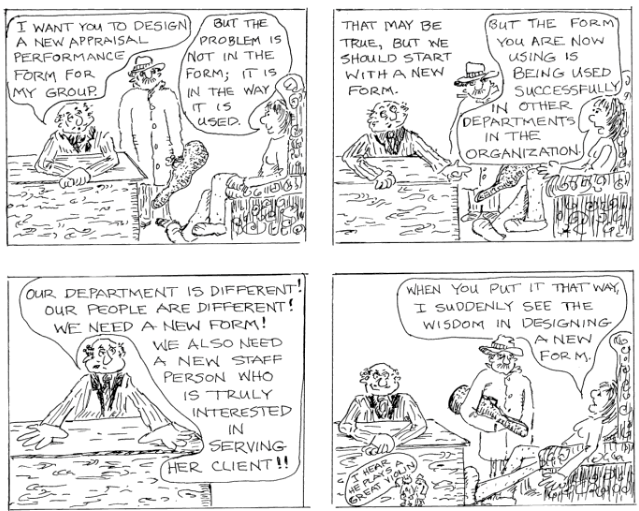
When I’m working with groups on these topics, I usually begin with a four-frame cartoon that provokes discussion.  (See image).  It runs as follows:

Manager:  I want you to design a new performance appraisal form for my group.

HR Rep: But the problem is not in the form; it is in the way it is used

Manager: That may be true but we should start with a new form

HR Rep:  But the form you are now using is being used successfully in other departments in the organisation.

Manager:  Our department is different!  Our people are different! We need a new form! We also need a new staff person who is truly interested in serving her client!!

HR Rep:  When you put it that way, I suddenly see the wisdom in designing a new form.

The discussion of the cartoon, which I’ve used with many different groups in many different environments and cultures, is usually heated.  What people begin to see as they discuss it is that people’s views on what appears to be a simple decision – the design of a new appraisal form (or not) for one organisational department is not straightforward, and neither is the motivation of the two people involved.

I remember Roger Niven’s, AMED talk which he said that rather than using cartoons, he, ‘uses art, artefacts, history, and maps, to stimulate conversations that generate fresh insights into strategic thinking in organisations.’ His view is ‘Such conversations may better enable us to explore often competing theories of strategy and leadership as a complex system.’

Like the artefacts, etc that stimulate discussion and generate fresh insights, the cartoon invariably leads into conversation and ideas on complexity, complex adaptive leadership and motivation.  It also, generally, confirms Niven’s view, ‘that greater awareness of the legacies and culture of other peoples, both within countries and across continents, is important. Each of us is constrained by our own race, gender, and background.  Hence, if we are to create organisational strategies that are appropriate to the 21st century, we must look harder and listen more.  Only then can we advance robust business models and behavioural theories that have relevance for the people we seek to employ and serve.’

Looking harder and listening more is taken up in an HBR article, by Heifetz and Laurie, The Work of Leadership. Niven references it in his slides and although it’s old (2001) the line the authors take ring true in my experience of hierarchical organisations today.  They discuss the adaptive challenge leaders face, the ‘murky, systemic problems with no easy answers.’   They note that, ‘Perhaps even more vexing, the solutions to adaptive challenges don’t reside in the executive suite.’

Heifetz and Laurie say, “Many executives reach their positions of authority by virtue of their competence in taking responsibility and solving problems. … But the locus of responsibility for problem solving when a company faces an adaptive challenge must shift its people.  … Solutions …. reside not in the executive suite but in the collective intelligence of the people at all levels, who need to use one another as resources, often across boundaries, and learn their way to those solutions.”  A restructure – mini or maxi – is often a response to a need to adapt.  Yet there is ample voice to the notion that they often don’t achieve the intended outcome (see, for example this article)

The adaptive challenge is keenly felt in complex organisations.  David Snowden,  originator of the Cynfin Framework, talks about ‘the complex domain which has its  basis in complex adaptive systems theory.  In a complex system, there’s so many interacting dependencies that future states cannot be predicted.  There constraints can provide a degree of coherence and direction but they can’t provide predictability.’

Complex situations require staying alert and watching to see how things unfold.  Brian Eno, quoted in Tim Harford’s book, Messy, says ‘Now I think what makes you alert is to be faced with a situation that is beyond your control so you have to be watching it very carefully to see how it unfolds, to be able to stay on top of it. That kind of alertness is exciting.’

That may be so for Eno, but for many of leaders and managers recognising that very few situations are within their control and can’t be predicted is a very hard unlearning. As one writer says, they ‘first have to get over the fact that it contradicts everything they’ve been taught about making decisions. B-school encourages students to frame problems, formulate alternatives, collect data, and then evaluate the options,’ as if they can control the outcomes.  This isn’t so in a complex world with multiple adaptive challenges.

However, Heifetz and Laurie offer six principles for leading adaptive work and, through this, fostering motivation.  These principles are:  being alert to the emerging patterns (they call it getting on the balcony), identifying the adaptive challenge, maintaining disciplined attention, regulating distress, giving the work back to people, and protecting voices of leadership from below.

The first three of these (being alert to the emerging patterns, identifying the adaptive challenge, maintaining disciplined attention) are related to leading in complexity, and the second three (regulating distress, giving the work back to people, and protecting voices of leadership from below) to motivating people in complex contexts where the interplay of intrinsic, extrinsic and achievement motivation needs considered exploration.   On first read, these six principles seem like an easy answer to a complex situation but thinking about them I’ve decided they’re worth discussing with the team involved and seeing if they provoke insights and give value.

What principles do you use to increase individuals’ adaptive capacity and motivation in complex organisations?  Let me know.

Image:  From Flawless Consulting: a guide to getting your expertise used, Peter Block