Organisation design systems models

A couple of weeks ago I said I’d alternate an extract a chapter of the coming third edition of one of my books with a reflective blog on that chapter.  This week is an extract on Models from Chapter 2, followed next week by some reflections related to that chapter.

MODELS

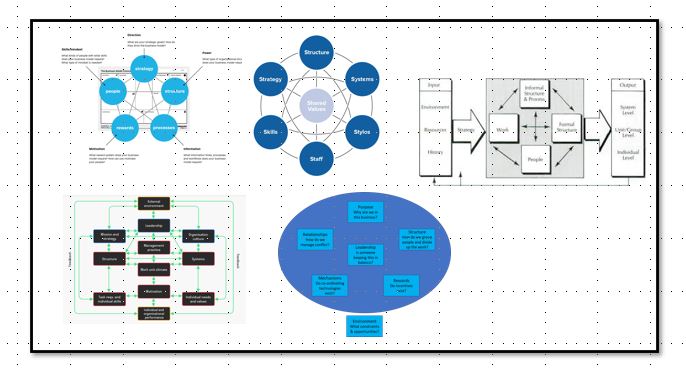
To support the application of systems thinking and systems approaches, organisation designers use ‘systems models’.  These are simple visual representations of an organisation’s elements and the links between them.  

There is sometimes a difficulty in explaining what a systems model is and what it is for.  It becomes clearer by thinking of an organisation as analogous to a living human being.  A human being constitutes 

  • systems –  e.g. the circulatory and nervous systems (note that a ‘system’ is both the whole system, in this case the human body, and sub-systems within it)
  • processes –  e.g. the digestive processes
  • organs – e.g. heart, brain, kidneys, liver and lungs
  • chemical elements – e.g. oxygen, hydrogen, carbon, nitrogen
  • tissues – e.g. muscle tissues, connective tissues

When the human is healthy these systems, processes, etc. work in harmony enabling interaction with their environment.

To explain these body constituents and their inter-relationships, medical educators make use of anatomical models.  Different anatomical models illustrate different constituents of the human body.  For example, Mixed Dimensions’ intricate models ‘show the minute details of the human body’s muscles, bones, and skin’ while SynDavers’ model includes bones, joints, muscles, organs and tendons, major nervous system and vascular components. Similarly, systems models differ in which organisational elements they feature.

Organisational systems models are used similarly to anatomical models.  They enable a step back from the day-to-day organisation – aiming to foster an impartial objectivity, that facilitates constructive discussion on the organisational elements and their relationships to:

  • the external ecosystem and environment (market)
  • the way teams, roles and tasks are organised (organisation)
  • the way business processes are run and the way value is delivered (operations)
  • the way the elements are interdependent

As with anatomical models, there are several different organisational systems models in common use in organisational design work.  Choosing one that is appropriate for a specific organisation’s design intent involves consideration of the strategy, the operating model and the problem or opportunity a new design is intended to solve. 

In cases where none of the off-the-shelf models seem appropriate, a bespoke model can be developed, although this takes time and energy that may be better spent on adapting one of the existing models to fit an organisation’s particular context.

Table 2.1(Note: in the book) compares the five systems models organisation designers most commonly use, noting the elements referenced in each model and some strengths and limitations of each. (Note: these are: McKinsey 7-S, Galbraith’s Star Model, Weisbord’s 6-box model, Nadler and Tushman congruence model, Burke-Litwin model).  This is not an exhaustive list.  There are other models in use some from the related fields of business architecture and enterprise design – for example, the Business Architecture Guild model, the Zachman framework and the Viable System Model. 

Comparing the models helps leaders and designers decide which one is best for use in a specific organisation in a specific context. The choice of model depends on several factors, including:

  • Whether there is a preference for model developed and tested from theory or a model developed and tested from practice (or both). Warner Burke in a paper discussing this point notes that, ‘from the perspective of both research about organisations and consultation to organisational clients, we have experienced some frustration about most, if not all, current organisational models that do little more than describe or depict. A case in point is the 7S model developed by Pascale and Athos (1981) and further honed by Peters and Waterman (1982).’[5] i.e. the models are not derived from empirical research or based in sound theory, but are practitioner or consultant developed, and gain credibility and use through association with a brand.
  • Whether there is a known organisational priority – for example if there is a general feeling that leaders do not give enough strategic direction and guidance, then a model with ‘leadership’ as an element might be chosen as this will drive the need to make an element explicit in the model
  • Whether the outside environment is important – some models do not show external context
  • Whether it can be easily and simply adapted if appropriate.

Further factors for model choice are suggested by researchers Falletta and Combs[6]

  • Whether it meets the organization’s current problem or need;
  • Whether leaders are comfortable with it;
  • Whether it fits the organization’s culture;
  • Whether it is sufficiently comprehensive to capture all of the factors and variables of interest without overwhelming or confusing key stakeholders in the organization.

The models shown Table 2.1 are still in use after 6 decades from first development, giving rise to debate on how appropriate they are for this decade when speed of adaptation to rapidly changing contexts is that much more than in the relative stability of the 1960 and 1970s contexts.  A current major challenge for organisation designers is dealing with so many different and changing types of businesses.  The ’traditional’ organisation and the ’new/evolving’ organisation exist side-by-side and sometimes within the same organisation. This suggests that adherence to one model throughout an organisation may not be appropriate if business units have different operating models, and different products and services.  

Most models force the clear declaration of the organisation’s function. The choice of model to develop the design is more a question of fit. But to help choose the model for the specific organisation, ask diagnostic questions such as:

  • Does the model package the organisational elements in a way that stakeholders will recognise (are there enough, are they ones that are important in the organisation)?
  • How will stakeholders react to the presented model (is it jargon-free, and simple to understand and communicate)?
  • Will the model find favour across the organisation or will it compete with other organisation design models?
  • Does the model harbour implicit assumptions that might help or hinder design work? For example, does it include or exclude factors such as local culture (both national and organisational) and human factors (such as personalities), or does it suggest ways that elements may relate to each other?
  • How adaptable is the model to the specific context and circumstances in which it will be used? Does it enable any new perspectives or innovative thinking? Is it scalable to small work-unit design and whole organisation design?
  • Does the model work with other models in use in the organisation (for example, change management or project management models)?
  • Are the costs to adopt the model acceptable (for example, training, communication and obtaining buy-in)?
  • Does the model allow for new and unconventional organisation design that will help drive the business strategy?
  • Does the model have a sponsor or champion who will help communicate it appropriately?
  • Does the model allow for transformational design as well as transactional design? (Transformational means a design developed in response to environmental forces either internal or external to the organisation – for example, creation or closure of a business unit or a merger – that affects the mission, strategy and culture. Transactional means changes related to the business or work-unit structures, systems, processes, and so on that might be needed to carry out the mission and strategy but do not change them.)’

[5] W W Burke & G H Litwin. (1992). A Causal Model of Organizational Performance and Change. Journal of Management. Vol 18. No 3 (1992) p 529

[6] Falletta, Salvatore. (2018). The Organizational Intelligence Model in Context, OD Practitioner Vol 50 No1

Introducing organisation design – part 2

Introducing organisation design sounds more straightforward than it is in practice.  Each time I’m asked to do something on introducing organisation design I ask myself what exactly it is that I am introducing. 

‘Organisation design’ is both a process – the process of designing an organisation, and an outcome.  Once the process is complete you have a designed organisation.  Except, more often than not, you don’t. 

Organisation designing is not like product designing.  You don’t end up with a definable ‘thing’ – a hairdryer or a notebook or a software module.     Organisations are not very definable, and certainly not in the ‘thing’ sense.  Common themes about what an organisation are include groups of people, acting together, in pursuit of common goals or objectives.

But this isn’t very satisfactory.  I won’t go into why this is the case, as Paul Griseri has covered it brilliantly in Chapter 1 of his (2013) book, An introduction to the philosophy of management

He opens the chapter asking ‘what exactly is an organisation? We can distinguish the two following senses of this question:  What is it for something in general to be an organisation?  How can we decide whether a specific ‘thing’ is an organisation or not?’  After 21 very readable pages he concludes without defining an organisation and without being able to confirm that organisations exist.  You can read the whole chapter here .

On the one hand, I take comfort from this as it illustrates the kind of conundrums I come up against when I think about introducing organisation design.  On the other hand – having been told many times in my career that I am ‘too academic’ – I take the view that I’ll raise challenging questions as and when and aim to keep myself in a position of equilibrium on the Perceived Weirdness Index. (I wrote about this Index a few years ago).

Thus, I plunge into Chapter 1: Introducing Organisation Design, of the book I’m writing, boldly side-stepping the indefinability of ‘organisation’ and whether or not organisations exist and start from the assumption that organisations are somehow ‘there’ (or ‘here’) evidenced by people getting pay-cheques and putting the name and logo of the organisation they get them from on their Linked In page.  And further assuming on this basis that organisations can be intentionally designed, at least in some aspects. 

As an aside, I was never able to explain to my mother’s satisfaction what organisation design is.  When I told her I had been asked to write another book on organisation design her immediate response was, ‘I don’t know how anyone can write one book on organisation design, let alone two.’  However, she proudly displayed all my writing on her bookshelf. 

What I learned from my mother’s response was to use familiar analogies and examples to illustrate points and stick to plain language.   I’m going to carefully check the book draft against George Orwell’s five rules of writing.

In introducing organisation design I suggest that the work of organisation designing should be effective, continuous and reflective.  To help make sure it is, I propose five principles to bear in mind when designing:

  1. Organisation design is driven by the business purpose and strategy, the operating model and the operating context
  2. Organisation design requires systems thinking: about the many elements of the organisation and the connections between them
  3. Organisation design takes strong, thoughtfully used, future-oriented mindsets and methods.
  4. The organisation design process involves social interactions and conversations as much as formal planning.
  5. Organisation design is a fundamental continuing business process, not a one-off repair job.

The set is not empirically researched, rather it is born out of the practitioner experience of the group working with me on the book (ed – is the group an organisation?) and their responses to the set in the second edition of the book which had six principles. 

We spent time discussing and refining that second edition set into the set of five above.  There are not major differences i.e. there are no different principles – the changes are of focus and some of the wording. 

On the first principle we all had different views on whether organisational members need a shared purpose or not.     Note that the concepts of shared purpose(s) are debated in Griseri’s chapter mentioned earlier. It could be fun to host a debate on ‘What’s the value of having a shared organisational purpose?’ – or similar title and hear all sides.

On the second principle, we abandoned the word ‘holistic’ which was originally in principle 2 as it is hard to be clear, as one of the group I’m working with, said, ‘on what holistic thinking actually is, because we all generally think about individual items and connections between them in turn, not about all of them simultaneously.’  Instead, we maintained the thread of systems thinking which is carried throughout the book. 

The third principle we are still debating!  And are thinking of offering an alternative, but similar, one ‘Organisation design takes intentionality, well-chosen methods, and thinking that is rigorous, open and forward-looking’.   We were challenged by a group member who asked: ‘Would principle 3 be the same if it said “OD requires future-oriented methods”.  Currently, it includes a few smuggling words: strong, thoughtfully used, mindsets – in each case, why? What would be wrong with a weak, thoughtless, mindless approach, as long as it were future oriented (!) ?’  What’s your view of principle 3?

Principle four has also been a focus of attention. We have agreed that we need to enable co-creation and collaboration – both in the OD process itself and in the capabilities of the resulting organisation.  But we haven’t specified those two words in order to allow for other aspects of ‘social interactions and conversations’.   Does the principle, as written, adequately include co-creation and collaboration?

This discussion took me into thinking more about designing organisations that are inherently collaborative.  Do they have particular design characteristics?  There’s a research article by Paul Adler and Charles Heckscher exploring this topic that I found helpful – Collaboration as an Organization Design for Shared Purpose.  The article discusses ‘the organizational form that could create and sustain a widely shared commitment to the organization’s ultimate purpose in large, complex, business enterprises facing dynamic environments’ the form they come up with is the ‘collaborative form’.

Adler and Heckscher offer four designable attributes for collaboration in support of shared purpose:  ethic of contribution, interactive process management, participative centralization, T-shaped skills.  On the T-shaped skills the authors say ‘the collaborative organization deliberately plans members’ skill development to support their ability to contribute to the organization’s ultimate purposes’, which runs counter to some arguments that people are in charge of their own career and skills development.     

They warn that ‘the collaborative organization is costly to create and difficult to maintain. It depends on reliable mechanisms for establishing and updating reputations; but we know that these mechanisms are vulnerable to opportunistic manipulation. The high level of participation in collaborative organizations requires considerable meeting time; but such meetings are costly and burdensome. The collaborative form requires openness to diversity, difference, and disagreement; but it offers little assurance these will not explode the collectivity or seal the organization off from the outside world as a closed sect.’ 

We do tend to toss around the word ‘collaboration’ or the phrase ‘a culture of collaboration’ and I wonder if we have thought carefully enough about what this means in practice. 

The fifth principle  emerged unscathed from our discussion of it and remains pretty much identical to the second edition version. 

In conclusion, the way I have used the principles in the past and the way I will continue, I think, to use them is as thought provokers to encourage reflection and intentionality about designing.  

What’s your view of the five principles?  How would you use them?  Let me know. 

Image:  Design management  Author/Copyright holder: Wiki4des. Copyright terms and licence: CC BY-SA 3.0

Introducing organisation design – part 1

introducing organisation design

When I wrote my Fresh Start blog last week, I had in my mind that there would be a weekly blog at least until the end of May 2021 when the draft of the book was submitted.  I’ve now checked my schedule – why didn’t I do this before? –  and see that the blog is actually alternate weeks.  So, theoretically I’m off the hook, except, judging from some lovely comments I’ve received, I think that readers are expecting a weekly blog again. 

In order to meet customer expectations I’ve decided to post an extract from each chapter of the book one week followed by a discussion – the properly scheduled blog – of that chapter topic by me or one of the group the following week.  Constructive comments on the extracts are welcome.

Here is a slightly edited extract from Chapter 1 which introduces the topic.  (You can also see me giving a video talk, Organisation Design 101 in the Quality & Equality Just in Case series).

‘This book is about organisation design, specifically the ‘doing’ of organisation design – the process of intentionally aligning the ‘hard’ and explicit business elements that can be documented through narrative or graphics, for example in business process maps, policy manuals, customer journey maps, system operating guides, organisation charts and governance mechanisms, so that each supports the others.  

Inevitably the ‘soft’ elements that are not easily documented – interactions, feelings, perceptions, cultural attributes come into play.  This interplay between the hard and soft elements of an organisation is another tension that leaders and organisation designers have to bear in mind.

The outcome of the activities of doing the organisation design is the design itself. Many people mistake the organisation design with the organisational structure (aka the organisation chart).  Design is not about the organisation chart. It is much more than that.  [There is an example which illustrates in the chapter]

Although organisational structure is discussed in this book it is not the main focus. Organisational structure – the arrangement of the different departments/units of an organization and the different teams and roles working in each department/unit, in an ordered way – is only one of several elements in an organisation design. 

To explain the differences between design and structure, consider the analogy of a vehicle.  The design of the vehicle is not just the chassis.  Like an organisation, a vehicle comprises multiple interdependent elements designed and aligned to deliver high performance.  For a vehicle, these include the engine, gearbox parts, drive axle, steering and suspension, brakes, oil filter, chassis, battery, alternator, shock absorbers and other parts.   The elements of the vehicle are designed and aligned to work in seamless unison to propel the car forward.  This totality is the design of the vehicle.

Even with advancing technologies a vehicle is not (yet) self-designed and delivered.  It takes people working on the end-to-end design to delivery process. These people are organized i.e. structured – into business units, into teams within the business units and into roles within the teams.    The appropriate structuring of people to deliver a product or service is one element of the entire design.

The analogy of the vehicle to an organisation is not perfect as a vehicle is a mechanical, physical, stable (in a design sense) object.  A car will not gradually morph into tank.  Organisations, on the contrary, are complex entities constantly shifting in response to their context.  The shifts may be intentionally designed, although very often they gradually shift form, without any overall intention. 

Organisation design is about intention to design a better organisation.  There are multiple definitions of the term ‘organisation design’, each giving a slightly different take on what it is:

Practitioner and academic Nicolay Worren in his blog ‘What is organisation design?’ says that OD means more than ‘boxology’, involving ‘the creation of roles, processes and structures to ensure that the organization’s goals can be realized’.  

The Center for Organizational Design says, ‘Organizational design is a step-by-step methodology which identifies dysfunctional aspects of work flow, procedures, structures and systems’.   

McKinsey describes organisation design as ‘going beyond lines and boxes to define decision rights, accountabilities, internal governance, and linkages’. 

The European Organisation Design Forum defines it as a systematic and holistic approach to aligning and fitting together all parts of an organisation to achieve its defined strategic intent. https://www.eodf.eu/

The definition of organisation design used in this book is ‘intentionally arranging people, work and explicit, documentable organisational elements to effectively and efficiently achieve a business purpose and strategy.’

What all these definitions have in common is they view an organisation as a system, comprising interdependent elements that collectively work to deliver a purpose – a design will not deliver if elements are designed in isolation.

Returning to the vehicle design analogy – in the same way that vehicle designers cannot ignore driver and maintenance engineer skills and the way that they contribute to high performance, so organisation designers cannot ignore the social and behavioural elements i.e. human elements of an organisation – employees, customers, of citizens, and so on – the human factor is an unpredictable, possibly non-designable, variable. However it must be considered as part of the design process.

Organisation design, according to Tom Peters,   is a business process that “is so critical it should be on the agenda of every meeting in every single department”. Curiously, however, executives rarely talk about it as an everyday issue, and even more rarely reflect on the interactions between the organisational elements and complex social dynamics in order to redesign their business for success.

Peter Senge, in his book The Fifth Discipline,  points out why intentional organisation design work is uncommon:

Part of the reason why design is a neglected dimension of leadership: little credit goes to the designer. The functions of design are rarely visible; they take place behind the scenes. The consequences that appear today are the result of work done long in the past, and work today will show its benefits far in the future. Those who aspire to lead out of a desire to control, or gain fame, or simply to be “at the centre of the action” will find little to attract them in the quiet design work of leadership.’

The premise of this book is that organisation design matters and that an organisation has a better chance of success if it is reflectively and continuously designed.’

And now you have a taster of Chapter 1 Introducing Organisation Design.  Next week’s blog will talk about the five organisation design principles discussed in the chapter.

Image: Principles for organisational design

Fresh start

A new year, a fresh start.  My last posted blog was at the end of July.  Five months ago.  At that point I said I was starting to write the third edition of one of my books, The Economist Guide to Organisation Design.  I have started.  Last week I sent the first two draft chapters to the editor for comments.

This hasn’t been without a struggle, writing is not easy.  And writing well is even less easy.  I am constantly making fresh starts on each paragraph.  Alongside the chapter I am writing I have a document called ‘cut bits’ which are all the bits I am cutting out that I’ve just written. I keep them in case I find that, after all, they contain a gem of insight. 

To my joy and gratitude, I am not alone in this endeavour.  What I’ve learned about writing in the course of my practice of it, is that co-authoring is not for me.  I’ve tried it a couple of times and that’s enough.  But having collaboration, discussion, reflection, feedback and general support from a group of interested people is what I felt I needed to keep going this time around.  And this would have to come with some structured process.  It’s too easy for me to write a schedule for myself and then let it drift away as I let other things distract my attention.  (Read Super Structured, by David Stiernholm for some good tips on sticking to your intentions).

On 9 August 2020, having just got the contract for the book, and knowing my ‘development area’ I contacted five people all of whom had previously said they’d be happy to contribute/give feedback/review the writing/generally be involved in whatever way they could and invited them to a Zoom meeting to discuss what this might mean in practice.

What happened then is turning into the most energising and supportive experience for me.  We are meeting alternate weeks.  I’ve been sending them a second edition chapter with my comments on it, they make comments and then in a 30-minute Zoom meeting we discuss the chapter and the various comments for me to start reworking for the third edition. 

For example, in Chapter 1 of the second edition I talk about ‘vision and mission’ – that passed me by but one of the group highlighted it, commenting:

‘I think ‘purpose’ is stronger currency than vision/mission now in the operating context.  I wonder if vision and mission now feel too future focused to be able to plan and predict and that we are now planning and designing in smaller chunks/iterations and in making smaller bets on the future we are able to course correct and adapt more easily?

There is a good article from HBR with a quote from Greg Ellis, former CEO of REA Group who said his company’s purpose was “to make the property process simple, efficient, and stress free for people buying and selling a property.” This takes outward focus to a whole new level, not just emphasizing the importance of serving customers or understanding their needs but also putting managers and employees in customers’ shoes.  It says, “This is what we’re doing for someone else.” And it’s motivational, because it connects with the heart as well as the head. Indeed, Ellis called it the company’s “philosophical heartbeat.”  (Hat tip: Fiona McLean)

This led to a fruitful group discussion on purpose versus vision and mission that has informed the new Chapter 1.   By 30 December we had completed the review of Chapter 9 of the second edition – the final chapter in the book, and I asked them if they wanted to stop the fortnightly meetings.   What’s so wonderful is that they said no – they were enjoying the process, learning things and honing their own ideas and wanted to carry on – this time with the actual new third edition chapters.   

Back in August 2020 I wondered how it would all work out.  Now we seemed to have formed what feels to me somewhat like an action learning set,  which we are all benefiting from.

When I heard their interest in carrying on, on the one hand I thought ‘that is so fantastic’ and on the other I thought ‘oh no, I’ll have to get down to seriously scheduling writing, and having something to share each fortnight.   But now it’s not just me!  Because in the course of the discussions I thought, others would enjoy hearing the different perspectives that inform our discussions.  

This led me to thinking about making a fresh start with my weekly blog and I asked the group members, ‘if each of you would be interested in doing a guest blog for my website, reflecting your thoughts on one of the topics we’ve discussed. …  They could be under an intro blog explaining how we are working on the book and why we are interested in the involvement.’

And this is what this is, the intro blog.  Each week till the final draft of the book gets submitted (28 May if all goes well and to plan), there will be a blog on each of the nine chapters of the book, four by me and five others, one by each of the group:  Jim Shillady, Rani Salman, Milan Guenther, Fiona McLean and Giles Slinger.  The idea is not to mirror the chapter content but to offer thoughts on the chapter’s topic from the perspectives of the writer.   They’ll introduce themselves and their interest in the topic they’re writing about. 

We’ve agreed a schedule and it may get followed to the letter, but as we are talking a lot about adaptability, uncertainty, readiness, unpredictability and so on we may be in the position of showing we can walk the talk if circumstances require.   And in our agreed alternate week discussions we’ll be discussing the upcoming blog and one of the chapters. My schedule demands two chapters a month!

You may be wondering why I’ve used the phrase ‘fresh start’ several times in this blog.  It’s because I was struck by Leo Babauta’s lovely piece on The Magic of a Fresh Start.  It had caught my attention back in October when he wrote it, and I looked it out again a week or so ago.   It opens:

‘One of the biggest obstacles to sticking with a habit change, a new system, a goal or long-term project … is that we get disrupted.

Something interrupts our progress — we skip a workout day or two — and then some programming in our brains turns that into a message of how we’re not good enough, we can’t do it, we should just give up.’

He offers suggestions on taking a different slant on this and ends saying

‘The beautiful thing is that a Fresh Start is available to us not only when we get disrupted or stumble … but in every moment. Every day. … Every new meeting with someone, every new conversation’.

It’s a good thought for me to hold onto.  Each time I falter in writing, or don’t meet the schedule,  I can offer myself a fresh start on it and know that I have the support of the group.  If one of them falters the others of us can offer the fresh start idea.  I like it because it offers a positive alternative to the idea of failure.  

And 2021 does, at a more global level, seem to be offering the possibilities and hope of a Fresh Start.

All the best to you and a Happy New Year.