Measurement and Organisation Design: three paradoxes

coastline paradox

Continuing the alternate week pattern of posting blogs picking up themes from the previous weeks’ chapter extracts from the forthcoming third edition of my book “Guide to Organisation Design,” this week’s blog, drawing on Chapter 6 – Measurement,  is written by Giles Slinger, an OD expert and member of the group I am working with on the book.  Next week will be an extract from Chapter 7.

Measurement is vital to most organisational life. Take the example of the Olympics. Much of athletes’ training is guided by measurement: the time taken, the height or distance jumped, the power produced. They seek to achieve a qualification benchmark or to break a record. It is just the same for the organisation that delivers the Olympics. The LOCOG (’Local Organising Committee of the Olympic Games’) must meet its own metrics in an extraordinary organisation design performance: 5-10,000 staff must be hired then made redundant again in a 1-3 year period, and their employment and allocation must be co-ordinated along with 70,000+ volunteers. Without measurement, this organisational design wonder could not occur.

Measurement in organisation design is especially interesting because it contains three inevitable paradoxes.

The first paradox is that you can’t measure an organisation… but you have to try. Anyone designing an organisation wants to understand their starting point, and must do so in the knowledge that measuring the full nature of the organisation, the full detail of what we supply, what we do, who we have, how are we organized – how the whole system fits together, is impossible. The CEO of SAS airline said that their business was composed of “50,000 moments of truth” every day. Even this was a gross simplification. The richness in the interactions between people, between employees and customers, and the variations possible are unmeasurable. So any organisation designer with an eye for measurement must swallow their pride, and simplify to accept that they must choose to measure only some basics: for example, how many people do we have, where are they, doing what, at what cost, and with what impact for customers?

The second paradox is that you can never get to the To-Be. You would love to be able to stop, point and say ‘we have arrived at the future!’, but it is never ‘done’. Is this like Xeno’s paradox, where the arrow never quite reaches the target? Not quite – it is because the world changes continually, and the design must continually evolve. Business leader and politician David Sainsbury has brilliantly explained that contrary to market-based views of economics, business life is forever in disequilibrium.[1] People continuously collaborate and innovate. Novel things are by their nature unplanned and undesignable. So measurement in organisation design must tread carefully: by specifying very precisely what ought to exist, and measuring very precisely our progress towards achieving it, we might become very good at delivering in future what would have been perfect in the past. Famously, armies are often re-designed to win the last war. Again, the organisation designer must swallow their pride and accept that designs of the future organisation should be incomplete.

The third paradox is that tracking against plan is vital, but potentially misleading. The purpose of tracking is not so that you can achieve conformity. It is not to spot variations, correct for them and control. The purpose of tracking is especially so that you can learn from places where the organisation starts to vary from the plan, because there will always be reasons why this is occurring. The differences can start to help you, the designer, learn from the organisation, your teacher.

So we have three principles:

  • Full measurement is impossible, but some measurement is necessary
  • Full design is impossible, and future designs should be incomplete
  • Ongoing measurement is vital, not to force the organisation to get it right, but to help the organisation designer learn from what the design got wrong

The three principles here argue for at least three moments for measurement in any organisation design work: (1) measuring an As-Is, (2) creating a quantified version of a To-Be, and (3) tracking progress against these two reference points. People typically ask for a host of questions during organisation design work but will almost always ask about these three moments and what metrics can be applied.

The full chapter sets out an 8-step approach to using measurement, starting with the purpose of measurement and the measures to use, finishing with presenting results and converting to action.  There are discussions of examples all the way, from Uber and Microsoft to healthcare, airlines and retailers.

I find the examples very useful – they make me ask myself whether I would have used the same measurement techniques, and to choose which metrics I would find worth the data-collection effort.

As a rule of thumb, which metrics are worthwhile? Briefly: outcome data – always. Examples: CSAT, mortality, output, revenue. Resource data – always. Examples: headcount, cost, hours used. System data: sometimes. Examples: activity data, skills data, location data, time data, engagement data. Qualitative information: always. Examples: atmosphere, alignment, energy. The qualitative information orients your choices of what quantitative information are worth collecting. Diversity data? Always. In an equal world we could ignore it. Our world is not equal, so diversity data is core resource information.

What do we put into the organisational system? What comes out of the organisational system? Measurement is critical to our ability to interact with organisations. As organisation designers, we have to be comfortable too with the idea that most projects will need to start with understanding the As-Is, will use reasons (design criteria) that guide us in choosing a quantified version of the To-Be, and that along the way we must track so that we can notice, learn and respond when things start to develop in unexpected ways.

This is not just a theoretical argument about how to think about organisations. Right now, some of the world’s largest organisations are having to redesign themselves. Automotive manufacturers are confronted with Tesla (established 2003) being worth as much as every other car company in the world combined. The stockmarket may be over-reacting, but its message is that it is more prepared to back Tesla to survive than all the others.

Meanwhile, an 80,000 person bank that ten years ago was rated ‘the most influential corporation in the world’ (Barclays, 2011)[2] is valued at less than half of a 2,500 person company started by two brothers in 2010 [March 2021: Barclays $43bn, Stripe = $95bn].

The banks, the automotive manufacturers, the retailers, the hoteliers, the airlines: a host of very large organisations have to think through what they are, what they do, and how they can move from a disappearing profitable position in one market disequilibrium to find another profitable position in a new market disequilibrium. For that move to work, a whole group of people need to be inspired by the purpose, the vision and the excitement of creating something new. And at the same time, the challenges of measurement to help with the transition are serious and worth engaging with. Organisation designers have to love the unmeasurable: the innovation, the novelty, the energy – and they have to be willing and ready to measure to deliver it.


[1] David Sainsbury, 2020, Windows of Opportunity

[2] Vitali, Stefania; Glattfelder, James B. & Battiston, Stefano (26 October 2011). “The Network of Global Corporate Control”

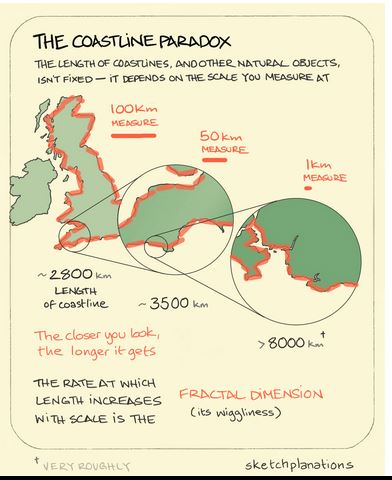
Image: https://sketchplanations.com/the-coastline-paradox

Organisation design measurement

Country engagement score

Continuing the alternate week pattern of posting chapter extracts from the forthcoming third edition of my book “Guide to Organisation Design,” this week’s extract is the opening section of Chapter 6, “Measurement”. Next week will be a discussion related to this chapter.

Measurement is important in organisation design.  It is a crucial part of assessing how to improve the design to improve performance.  Ideally, measurement prompts reflection on what is being done, how it is being done, the effects in the organisation and the wider world, and how things could be different. The purpose of measurement is for learning and reflection in order to improve the design and how it is delivered.[1] 

That can include measurement for control:  to check, for example, whether accountabilities are being discharged effectively, or whether targets are being met, or where progress or performance is not as expected. When measures are used for learning or control, it is important that they are considered in the context of the design, the organisational system and the wider ecosystem.

Organisation design measures usually include resources used (who, where), business processes (doing what); outputs (how many things produced, how quickly); and real-world outcomes (revenues, client satisfaction, employee wellbeing etc). Some of these will be leading (real-time) measures, some will be lagging (only measured after the fact).[2]

Starting out on organisation design work, whether project-based design or continuous design, people generally want to answer some key questions, and most of these benefit from metrics of one kind or another (marked below with [M]):

  1. Where are we now: can we measure our baseline in headcount, costs, locations, activities, skills [M]
  2. What outcome measures indicate that a new design is needed? [M]
  3. Are we sufficiently aligned on our mission and values? [M – or by qualitative observation]
  4. What should our new design be? To what extent can we quantify our to-be state in terms including headcount, costs, locations, activities, skills? [M] To what extent must we leave our to-be state under-determined? [qualitative assessment]
  5. What measurable gaps do we need to close? [M]
  6. What can we measure during the organisation design change process to make sure we are on track? [M]
  7. What can we measure as an outcome of the organisation design change to confirm whether or not it has delivered? [M]

Most organisation design work has to start at least with a sense of ‘where we are now.’ And that is certainly possible to achieve: measurements are available inside most organisations on financial performance, customer data, workforce profile and so on though with varying degrees of consistency, reliability and cleanliness. This means that many organisation design initiatives start off with a house-cleaning exercise on the organisational data. 

The challenge of getting the baseline right, and managing data of mixed quality from multiple measures and sources often overwhelms the good intentions of the organisation design team. Yet people have always had to make decisions and to move forward, sometimes knowing the data to be incomplete or imperfect, and sometimes knowing that the future is still to be shaped, so that data cannot yet exist. So, a key skill for an organisation designer is to know when to declare the data ‘complete enough’ to go forward.

As Carlo Rovelli, a physicist, says, ‘In this uncertain world, it is foolish to ask for absolute certainty. Whoever boasts of being certain is usually the least reliable. But this doesn’t mean either that we are in the dark. Between certainty and complete uncertainty there is a precious intermediate space – and it is in this intermediate space that our lives and our decisions unfold.’[3]

Quantitative data derived from measurement can support decision making, if their limitations are accepted and factored in.  Organisations are complex systems in a constant state of flux, of creative evolution and not in laboratory-controlled conditions or market equilibrium. Thus, many quantitative organisational measures are only indicators at a point in time and must be interpreted in their own context.

This is especially true of data coming from surveys. For example, Gallup, an American analytics and advisory company that tracks employee engagement, found that in early May 2020, employee engagement in the U.S. accelerated to a new high.  One month later, came the most significant drop in engagement that they had recorded in their history, dating back to 2000, of tracking employee engagement. They attributed this drop to various combined stressors including the ongoing pandemic and related restrictions, mounting political tension as the election neared, the killing of George Floyd in late May with the subsequent protests and riots and societal unrest surrounding racial tensions.[4]

By the time of the next measuring of employee engagement, the context, or attitudes, may well have changed and the sets of measures are not directly comparable.  The interesting point about the change in score is not the score itself, but investigating why it has changed – what are the possible (multiple) reasons for this, what does a change mean?  The score in only relevant to prompt questions and discussion.

The blog image[5] shows a single score for which countries have the most engaged workers.  However, the relationship between engagement and, for example. country productivity is not made begging the question whether countries lower on the ‘average engagement’ chart below – such as Singapore, Germany and Japan – have grown less strongly in the last 50 years than countries ‘higher’ on the list, such as USA, France and Canada. This leads to the further question of what engagement means:

  1. Is it about feeling happy at work?
  2. Is it about being absorbed in what the work is?
  3. Is it about being energized by the work?
  4. Is it about having work that is meaningful?
  5. Is it about improving productivity?
  6. Or is it all of the above? [6]

As this example shows, a focus on the number doesn’t tell the full story.  Additionally, it is often the case that organisations present a single ‘score’ on, say, engagement with any outliers in the measures contributing to this removed. But there is always the possibility that one of the outliers is the “black swan” – the rare event that brings large consequences that cannot be ignored.[7]  

For greater impact, an organisation should look into the detail behind, in this example, overall ‘engagement’ metrics, in order to understand what the driving factors in engagement are: leadership, strong mission, alignment to company values, fairness of pay, diversity, line manager impact and so on. These can help to shape organisational design decisions, in a way that a single overall score cannot.

In any event no particular score should determine the next action – the numbers cannot ‘drive’ an organisation’s design. Using quantitative measures as general indicators and sources of feedback to spur reflection is sensible. But analysing and interpreting the data depends on individual perspectives. Statistician Nate Silver reinforces the point saying, ‘The numbers have no way of speaking for themselves. We speak for them. We imbue them with meaning.’[8]

Qualitative data is useful to add depth and richness to the quantitative data – to give the human experience and surrounding story, to understand alignment around the organisation’s vision and goals, and the perceived effectiveness of the existing system.  Focus groups, interviews, listening circles and similar are worth including in the portfolio of measurement tools.

To measure design effectiveness, carefully consider selecting a few measures (and employee engagement might be one of them, or not) that will help tell a whole organisation story.  Use data sources and approaches that reflect the interdependencies of the organisational elements and their impact on human performance and well-being.

Reflective question:  What are the limitations and strengths of quantitative measures in assessing organisation design effectiveness?


[1] https://medium.com/centre-for-public-impact/made-to-measure-how-measurement-can-improve-social-interventions-2212a6ed6138

[2] ibid

[3] https://www.theguardian.com/commentisfree/2020/oct/26/statistical-illiteracy-pandemic-numbers-interpret

[4] https://www.gallup.com/workplace/321965/employee-engagement-reverts-back-pre-covid-levels.aspx

[5] https://www.qualtrics.com/research-center/employee-experience-trends/

[6] https://www.analyticsinhr.com/blog/measuring-employee-engagement/

[7] https://www.amazon.co.uk/Fooled-Randomness-Hidden-Chance-Markets/dp/0141031484

[8] https://www.amazon.co.uk/Signal-Noise-Art-Science-Prediction/dp/0141975652

Organisations as living systems

fiona picture

Continuing the alternate week pattern of posting blogs picking up themes from the previous weeks’ chapter extracts from the forthcoming third edition of my book “Guide to Organisation Design,” this week’s blog, drawing on Chapter 5 – Continuous Design,  is written by Fiona McLean, an OD expert and member of the group I am working with on the book.  Next week will be an extract from Chapter 6..


What would it mean if we could learn from living systems and apply that learning to organisational life?  How might it be if we were to see an organisation as a ‘body of bodies’ and how might we take the learning from living systems and apply it in particular to the key governance bodies within organisations?  What might it mean for governance roles, membership and, most importantly, the interplay and relationship between governance bodies?

Manoj Pawar talks about lessons we can learn about organisations from the human physiology perspective. He suggests organisations wishing to survive in today’s complex business environments must be able to adapt in the same way that living organisms evolve in response to changes in the environment.  His article considers five processes from human biology and proposes practical ways that may have applications for organisations.

Taking a whole systems design perspective alongside the analogy of an organisation as a living human being, I like to think about anatomy as the structure and psychology as the culture and behaviour.  I see governance as the physiology of an organisation – the flow of information that keeps the organisation continuously evolving and emerging just as the process by which the nervous system alerts the body to move or adjust in some way.

It is nothing new to compare an organisation to a living system.  In chapter two the author refers to organisations as being analogous to a living human being.  The various human systems (circulatory, digestive, organs etc.) of a healthy body work in harmony enabling interaction with their environment and, like organisations, have multiple parts that are interdependent.

In ‘ReOrganizationKarlöf/Helin Lövingsson draw the same comparison around organisational anatomy, psychology and physiology and go a step further to consider the human factors which affect the workings of an organisation but which are difficult to find in a traditional organisation chart.  Organisation Designers are generally agreed upon the limitations of design by organogram (simply put, don’t!) and to an extent traditional governance processes may mirror the hierarchy that the organogram makes visual but they conclude that for an organisation to achieve its best possible results, its physiology (information flow through governance and decision making) must go hand in hand with its anatomy (structure) and psychology (culture and values).

Pawar also talks about the importance of cellular turnover and regeneration in human beings, and I wonder how much organisations are at risk of stagnation if they haven’t developed sufficient capability to understand what is required of them in the future and so have no way of developing their own cellular renewal.  I am fascinated by the idea of organisational homestasis where, in my role as an organisation designer it can feel like we are constantly making adjustments (re-designs) in order to remain exactly the same – the human body is expert at this.  Whilst I am not expert on biology/physiology I understand the importance of homeostasis in humans in maintaining our body temperature, for example.  So what might the implications for organisations be?

Jeremy Miller, a strategist from an organisation called Sticky Branding, says that homeostasis in organisations is only a problem when you want to change and that you ‘have to build the habits and organizational capacity for the next level to get to the next level.’  He also implies that the ability to get to the ‘next level’ may succeed or fail on a single individual entrepreneur, CEO, owner or leader’s individual and personal capability to change – I’m not sure that I agree with this when taken from a whole systems perspective and seeing an organisation as a body of bodies (including governance bodies) as this perspective would surely mean that there is no one single point of failure in such a system?

Where I find I do agree with Jeremy is on the three things that he believes to be important in order to overcome homeostasis:

 Growth strategy: where clear thinking drives results – how do we create the conditions for clear thinking?

Strategy implementation – are we falling into the trap of thinking that strategy is simply building plans around projects and tasks deemed as priorities for growth when we should be building organisational capacity to operate at the next level?

Leadership coaching: described as the ‘best offense’ to overcoming homeostasis – how do we understand our own worldviews as leaders?

Karlof/Helin Lovingsson also draw reference from the work of Gareth Morgan  on important sources of power and his description of the alliances, coalitions and networks that exist and that, in themselves, can create a chance of expanded organisational influence.  I believe that governance processes and bodies designed well create such influence intentionally and deliberately and can create an important condition for continuous design.

LIVING SYSTEMS – WHAT WOULD IT TAKE TO RE-IMAGINE GOVERNANCE? –

As a group, when we first discussed the chapter on Continuous Design Jim Shillady posed a great question – ‘how will we design non-structural aspects of organisation in a way that clarifies how we actually need to function?’  To me that must include the human factor – governed by collective leadership that may be tied not to hierarchy but where it makes sense to have a leader and where it makes sense to have a body of decision makers.

Visualising a flow of information that ran between groups/communities or governance bodies convened as the collective leadership of organisational success at the crucial moments could be a key to designing an important part of organisational life in a non-structural way.

If good governance is about strong alignment to organisational strategy and direction the infinity loop of governance boards (see blog image) may be a good place to start. It is in that configuration of flow that a dynamic feedback from strategy to action/delivery and back in to strategy develops. What that means is getting really clear about how strategic activity hangs together coherently, making stronger connections between strategy, design, delivery and corporate performance

The infinity loop success is predicated on the constant interplay of individuals as part of a community of decision makers. Balancing vertical functional leadership with the right horizontal accountabilities means creating a platform that enables the development of distributed leadership where decision making is more diverse.  Governance community members are individually responsible and collectively accountable for outcomes.  In this way it shifts leadership behaviour to a flow rather than vertical silos of decision making and shifts the power dynamics from ownership to belonging, to seeing your part in a larger social field or whole.

There is a role for such governance communities in ‘signal detection’ where pattern recognition may lead to mitigating the risk of design decisions made without understanding the impact on the wider enterprise – a vital role in the ‘counterforce against the common decay of Enterprise Design.’  I see the role of the organisation designer to sit along side such an effort towards the final step in the sequence – meaning making.  OD Practitioners have well-honed skills of listening well, revealing hidden patterns and bringing new perspectives to life and helping people in organisations to reshape their worldviews and as the author says ‘not just of business, markets and competition – but, their own humanity and their respective places in the world’.

Ending…

How could you see your organisation as a living system? Where governance bodies and processes are less bound by hierarchy, more inclusive, transparent.  Where decision making and information flows smoothly from strategy to design and back around in a dynamic feedback loop that results in strategy being delivered into action.

What would it take to design your governance bodies and processes to be the strong pair of lungs transferring life giving oxygen into the system for vitality, in order to create the conditions for continuous design?

Continuous organisation design

continuous

Continuing the alternate week pattern of posting chapter extracts from the forthcoming third edition of my book “Guide to Organisation Design,” this week’s extract is the opening section of Chapter 5, “Continuous organisation design.” Next week will be a discussion of this chapter.

Chapter 5

Evolution … starts from an existing design and alters it progressively by a series of small changes over many generations … every stage in the evolutionary sequence must be capable of holding its own in a competitive world. R. McNeil Alexander, Bones

Deliberate organisation designing takes two forms, project and continuous.  Project design, discussed in Chapter 4, is usually undertaken to deliver a specified outcome by a given date.  Continuous design is an ongoing activity driven by having to respond to current or potential internal and external context changes.  In that sense, as principle 5 discussed in chapter 1 states, it is a fundamental continuing business process, not a one-off repair job. 

Adoption of the principle means establishing a business process that delivers continues design and redesign.  Effective organisations develop and hone continuous design capability alongside their project-based design capability.

Failure to adopt the principle does not stop the organisation design changing.  It does so regardless of any intentional design interventions.  An organisation is constantly changing and evolving as the internal and external context changes.  For example, over the past few years employees have set up colleague WhatsApp groups, which are outside the control, and perhaps awareness, of the employer. 

This is part of a wider shift as employees increasingly use their personal smartphones in the office, and/or access social media and messaging platforms via their workplace IT systems. This raises risks and issues for employers. Some that have cropped up are bullying and harassment, use of privileged information, inappropriate comments, exclusion from a colleague group, rights to privacy, and out of business hours use for business purposes – leading to stress and, in the UK breach of the Working Time Regulations 1998. [1]  

The rise of social messaging platforms and the mixed personal/business use of them by employees has design consequences, including changing networks of interaction and influence, changing behaviours and changing knowledge and information flows.

Unless this more or less spontaneous change is noted and an intentional response to it activated, the organisation may well suffer the consequences of inattention.  Intentional and continuous design enables an organisation to evolve advantageously over time. 

In continuous design, designers look for clues and evidence that the design is delivering intended performance outcomes, that potential opportunities, disruptions and risks are on the radar and that the organisation is has the capability to adapt beneficially to meet changing circumstances. 

Netflix is an example of an organisation well versed in continuous design.  They have been practicing for more than two decades, reinventing the organisation from DVDs by mail to streaming and most recently from licensing shows and films to creating them.[2]  Since going public in 2002 the firm’s share price has risen 500-fold and in 2020 Michael Nathanson of MoffattNathanson, a consultancy, observed ‘every time that Netflix faced a roadblock it found a clever way to work around it and emerge stronger.’[3]

Whether Netflix can maintain the ability to continuously redesign and evolve as its operating context changes remains to be seen.  It faces three pressures – two internal and one external.   The first internal one relates to the speed of growth – by 2020 the organisation had grown globally four-fold in five years.  Assimilating a global workforce into what is, essentially, a Silicon Valley culture typified by a flat hierarchy, autonomous teams and local decision making presents a challenge. 

The second internal pressure relates to ‘sectoral girth’, moving beyond streaming into film making, where Netflix is competing with Disney among others, may mean having to expand into new industries.  Disney, for example has theme parks, merchandising and TV networks.   

The external pressure comes from the public, increasingly pushing for inclusion and diversity across society – witness the rise of the #BlackLivesMatter, and #MeToo movements.  In 2019 comedian Mo’Nique brought a case against Netflix for ‘a discriminatory low-ball offer [made to her in 2017 for a stand-up special] in comparison to her colleagues, particularly those who are white and male.’[4]  In July 2020 a federal judge denied Netflix’s motion to dismiss her race and gender discrimination lawsuit allowing it to go forward.

In 2018 Netflix appointed Verna Myers, their first VP of Inclusion Strategy. Whether or not this is related to the then impending court case is unknown.  The noteworthy point is that a discrimination case and a new inclusion VP occurred at much the same time. Societal pressures against discrimination had reached a tipping point.  In this specific case, it may be that Netflix was alert to discrimination risks they faced with the societal mood shifting and took action on that assumption, or it may be that they reacted to news of the forthcoming case by making the appointment.

Either way, their first Inclusion Report, published in January 2021 was ambitious in its reach, recognising that the process of continuous design for diversity ‘is not about perfection – it’s about humility, vulnerability and unlearning as much as it is learning.’  This extends not just to Netflix’s workforce but also to the products and services they offer.  Part of their ambition is to continue to influence which stories get told and by whom.  Myers notes some examples of doing this, saying, ‘We’re uplifting stories about Black British lives. We’re chronicling the life of a gay man with cerebral palsy on TV, a first. We’re moving some of our cash into Black banks’ and by doing this Netflix is helping change societal attitudes to inclusion and diversity.[5]

The Netflix evolution illustrates both the need for, and the power of, continuous design and also some of the potential challenges to it – in terms of being prepared for potential context changes.  As the Netflix case illustrates, the pressures for organisations in general to continuously design come from both internal and external sources.

Reflective question: What is the value of intentional continuous organisation design?

This chapter continues by discussing three critical skills needed for continuous OD – signal detection, pattern recognition and meaning-making.  It moves on to consider where to focus the skills and concludes by describing what a continuous design business process looks like. 

Image: Tyler Foust continuous line drawing.


[1] https://www.hrmagazine.co.uk/article-details/whatsapp-in-the-workplace

[2] https://indianexpress.com/article/technology/opinion-technology/netflix-ceo-reed-hastings-covid-19-crisis-6589504/

[3] https://www.economist.com/business/2020/09/12/can-reed-hastings-preserve-netflixs-culture-of-innovation-as-it-grows

[4] https://www.nbcnews.com/pop-culture/pop-culture-news/netflix-loses-motion-dismiss-mo-nique-s-race-gender-bias-n1234167

[5] https://about.netflix.com/en/news/netflix-inclusion-report-2021

Progress review

project.flow

Regular progress reviews are something I advocate in organisation design work.  Applying this advocacy to myself this week’s blog is a report on how the writing of the third edition of my book, Guide to Organisation Design is coming along.   I’ve used a simple template ABCD that I use on projects – usually as weekly report. But today’s is a longer time frame, covering the 9 weeks from 1 January.

Achieved

Well in quantitative measures I’ve now written, and submitted to the editor five (of nine) chapters. From experience I know that chapter submission is not the end but the beginning of a whole process of re-drafting, re-thinking, switching things around and so on.  But I’m trying not to think about that too much.  My focus is on getting all nine chapters written.

The schedule that I prepared last November – for chapter completion and blog posting – I have amended in the light of slower progress than I anticipated.  I was originally planning to have chapter 6 completed by the end of February but have not got to that – I’m about a third of the way through it right now.  I start re-writing each chapter with optimism that it doesn’t need much work, just ‘tweaking’.  Not the case.  Each chapter has seen major changes to the second edition chapter.   Amending the schedule, I think is an achievement (Ed: Really, why !!??) – reflecting the reality of other stuff going on in my life.  I think I’ll still make the end-May deadline assuming sticking to the new schedule and helped by a project flow chart my daughter sent me – see the accompanying graphic.

A lovely group achievement is maintaining the alternate week discipline of a 30-minute meeting with the five people helping me think through the book.  For me, it’s a fantastic, energising, learning, fun discussion, each of the six of us contributing from various angles, and examplifying one of my messages about the value of diverse views.

The blog posting of extracts and commentary feels like an achievement in that there has been a posting each week.  Writing the blogs feels less like a distraction and more like a focus for refining my thinking and a related achievement, not mine though, is that it generates really helpful discussion/comments from readers.   (More on this in next paras).

Benefits

Hmm, what is the benefit in writing a book?  The Project Management Institute defines benefits as ‘Value that is created for the project sponsor or beneficiary as a result of the successful completion of a project’.   For me, first it is an opportunity to really think about how I practice organisation design, what it is, why it has that label, are organisations designable, what is its value … ?  (I can hear voices saying, ‘Stop over-thinking, just get on with it’). Second, it’s an opportunity to learn from the comments and additional sources of information people are posting on the blogs. Thanks you readers for that.   I had to buy the book Jim Stockmal referenced, Orbiting the Giant Hairball. I loved the title.  It reminded me of another book I enjoy ‘Sacred Cows Make The Best Burgers’  – a good design principle to consider.

In ‘book-as-project’ terms the publisher, I guess, is the project sponsor, and the beneficiaries are the readers of the final book.  My task as ‘project manager’ is to ensure ‘benefits realisation management’ i.e. the ‘Collective set of processes and practices for identifying benefits and aligning them with formal strategy, ensuring benefits are realized as project implementation progresses and finishes, and that the benefits are sustainable—and sustained—after project implementation is complete’.

So, the processes and practices of blog posting, collaborative working with the book group, encouraging myself to write something everyday, and saying ‘no’ to other stuff coming my way are ways of aligning with the strategy of ‘get the book written’.  I think these various processes and practices are contributory to benefits realisation as the book progresses.   They are honing my thinking and giving rise to quite a different take on organisation design from the current second edition.  From this, I’m hoping that the benefits to readers will be sustainable in the next few years.  Sidebar: I make an exception on saying ‘no’ to extra  grandchild care i.e. beyond what we’ve agreed, as I learn a lot from being with a 3-year old.  The jelly-snake negotiation I got involved in the other day required employing tactics that may be applicable to leaders at impasse as each holds their own ground.

Concerns

Concerns are several:

  • Those reading the extracts/blogs don’t have a full map of the book – the chapters, the preface, the approach, the target audience, etc. So, comments on what I’m posting relate only to the extract.  I wonder if it would be helpful to give more info on the map – the chapters, the rationale, my thinking/’philosophy’ of organisation design, and also the territory that the book covers, otherwise the comments feel a bit like the story of the blind men and the elephant.  (But see above on benefits).
  • Readers of the blog post seem to be in the field of organisation design/development/systems but those are not the target audience. The target audience is organisational leaders and line managers who reach for an organisation chart when trying to solve an organisational issue/opportunity.
  • The swiftness of the context change makes it hard to position the book for a shelf-life of 3 – 5 years. Every time I give an example of an organisation a couple of weeks later the example becomes out of date.
  • The examples are skewed towards well-known large private-sector organisations – where are the SME’s,  the big players in smaller countries, the non-profits, the governments, etc. The well-known examples are often not generalisable e.g. not every organisation can, or should, copy the Spotify model (which in any event has come in for criticism).

 Do next week

Doing next (this) week is Chapter 6, on measurement,  I’ve started work on it – the article by Toby Lowe ‘Made to Measure’ stimulated my thinking, as did the video ‘Quantify the Un-quantifiable’.  I’ll also be following up on some of the comments and taking them into consideration as I both review the written chapters and write the subsequent ones.

Additionally, I’ll be keeping my eyes peeled for good organisational examples to illustrate points made in coming chapters. I keep a running list of useful ideas, articles (popular and research), quotes, references, and so on.

And, I’ll be continuing discussions with people about the chapters.  (The four left to write are Measurement, Comms and Engagement, Leadership & Organisation Design, Culture).  The fifth chapter, just completed, ‘Continuous Design’, I’ll be selecting an extract from for next week’s blog.