Forthcoming OD app

From Quality & Equality website

Mee-Yan Cheung Judge, Quality and Equality, is developing an organisation development app.  She has asked me to contribute a section on organisation design, saying ‘the purpose of what you write is to help users to get to understand what your specialism is, what are the required competences needed if they want to be like you – a specialist in Org Design, and tips on how they can pursue their mastery in this area.  As number of other contributors are doing similarly for their specialism and for app design purpose, we need the same structure for each piece:

 Part 1    – share a short personal journey how you get to have mastery in this area (what evoked your interest, why org design. etc)

Part 2 – what is org design, definition and what does this specialism do., a bit of the field history if there is any?

Part 3 – What are the required competences any org design specialist should have eventually?

Part 4 – what does one need to do to develop themselves + few resources if they want to know more?

I said to other contributors that this is NOT an academic article, this should be a practical, accessible guide to people who want to be organisation design specialists.   A simplified road map to help them know enough to begin their route and then know how to navigate to achieve their specialism.’

That’s a tall order in a short number of words (approx 1900) but I said I’d give it a go.   So, I’ll try out a slightly shorter version here to get feedback from you before I send on to Mee-Yan (with any of your thoughts included).

Part 1: My journey into organisation design accelerated when I worked for British Airways, (1996 – 2001) as an internal consultant.  One of my colleagues there was interested in organisation design and ran a couple of programmes for the consulting teams. 

I’d been heading into the design direction without fully realising it for probably the 15 years before.  My first career was in adult education and from there I moved into managing learning and development functions, but came to the conclusion (maybe contentious?!) that learning and development on its own does not necessarily lead to organisational change, although it may be of great benefit to the individual, or groups of individuals (as in team development).  

You’ve probably all experienced leaving a course on a high with all sorts of intentions of doing things differently back in the workplace, only to be stymied by systems, structures, policies, controls, and all the stuff that makes organisation design.  (Sometimes described as the formal elements, with learning/development/culture/behaviours as the informal elements).   

Thinking that organisations change only when there is a combination of intentional shaping of both the formal and informal elements of them, I got interested in systems and did a couple of Open University courses in systems approaches.  One I recommend now is the Post Graduate Diploma in Systems Thinking in Practice.

Part 2:  Thus, systems were in my interests, but a process and framework for applying systems change into the design work wasn’t there until the British Airways courses.  Then it was.   

Since leaving BA, I’ve taken many other learning paths around organisation design. You can read more about what I’ve found works for in my blog on the topic here.

I now define organisation design as ‘intentionally arranging people, work and formal organisational elements to effectively and efficiently achieve a business purpose and strategy.’ There are countless other definitions of organisation design.  But that’s the one that seems most appropriate for the analogies and methods that I use.

Accepting that organisations are systems and that systems thinking helps in design work enables designers ‘to step back from the system they are in, think about what they are trying to achieve in relation to the bigger picture, and collaborate with a broad range of stakeholders … encouraging them to assess and question the existing system – the boundaries, perspectives and relationships that could be relevant to addressing their design issues and opportunities.[1]   

Note that systems thinking includes thinking about the culture, behaviours and informal elements and, more specifically, how the formal elements are instrumental in shaping these (and vice versa).  It is not possible to do organisation design work without doing organisation development work.  Although it is possible to do organisation development work without doing organisation design work – but it may not be as effective as hoped.   See my blog on the relationship between organisation design, organisation development and change management here .

The field history of organisation design is problematic and contested partly because it depends on what we mean by organisation design.  Another of my blogs discusses this question.  Suffice it to say that we are moving from descriptors of organisations as mechanical systems and pyramid hierarchies (the language of pulling levers, triggers, chains of command) that can be manipulated,  towards descriptors of organisations as networks, collaborations, and complex adaptive systems that ‘emerge’ and can only, perhaps, be shaped. 

Part 3:  Mee-Yan describes competences as ‘the characteristics that define successful per­formance by a professional practitioner. It delin­eates who practitioners need to be, what they need to know, and what they must be capable of doing. It is a detailed description of an ideal performer.’    The Organisation Design Community certifies org design practitioners on evidence of practical experience.  It does not list required competences.  

The UK’s CIPD has an HR Profession Map with one of the specialisms being Organisation Development and Design.   This is at four levels and, rather than competences, states ‘what you’ll understand’ by category at each of the levels.  For example, at the Associate level, one thing you’ll understand is the ‘Macro trends that impact the design of organisations (eg sustainability, geopolitical, demographic, technology)’.

I don’t know if you can get to a ‘detailed description of an ideal organisation design performer’, as the work requires different competences in different contexts and situations.  My view is that critical thinking, and curiosity are required.  I read about the necessary attributes for a diplomat – ‘objectivity and scepticism’ and I thought they were apt for organisation designers. (Maybe org designers need similar skils to diplomats?)   

Another attribute organisation designers need is the ability to wield credible influence – all too frequently internal organisation designers are in a more junior position than people they are aiming to advise and their skills, knowledge and experience are side-lined.  External organisation design consultants typically do have credibility and influence but are not familiar enough with the organisational context to execute/implement the design.  More successful design work blends external and internal expertise.  Again, a couple of my blogs talk more on this.

So, there’s a sketch of three of the parts Mee-Yan is interested in for her app.  Any comments on this, let me know.


[1] How systems thinking enhances systems leadership, Catherine Hobbs and Gerald Midgley, Centre for Systems Studies, University of Hull,

Challenge your cicada instinct. Opportunities in crisis: take actions (part 2)

Last week I talked about the first four, of seven, actions organisation designers can take to seize the advantage of the opportunities in crisis:  think systems, encourage rebels. recognise complexity, experience the cultures.

This week, I’ll cover the final three of these:  challenge assumptions, stop the swirling, ‘confront the most brutal facts of your current reality’.   

Challenge assumptions:   Last week I was talking in a webinar with Mark Cole, of the NHS Leadership Academy about the design opportunities in crises.  Around 40 people attended the session, and afterwards I asked one of them what he made of it.  His response was ‘What I am never quite sure on, based on my years in the NHS, is how much people understand and get org design – still many default to a structural lens only. So, I wonder if it’s worth sharing a quick definition / explanation to make sure they think similar things to you when you say org design?’

I thought this was a great challenge to my assumption that participants and I would have corresponding views on what organisation design is.  

For the next go round – a similar session I’m running next month, I’ll start with something on what is organisation design.  What though?  I remembered an article,  ‘Emerging assumptions about organisation design, knowledge and action’.  (Fortunately, I also remembered the name of the author, Alan Meyer,  so I was able to find quickly).  It was written in 2013.   

At the time it prompted me to extract and synthesise some aspects of the author’s thinking that still inform my work.  In my work the emerging assumptions have full emerged, but it may be that other I work with are still holding to the established assumptions.  (See table below).

Established AssumptionsEmerging Assumptions
Organisation design is about organisation charts.Organisation design is about systems and processes.
Organization designs should be hierarchical structures supported by organizational processes that control members’ behavior.Organization designs should emerge from “design thinking” and principles that generate empathy with users.
Designers should create structures and processes that ensure control, create stability, and absorb uncertainty.Designs should set in motion novel actions in pursuit of novel goals.
Designs should be developed by leaders.Designs should be developed through involvement of people who do the day to day work.
Design work is a spasmodic event.Design work is a continuous process.

Nearly 8 years later it seems that the ‘emerging assumptions’ are still emerging.  Will it take a full 17 years before we see them become established and will there, by then,  be other emerging assumptions?

I say 17 years, because when I was thinking about this how challenges to emerging assumptions come to full daylight, an image came to mind. I was in Washington DC in 2004 when the cicadas emerged after a 17-year gestation.  It was a staggering sight.  Unfortunately, I wasn’t there this May when, again, ‘billions of the loud, winged insects emerged from the ground in a quantity not seen in 17 years.  The sound of such a massive swarm is said to reach up to 100 decibels.’

One of the reports of this year’s cicada emergence tackled the question ‘How much has our life changed? Take a look back at how the D.C. area looked in May 2004.’

It struck me that although the context for organisation design has changed massively maybe the assumptions around organisation design haven’t changed, in much the same way that changes in Washington DC do not seem to have changed the cicadas assumptions related to their established life-cycle.   

Challenging assumptions is not easy (either for ourselves or when enouraging others). I often use a list of questions derived from Stephen Brookfield’s work on critical thinking, when I am working with others on organisation design. 

The questions are: 

  • What assumptions am I making about my organisation, for example, its purpose, capabilities and commitments?
  • What assumptions am I making about stakeholders, for example, their interests, capabilities and commitments?
  • What am I assuming, based on previous experiences, that may not be true now?
  • What am I assuming about available resources?
  • What limitations am I assuming to be so—and what surprises might I find?
  • What am I assuming about external circumstances?
  • What am I assuming about what’s impossible–or possible?

Stop the swirling:  Five years ago, I wrote a blog, Implications of Swirl,  a word I came across in a Bain brief ‘Four paths to a focused organisation‘ looking at change and transformation. They have a graphic that illustrates swirl that runs on the lines of:

  • Issue identified that requires resolution
  • New process/initiative proposed to resolve issue
  • Data needed to determine whether proposal merits go-ahead
  • Meetings scheduled to review data
  • Additional requests come from meetings before any decision to go ahead can be made
  • Data needed to answer requests
  • Follow up meetings to review answers before any decision to go ahead can be made (this cycle continues in a downward swirl).

The implications of this is that, first, a lot of people spend time and resource getting stuck in the data and second the issue is not resolved, instead heading towards the plug-hole the swirl leads to.

The image and the concept have stuck with me because it’s a very familiar scenario in my work.  Getting out of the swirl involves, among other things, being clear on decision making rights and authorities (lowest level possible), rapidly experimenting with small trials to test hypothesis (not waiting for everything to be ‘known’), clearly describing what is going on – see a useful blog on the value of clear description in unblocking situations.

Confront the most brutal facts of your current reality’.  This statement comes from James Stockdale, a United States military officer who was held captive for eight years during the Vietnam War.  The Stockdale Paradox, as his experience is known is rooted in the fact that, while he had remarkable faith in the unknowable, he noted that it was the most optimistic of his fellow captives who did not survive the ordeal. They could not contemplate the brutal reality of the situation they found themselves in.

I have set of reflective prompts to help people ask the brutal questions and confront their brutal facts. They come with the prompt, ‘If this set of questions is not brutal enough for you, feel free to amend or add!’

  • You’re in charge. So what?
  • What is working best in your business today? What do you do to contribute to it?
  • What is not working in your business? What do you do to contribute to it?
  • When was the last time you really talked to your customers/audiences/users about what they really, really want from you?
  • Are you prepared to give them what they want?
  • What are your most treasured assumptions about your people, customers, markets, products, services and yourself? What if one of them weren’t true? What would you do then?
  • Are you out of your depth?
  • Now, having looked at your brutal questions, what are your brutal facts? What are you going to do about them?

Which of the seven actions in this week’s and the previous week’s blog are ones you will take? Let me know.

Opportunities in crisis: take actions (part 1)

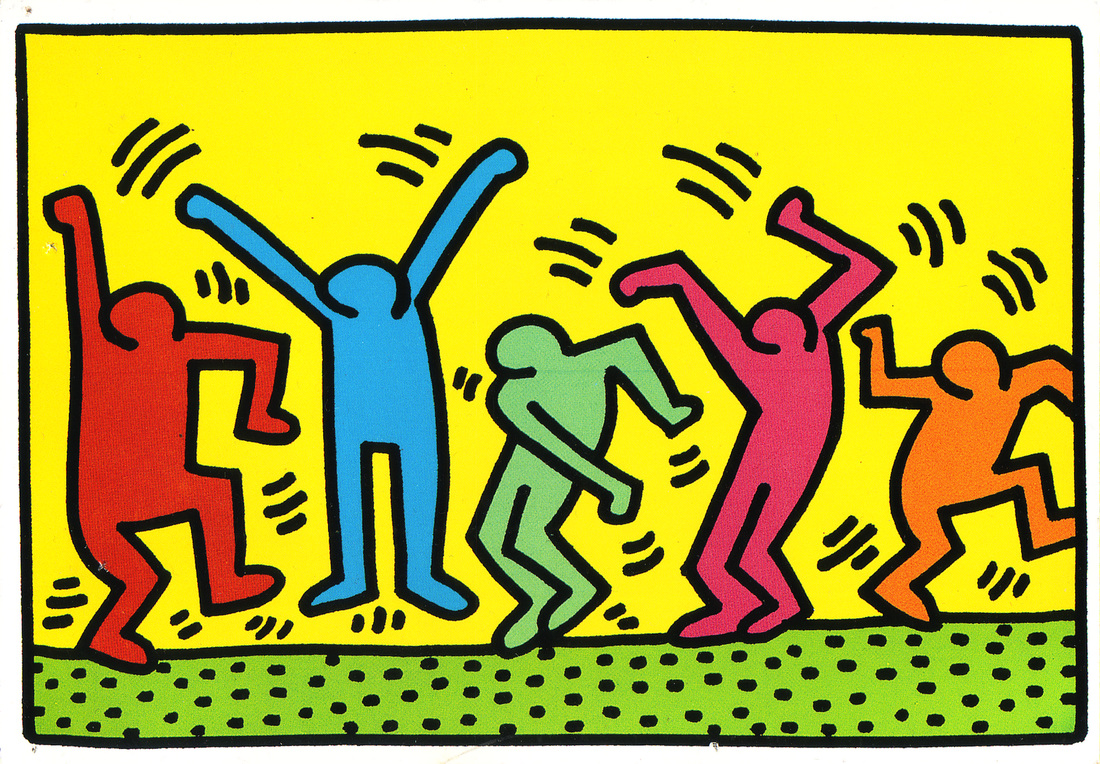
Keith Haring, Actions

Last week I offered a list of seven actions to help organisation designers take advantage of the opportunities in crises. 

  1. Think systems
  2. Encourage rebels
  3. Recognise complexity
  4. Experience the cultures
  5. Challenge assumptions
  6. Stop the swirling
  7. ‘Confront the most brutal facts of your current reality’

This week, gives more on the first four of these, suggesting why each is useful and ways to develop skills in taking the action. 

Think systems: ‘Silos’ and ‘Silo-ed thinking’, are frequently heard words in organisation design. Leaders want to break down organisational silos. Several years ago, I worked for an organisation called SiloSmashers and it may have been there that my conviction that systems thinking is a required attribute of organisation designers, got accelerated. 

In my forthcoming book I talk more on the phrase ‘systems thinking’ which has many challengers. However, a practical start-point is to accept that organisations are systems – that is, they are composed of inter-related and interdependent elements, ‘linked together by dynamics that produce an effect, create a whole new system or influence its elements’. Designing being clear that an organisation is a system, which is part of wider systems mitigates against silos. If you want to learn more about systems then a good (free) start-point is a short Open University downloadable course Strategic planning: systems thinking in practice.

Encourage rebels:  When I offered this suggestion at a conference of government leaders. It caused great amusement and some bafflement.  Why would an employer want to encourage rebels in the work force? My observation is that if you want to change an organisation, you have to look for people who are kicking against the way it is and channel their energies into helping make the changes. There’s a very good website Rebels at Work, with multiple examples of why rebels are good for organisations.

My thinking on this was triggered years ago – not by one of my first managers who told me I was ‘unmanageable’ (not as a compliment!) – but by Debra Meyerson’s research on tempered radicals. Her book Rocking the boat: how tempered radicals effect change without causing trouble , although a bit dated, is well-worth reading. Good rebels are crucially important in offering alternative views, recognising inconsistencies, being curious and questioning, and usually energetic in their activism.  I came across a quote by Vladimir Nabokov the other day, ‘Curiosity is insubordination in its purest form’. Yes, hierarchical organisations try to weed out the curious – to the disadvantage of the organisation.   

One of the first actions you could take to encourage rebels is to print off copies of a wonderful Tanmay Vora graphic in his blog Sketchnote: ‘what rebels want from their boss‘ and stick it on every notice board in your building (or as a screen saver). Go on, I dare you.   See also What makes a good rebel? Consider becoming one yourself.

Recognise complexity: If you’ve ever read a short story by Ray Bradbury, The Sound of Thunder, you’ll start to get the idea of complexity. I read it first in my early teens and it’s one that’s stuck with me ever since.  In the story, a butterfly was accidentally crushed by a big game hunter who travelled back in time to pursue a tyrannosaurus rex. The insect’s death had haunting consequences that rippled through 65 million years to change, among other things, written English and the results of an election. Nothing was quite the same, as the hunter found when he returned to his 2055 departure date.  

If you’re not sure how to apply the idea of complexity, one activity is to use the Futures Wheel, created by Jerome Glenn, to identify the potential consequences of trends and events, but you can also use it in decision making (to choose between options) and in change management (to identify the consequences of change).  Another is to use the Hyper Island tool Unintended Consequences.  Either of these tools will be useful in generating rich design options.

Experience the cultures: Originally, I had this action as ‘understand the cultures’. Now, reflecting on my conversation with Memory Nguwi on cultural transformation that we had the other day, I’ve changed it to ‘experience the cultures’.   (Listen to the discussion, on Human Capital Hub here).

 I’ve changed it because I’m not sure it is possible to understand the cultures?  You can only experience them and then try and convert the experience into words or visuals that are transmissable in a way that will give others a flavour of your experience in order for them to see if it matches theirs.  If you can get to some common flavour of experience it makes it easier to look for opportunities to reshape the culture.

Think about the weather. You can describe it in terms of metrics – temperature, humidity, likelihood of rainfall, windspeed, and so on. But the metrics don’t convey an individual’s experience of that weather – which may depend on a number of factors and may differ from another individual’s experience of that same weather.  Similarly, you can do cultural surveys e.g. Human Synergistics Organisational Culture Inventory, that describe the cultures in various metrics, but they do not provide much insight into how individuals experience the cultures. 

Notice I’ve used organisational cultures as a plural. I don’t think an organisation has one culture that can be transformed via a single label as in ‘a culture of collaboration’, or ‘a toxic culture’. Organisations have multiple cultures, perhaps with common threads running through them,  that are shaped by national cultures, professional cultures, and social network cultures and so on.  

The lack of one organisational culture is one reason if someone moves role, within the same organisation, it can feel culturally very different. (Take a look some info on cultural transformation through network analysis.)

Next week I’ll expand a bit on the other three actions: Challenge assumptions, stop the swirling, ‘Confront the most brutal facts of your current reality’

Meanwhile, what actions will you take to seize the opportunities in crises? Let me know.

Opportunity in Crisis: Redesigning Organisations

There’s that moment when I realise that, months ago, I committed to presenting at a conference, and now I have to actually present. The day has arrived! So it was last Thursday, when I travelled to The Grove in Hertfordshire, to talk with participants at the Richmond Events conference, on the topic ‘Opportunity in Crisis: Redesigning Organisations’.

Being face to face with people, in a wonderful location that I’d travelled to, was a real novelty after months of only zooming from the same room. Just walking into the conference centre illustrated some aspects of organisation redesign – the room layouts, the instructions and policies, the hand sanitizing stations, the wearing of face masks, the social conventions around hand shaking (not) – what had The Grove management had to redesign to get all participants safely accommodated? 

My session outline ran: 

The challenges presented by the complexity of the overlapping crises of inequality, health, justice, technology, environment, culture and now the coronavirus pandemic, are presenting opportunities to reimagine products and services and recraft the role of organisations in society.

Organisations must become committed to making smarter use of data and technology, engaging the skills and time of employees, customers and citizens, and equipping themselves with the tools to innovate, collaborate and knowledge share. 

This session, through examples in action, encourages participants to reconsider how work is done, the role of workplaces, long-held assumptions, and how they can enable the possibilities and new opportunities for their organisation.

That’s a lot to cover in 50 minutes, and getting what I hoped would be an involving slant on it wasn’t easy. 

However, we started with questions about what constitutes an organisation – where are the boundaries of it that you’d want to draw if you’re trying to respond to these crises? Does it include suppliers, contingent workers, robots, partner organisations, your platform providers?  

Opportunity 1: Get to a common understanding of what constitutes your organisation, and why you are including or excluding aspects of it. This gives you the opportunity to see ‘the organisation’ differently, opening up all sorts of possibilities.

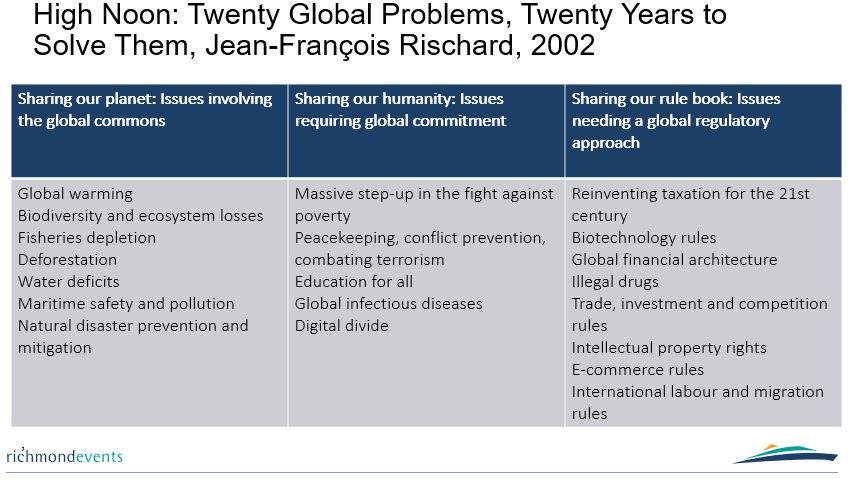
We moved on to looking at the complexity of the overlapping crises, Sadly, the 20 global problems discussed in Jean-Francois Rischard’s 2002 book, High Noon: 20 Global Problems, 20 Years to Solve Them, remain unsolved, despite his assertion then that we had twenty years to solve them. (See image for the list).

In fact, the list has grown longer. We noted that cyber security, space junk, cultural tensions, erosions of democracy and various others, were not on it.  All these crises impact organisations whether people are conscious of it or not. For example, migration rules contribute to labour shortages, trade and competition rules to supply chain issues.  

Opportunity 2: Review the crises list. Take the opportunity to actively work towards designing your organisation in a way that helps solve as many of these as you see impacting your organisation. (Bear in mind they are interdependent).

We moved on to the pandemic considering the statement from McKinsey: ‘The coronavirus pandemic has placed extraordinary demands on leaders in government, business and beyond. The global scale of the outbreak and its sheer unpredictability make it challenging for politicians and leaders to respond resulting in a high degree of uncertainty that gives rise to disorientation, a feeling of lost control, and strong emotional disturbance.’  

Opportunity 3: Reflect on how your organisation has responded to the pandemic. Learn from it what has worked, what you’d like to keep on doing, what didn’t work. Remember there is no going ‘back to normal’. (See also an RSA blog How to create real, lasting change after Covid-19.)

Thinking about where we are now, led to discussion on the requirement for different thinking, fresh and intentional designs, and complete clarity on organisational purpose (the last from multiple stakeholder perspectives).  ‘Different thinking’ is rather difficult in my view. How do you encourage it? Some suggestions I proposed were using Oblique Strategies, 6-thinking hats, working with people from other disciplines, tension and practice cards.

Opportunity 4: The pandemic has shown us how we can rapidly change our thinking. Seize the moment to keep doing this in order to create fresh and intentional designs. (Listen to the Brave New Work podcasts)

The Economist has a list of ten trends to watch for in 2021. Looking for signals, identifying patterns in them, and then making meaning from them, require high level skills in collaboration, sharing knowledge and innovation.   One of the trends is a ‘less footloose world’, and two people working in the airline industry offered insights into the signals they and their colleagues are watching on this and the patterns, and meaning making they’re now beginning to redesign with, in order to reshape their sector.  

Opportunity 5: Become a trend spotter, looking for the strong and weak signals your organisation should be alert to. Use this as an opportunity to redesign for readiness.  NOTE: I talk more on signals in a chapter of my forthcoming book, ‘Designing Organisations: why it matters and ways to do it well’, coming in March 2022.

The penultimate section of the session started to challenge assumptions about work and workplaces, asking the questions:

  • What assumptions am I making about my organisation for example, its purpose, capabilities and commitments?
  • What assumptions am I making about stakeholders, for example, their interests, capabilities and commitments?
  • What am I assuming, based on previous experiences, that may not be true now?
  • What am I assuming about available resources?
  • What limitations am I assuming to be so—and what surprises might I find?
  • What am I assuming about external circumstances?
  • What am I assuming about what’s impossible–or possible?

Opportunity 6: Challenge your assumptions about work and workplace in order to develop new possibilities on these.

Finally, I offered seven actions to help organisation designers take advantage of the opportunities in crisis.  

1.      Think systems

2.      Encourage rebels

3.      Recognise complexity

4.      Understand the cultures

5.      Challenge thinking

6.      Stop swirling

7.      ‘Confront the most brutal facts of your current reality’

 Opportunity 7: Take advantage of the opportunities a crisis offers. I’ll pick up on the seven actions above in next week’s blog. 

How would you create organisation design opportunities from the current crises we face? Let me know.