Professional citizenship: is it for designers?

I think it’s called reticular activation – when you come across something you’ve haven’t seen before – and suddenly you notice it everywhere.   Well, about two weeks ago I was in a meeting where ‘professional citizenship’ was on the agenda and since then it’s been coming at me in various guises, almost daily.

It was a new concept to me, but I discovered that: ‘It emphasizes the role of professionals in rebuilding the civic life of communities in addition to their traditional role in providing specialized services to individuals. It moves beyond the late 20th century notion of the professional as a detached expert who informs other citizens but is not informed by them, who critiques social systems but does act to change these systems, and who tends to see patients, clients and communities in terms of their needs and not their capacities for individual and collective action. … Citizen professionalism is mainly an identity: seeing oneself first as a citizen with special expertise working alongside other citizens with their own special expertise in order to solve community problems that require everyone’s effort.’

The idea that was being talked about in the meeting was that members of a professional body should use their expertise outside their ‘day job’ to help with societal issues and opportunities.   This idea sounded worth pursuing but raised some questions in my mind:

  • How does a ‘professional citizen’ differ from a volunteer?   I’m assuming that it’s about using the specific professional skills in the volunteer role.
  • Is being a ‘professional citizen’ the same as being a ‘good’ and active, community member?   I asked this one, because during the week a couple of organization design communities and another couple of HR ones asked me how they could grow the professional skills of their members by encouraging and supporting the members in helping each other develop and apply their skills.
  • Is being a ‘professional citizen’ a role that is part of the requirement of a given profession?  Or just an add-on if the professional feels like taking it on?  And if a requirement, perhaps as part of CPD or licence maintenance, how do you monitor or evidence it in action?
  • What are the boundaries of ‘citizenship’.  If being a professional citizen is something professionals are expected to do as part of their membership of the profession is the role within the profession (see active community member above) or within wider society deploying skills in situations not part of the ‘day job’.  This point is discussed by Richard Smith in an interesting blog Doctors—the case for professional citizenship
  • What if you’re not a ‘professional’ in the sense of being a doctor, lawyer, architect etc?  Can you still be a ‘professional citizen’ or does the ‘professional’ bit put you in a different category of citizenship?

As I’m poking around these questions in relation to organization designers (I’m not going to discuss whether they can be categorised as members of a ‘profession’)  I’m finding some pointers.  Three I’ve enjoyed are:

  • Carrie Bishop, Director of FutureGov talking about how design can change the world and the role of organization designers in that.
  • The activity ‘What kind of citizen/community member are you?’  (It’s aimed at K12 students but perfectly adaptable for anyone).
  • The RSA report You know more than you think you do: design as resourcefulness and self-reliance that asks  ‘what happens to design and to society if you shift good citizenship from a secondary benefit to a primary goal of design?’

What’s your view of professional citizenship.  Is it a role for organization designers to take on?  Let me know.

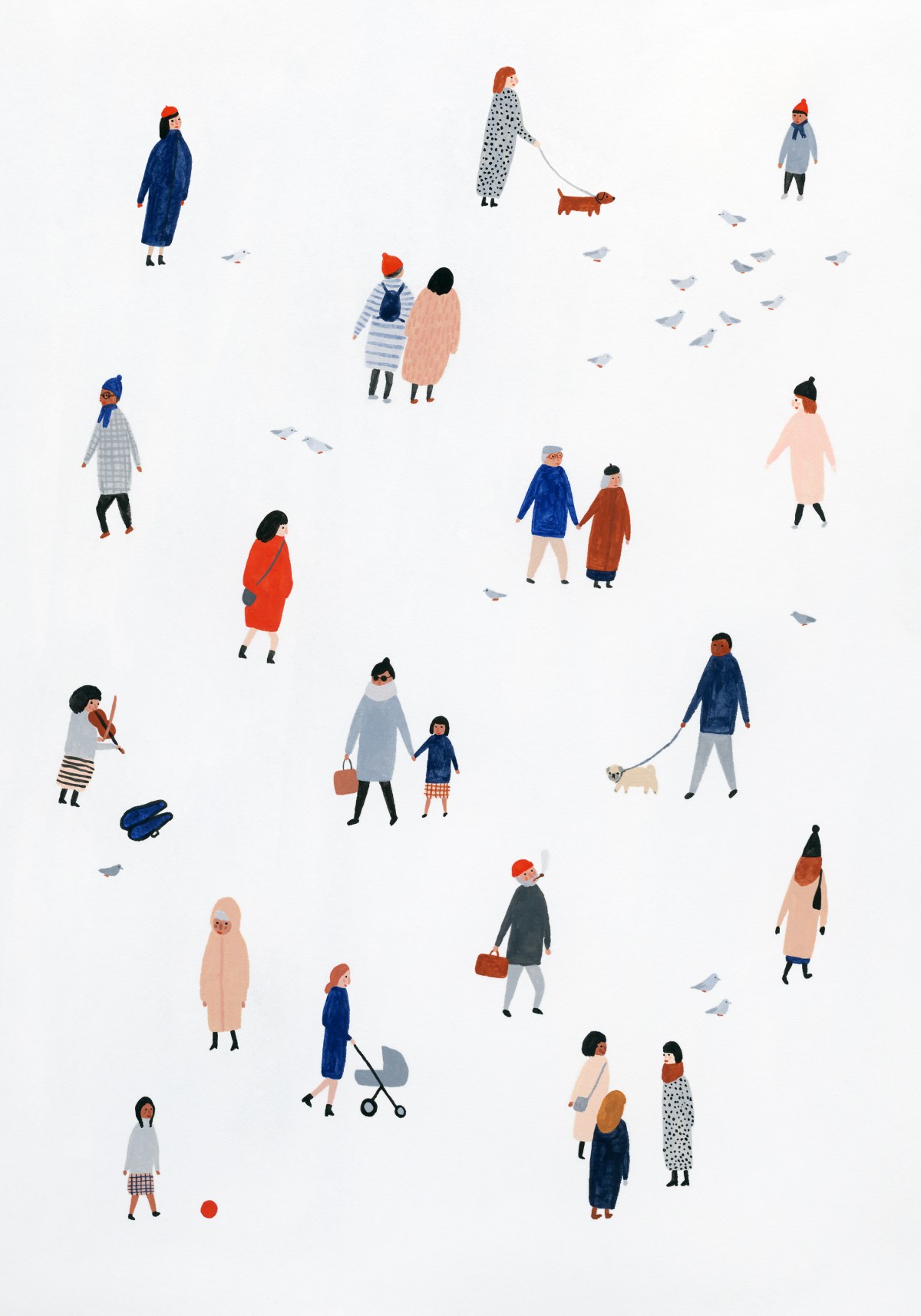
Graphic:  Kate Pugsley, Tiny People. https://www.katepugsley.com/shop/print-9×12
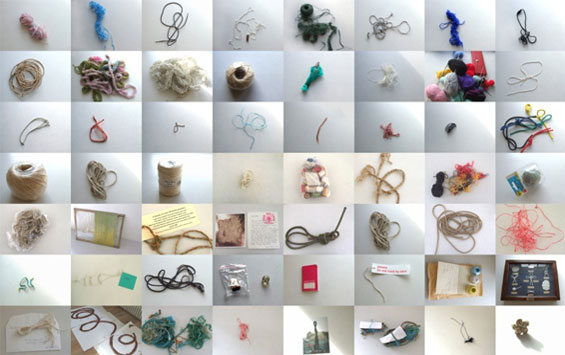
Collecting for design

Do you have weeks when you collect interesting phrases that, like small lengths of string, might come in useful someday?  You put them in a mental drawer and there they stay, until after a while you take a look at them, either when you’re tossing in another one, or looking for exactly the phrase you want to neatly express a concept or to explain something.

This past week I’ve collected quite a few of these phrases.  I don’t know why it’s been a particularly rich week for them – maybe I’ve been more attentive, or maybe I feel the need to stock up in case of phrase famine.

So now I’m unravelling them, smoothing them out, and bundling each neatly ready to put in the phrase drawer for future use.   But for now, I’ll just show you what I’ve added to the stock this week.

Creative disobedience:  I was reading the 2017 Human Capital Trends which has a chapter on ‘The Organization of the Future’ (worth reading) about organization design.  The authors assert ‘Still, many business leaders seem to have little confidence they will get the [design] process right … many consulting firms anecdot­ally report that up to 70 percent of reorganizations fall short because of “creative disobedience” from the executive team.’ I really enjoy that phrase – it’s definitely one that’s usable, even if only privately, when sitting in a thorny exec meeting where people want to start with an org chart and forget about systems thinking.

Lyapunov exponent: this is a mathematical concept, I read about in New Scientist and which really grabbed my attention. The basic premise of the concept is that: “We cannot predict the future. Any little uncertainty gets amplified exponentially by chaos.  Whether it is predicting the weather, the stock markets or the next president, Lyapunov exponents tell us our efforts are futile. But experience tells us we’re unlikely to stop trying.”   It could be just right for when I’m next trying to explain that I am not able to say with certainty, what precise and evidence based benefits a new organization design will bring in the coming 2+ years.

Automated groupthink: I was talking with Rob about Sli.do. It’s advertised as ‘Audience interaction made easy’, with the ability to ‘Crowdsource the best questions from your audience’.  In the meeting I was at, audience members submitted a question and the questions(s) that got the most ‘thumbs up’ from other audience members were the ones the speaker answered.  If a question didn’t get any ‘likes’ it wasn’t tackled.  This is similar to Amazon’s ‘people also bought’ aka affinity analysis, but it seems to me a strange logic that the most likes indicate the ‘best’ question.  It got Rob and I discussing curiosity and random connections that often result in innovation and he wondered whether Sli.do encouraged ‘automated groupthink’.   In organization design work being curious and asking questions that act against confirmation bias, challenge assumptions, inspire creativity, open up a broader context, and cause reflection, even if people do not ‘like’ them, are as important as those questions they do.

Working backwards:  This came from a conversation on planning, with the suggestion that we begin with where we want our new design to be in six months and ask ourselves what we have to do to get from there back to our current starting point.  When it was mentioned, I remembered the pre-mortem exercise that I’ve done several times.  But it works from if things have gone wrong, whereas working backwards implies working from if they had gone according to plan and then constructing the plan from that point back to the starting point.  Maybe the pre-mortem and working backwards could be done jointly?  Others have got intrigued with this idea of working backwards and I particularly liked Akiko Busch’s comments on it.

Two other phrases that I jotted down last week are ‘occupying a conceptual space’, and Finite and Infinite Games.  The latter is the title of a book by Timothy Carse.  It begins with the provocation: ‘There are at least two kinds of games.  One could be called finite and the other infinite.  A finite game is played for the purpose of winning, an infinite game for the purpose of continuing the play.’   I stopped reading the book at that point and instead found myself ‘occupying a conceptual space’ considering organisation design as either a finite or an infinite game.  If someone wants the ‘right’ design to be ‘delivered’ within a given period is it a finite game?  Alternatively, if organisation design is considered an ongoing evolving process then is it an infinite game?

Why do I collect phrases?  Unlike collecting string, phrases make me stop and think, they usually extend my knowledge or I learn something from them, and (like string) I could use them in the right circumstances.   What do you collect that aids your organization design work?  Let me know.

Image: Richard Wentworth, A Confiscation of String


Designing a small function

Twice this past week I’ve been asked the question how to design an HR function for a smallish (500 people) organization, with plans to grow quickly in both their current market and new but related markets.  As their business develops the number of employees will grow.  They’re both looking for a design process that is simple, involving, quick and results in an HR function that can shape and guide their organization’s growth but not by growing the HR function in line with this.  (That function has to stay small).

My first thoughts on this are that with a small team the approach is less about ‘a re-design’ as a one-off, and more about asking a series of questions that lead to continuous action (at a manageable and involving level) that keep the design constantly refreshing in an unobtrusive way.  My image is one of diverting a river not by obvious intervention of dykes and dams, but by shaping the natural landscape a bit so that the rainfall over time changes the path naturally, or by enabling natural flood defences rather than constructing them.

At this stage, three questions that this thought on continuous design poses for me are:

  1. How much do we want the design process and the design outcome to be a ‘test and learn’ for developing our design process and thinking for use with other parts of the organization in the coming months as the organization grows?
  2. How should we determine what HR activity needs to be done and then determine how to do it in a way that delivers on our organisational strategy, aligns with our wider organisational design (itself under review) and meets requirements and expectations of our – HR and the organization’s – various stakeholders?
  3. How much do we want our design work and outcomes to reflect the new ways of working that are emerging in most aspects of HR (and organizations as a whole e.g. automated, data driven, networked)? For start-ups and smaller, newer organizations this could be easier than for well-established, larger organizations that have a legacy of process, system and practice.

Thoughts on Q1 (test and learn design):  Paradoxically, just asking these questions is part of the design process.  As Edgar Schein says in his talk on humble consulting, ‘the [old consulting] notion of having a diagnostic period followed by intervention is absolutely not the way this process works at all.  It works with the recognition that the very first response I make to a client on the phone or over lunch or whatever is already an intervention’ .

In many organizations – regardless of size – it’s not easy to get across the idea that conversations and informal interactions without blueprints and models are just as shaping of designs as conversations about any formal design blueprints and models presented.   Read Managing Change as Shifting Conversations if you are interested in this topic or look at Chris Rodgers’ blog Mastery, Mystery, and Muddling Through.

Thoughts on Q2 (HR activity): There’s a useful list of HR activity produced by the Corporate Executive Board that starts to frame a discussion around what HR functions need to do and where to focus their energy.  I’m not sure how many HR functions could tell someone which of the activities they do produces most organizational value.  It’s worth working this out and asking whether low value work can be done differently, elsewhere more cheaply/effectively, or not at all.   Related to ‘what activity’ is the idea that the ‘right’ activity for an HR function depends on numerous factors.  Look at A New Strategic HR Model and HR Operating Model: A new blueprint for HR for some ideas on this.

Thoughts on Q3 (new ways of working):  A smaller, newer organization may well be at an advantage in not being hidebound by a tradition of what HR does.  But they may not be. It is hard for people to be bold thinkers or flout the conventions of the profession in which they are trained.  One way of being self-challenging is not to look for benchmarks, best practice, and examples of what ‘others like us’ are doing.  But to look at examples of what ‘others not like us’ are doing to meet the challenges of offering a professional service from a small base of staff working in new ways enabled by data, automation, and collaboration.  Corporate Rebels has some good case studies and Culturevist is a good source of info too.

What are your thoughts on the 3 questions related to the continuous re-design of a small HR function?  Let me know.

Learning from Lego(land)

Legoland, Windsor  was not on my bucket list but became a must-go place when two boys of my acquaintance, who had never been but had clearly heard about it, started telling me how wonderful it would be to visit.  They told me many times.  In the end, we went on Monday.   The experience definitely honed my consulting skills, and probably started to ground the boys to take the consulting career path in the future.  Here are four of several skills I added muscle to during the day:

Problem solving: Arrival at the station on time for the 08:28 train was a significant achievement.  But met us at Waterloo was initially a ‘delayed’ departure notice followed, two choc croissants, later by the flashing red announcement of signal failure and a minimum of 2-hours delay.   Going from Waterloo to Paddington was instant new plan (think rush-hour but we can manage).  Our train left on time stopping just 300m outside Paddington – no explanation.   30 static minutes later, we decided to re-frame the problem of how to get to Legoland, abandoning the train at the first sensible opportunity (Slough) and getting an Uber.  (The driver was diplomatic on the various Uber problems and enthusiastic on Legoland).

Continuous learning:  During the outside-Paddington wait I learned thumb wrestling perhaps a useful addition to my conflict resolution toolkit.  (Winner takes all), followed by 21 about winning strategies – another for my tool kit, and some variants of rock, paper, scissors teaching how to hold your nerve.

Resilience: I see Lego itself has a resilience officer and I wonder how long he spent at Legoland practicing his skills before applying for the job.  It takes a lot to stand in a long line multiple times in one day even with a Q bot to reserve a space, with the ride shop temptingly close, but it does give lots of opportunity to explain how pocket money works,  the marshmallow experiment on delayed gratification, and remembering to focus on outcomes and not the process. (They did enjoy the rides).

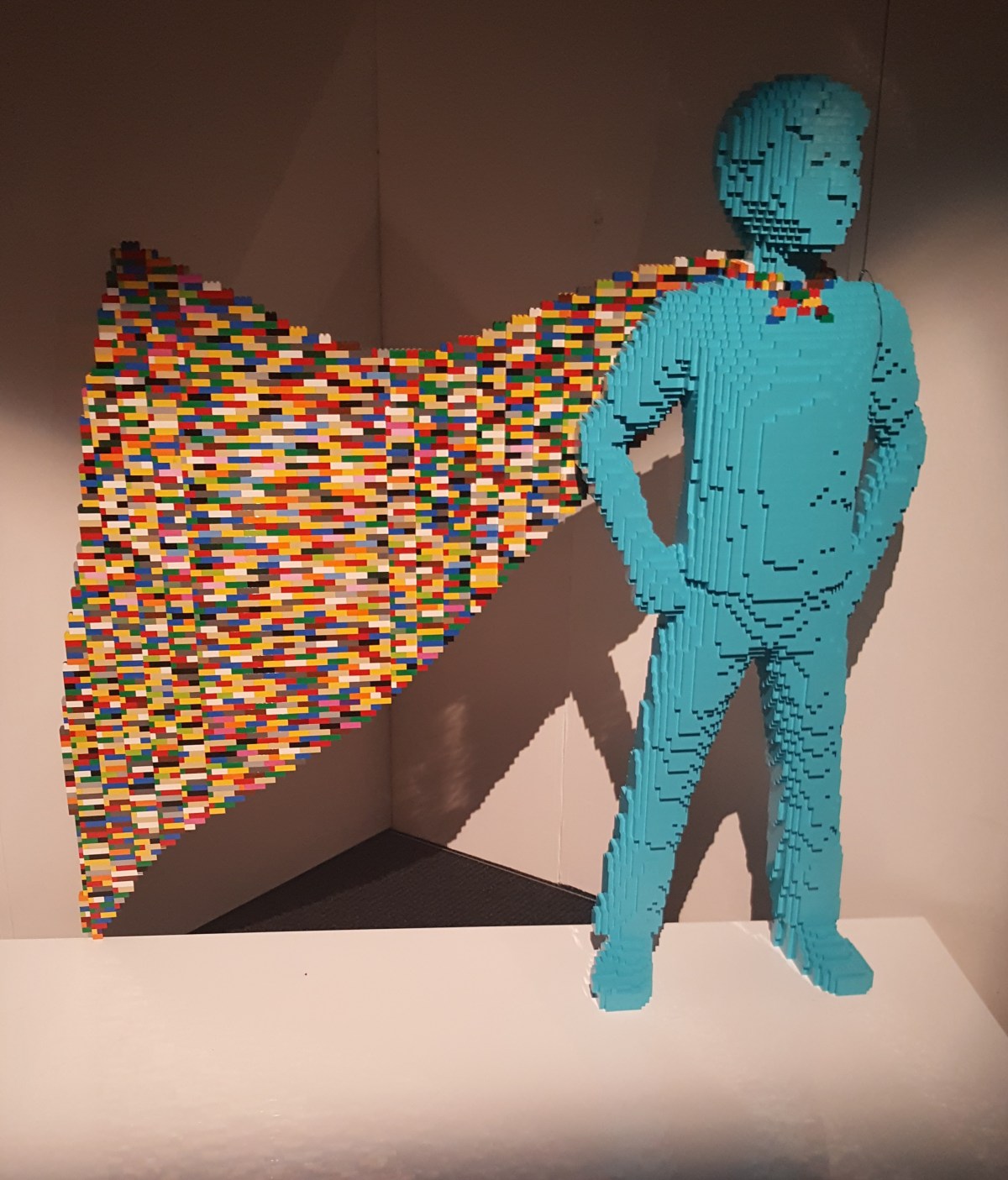
Fun:  The versatility of the Lego bricks and the learning and creativity it inspires is huge fun to see playing out.  I was enchanted seeing the children absorbed in Lego constructing, their enjoyment (and mine) of the giant Lego giraffes, dinosaurs, the miniland township, and the variety of Lego education events.  I’d prepped for Legoland by going to Lego artist Nathan Sawaya’s superb art exhibition using ‘nearly 2,000,000 bricks to create large-scale sculptures of the most enduring Super Heroes and Super Villains’.   Another surprisingly fun event.     In our agile workshops we use Lego (see Lego4Scrum) – people have fun at work with it.

Are you a Lego fan?  Could we develop organization design and consulting skills using it in a fun way?  Let me know.


Image is Nathan Sawaya’s ‘Hero Within’

While cycling …

Cycling the Fakenham 50k on Sunday gave me thinking time to work on the rough outline of a blog piece on programme management. Why that topic? Because last week I found myself re-immersed in the world of Terms of Reference, Project Initiation Documents, version control, project dashboards with RAG ratings, Programme Boards requiring regular presentations in a specified format and so on.

I raised the possibility that as my work-stream is on change we could tackle all this with less formality, and in doing so demonstrate change in action. In response, I got ‘Good luck with that one’.

Ho hum. I’ve dusted down my Managing Successful Programmes course notes, started re-learning the vocabulary and acronyms and turned my sights from the different world of sense-making, story-telling and emergence.

What’s interesting about this time’s immersion into the project world is that, since I was last in it big time, it’s absorbed another approach – Agile. So not only is there the original language and requirements, there is the new language and requirements of sprints, daily stand-ups, scrum masters, backlogs, and the rest of it, including the use of boxes of post-notes. Fortunately, I have been close to the Agile world in the last couple of years, so have a good working knowledge of how it goes – for good and for learning from failure.

However, I’m wondering whether I should formally update my skills by taking the Agile Programme Management course that promises that by the end of it I will be ‘Responding to change with speed and grace’. I like the ‘speed and grace’ bit. It sounds just what I need for cycling in hot weather around Norfolk.

Alternatively, I could just buy the book ‘Project Management the Agile Way‘ and mug up on ‘the Agile Grand Bargain, the shift in dominance from plans to product and input to output, the latest public-sector practices, and new concepts such as return on benefit, and Kanban’. But probably reading it wouldn’t be in scope – thus being an exclusion – but if it was in scope, would it be critical or priority, or just a regular inclusion?

In terms of my personal learning project/ToR on the topic I think I’ll just put reading the book down in the Constraints section (not enough time to read it).

I realised I wasn’t quite there with the team and the method yet when I missed Friday’s stand-up by noticing my pop-up 15 minute reminder to attend, and then getting lost in time as I constructed the Configuration Management Requirements (five activities and three forms) section of the ToR I’m writing. To mitigate the risk of this happening again I have now set a 10 minute and a 5 minute alarm on my phone.

Writing that sentence has reminded me that I must put my phone to silent when I attend the stand-up as I got a knuckle rap last week when it rang. So, I just have to remember to put the phone on silent and go to the stand-up when the alarm rings. Oh, but I must then set another alarm to remind me to put the phone ringer back on after the stand-up. I can’t make the assumption that I will remember to do it. It is thus a risk and not an assumption. So maybe two alarms – one before and one after stand-up? (I checked that the alarm does go off even when the phone is in ringer-silent mode).

I see another risk that as I start churning out project documentation and attending various Boards and Authorities. I might start speaking only in the language of programmes and projects. I just read a warning on this. It begins ‘Every trade is also a tribe … One way that tribes, from teens to programmers, signal membership of the group is through language.’ So, I have to mitigate that risk. I can do that in one of two ways – making sure everyone not of the Project Tribe has the glossary of 800 commonly used project terms to hand – maybe on wall posters?

Oh, I just noticed that it doesn’t include all commonly used Agile words e.g. scrum! But don’t worry, we can hand out the Agile Glossary too. It’s worth a skim because you’ll see that some of its specialist vocabulary (or as they call it ‘unique terminology’) has slipped into Plain English e.g. Sign Up for Tasks

My second mitigation is that I could demonstrate being tri-lingual – fluently speak AMP (Association of Project Managers) and Agile with my project colleagues as the occasion merits – remember we are doing Agile Programme Management – and switching seamlessly to Plain English with the rest of the workforce. Additionally, I could suggest to Duolingo that they offer bite-size lessons in APM/Agile

So here I am reaching for my templates telling myself it’ll be fun. What are your hints and tips on doing organization design/development the Agile Programme Way? Let me know.

Leading design work

I'm writing the final chapter of my forthcoming book Organization Design: a practitioner's guide. I've got to the bit on business leaders and their role in design work, which I think calls on some specific skills which although useful in the 'day job' are not as essential as they are in taking a lead in design work. Here's a slightly shortened version of the section:

Leaders play a critical role in three ways in relation to organization design work: stating and explaining the 'why' of design or redesign, supporting people in making sense of the context that the re-design work is responding to, and telling the stories of how it is going.

There is no value in doing organization design work if the 'why' of doing it is not clear to people. Too frequently the 'why' is not obvious – if things are ticking along nicely then why change it, is a common attitude to proposed organization design work. 'Whys couched in terms like 'to be more adaptable', 'be fit for the future' or 'be more competitive' are not sufficient to convince people that the upheaval of redesigning is worth the effort. Nevertheless, it is that rather vague 'fit for the future' requirement that impels many organization redesigns.

It falls to the leaders to state the 'why' in terms that are meaningful to stakeholders so that they can understand how the new design will affect them. A leadership team that spends time really thinking through the 'Why redesign'?'question – its contribution to and impact on the work and the workforce – makes a big difference to the speed with which work can progress.

Explaining the 'why' of an organization redesign helps people make sense of what is going on. Leaders often see more of the context, and have more of the puzzle pieces than people who are focused on doing a particular task or role. Having access to the bigger picture puts the onus on leaders both to make sense of complex environments for themselves and then to support and work with others in their sense making so that a reasonably consistent and common view emerges.

Sense making is a collective and collaborative activity 'triggered by cues – such as issues, events or situations – for which the meaning is ambiguous and/or outcomes uncertain.' People typically become anxious in situations like this that violate their expectations. They expect leaders to interpret and make sense of the situation for or with them. Failure to do this on the leaders' parts leads to heightened anxiety and multiple individual interpretations of the situation.

Deborah Ancona, director of the MIT Leadership Center at the MIT Sloan School of Management explains how leaders go about sense making:

'This sense making ability is a particularly important predictor of leadership effectiveness right now. … It requires executives to let go of their old mental models and some of their core assumptions; to take in data from a wide variety of sources; to use the information they have to construct, with others, a "map" of what they think is going on; and to verify and update the map -— in part by conducting small experiments that provide the organization with more information.'

Researcher Sally Maitlis found that leaders approach their role of supporting collective sense making in one of four ways:

  • Guided where they are 'energetic in constructing and promoting understanding and explanations of events'
  • Fragmented where leaders are not trying to control or organize discussions but allowing stakeholders to generate alternative pictures
  • Restricted where leaders promote their own sense of what is going on with little stakeholder involvement
  • Minimal when both leaders and stakeholders await some other interpretation of the issues.

If leaders of organization design work take a combination of guided and fragmented sense-making approaches then stakeholders are more likely to feel involved in the design process. This is a tricky tension to work with. The guiding sets the framework and the outlines, the fragmenting allows for local or individual interpretation within the framework.

Explaining the 'why' and guiding stakeholder sense-making can be supported by storytelling. Be aware, though, that stories can be an effective and inspirational tool to both make sense of what happens in organizations, or to inspire, provoke or stimulate change. And stories can be used to mask the truth or to manipulate.

The skill of a leader in telling stories is to recognize that there are many stories possible from the same situation. (See the TED talk The Danger of the Single Story). Effective leaders, as story tellers, neither abuse their power, nor tell a single story. They tell many stories and they tell the stories from a position of equality and respect, illustrating organizational complexity, a diversity of views, and their own responses to uncertainty.

Stories told this way – that explain the why, and acknowledge uncertainty and anxiety – help build confidence in and emotional connections to the new design. They contribute to demonstrating authentic, transformational leadership.

What do you think the role of leaders is in organization design work? Let me know.

Observing and sense making

We were set a writing task last week to go out and observe, not participate, and then develop a short story from the observation. (I was on a creative writing course). That's a fairly open-ended task and we had to complete it within a couple of hours.

It reminded me of the start of most design projects I get involved in. One of the early steps is to find out what's going on in the client organisation, using various methods, and observation is often one of them.

Most design and change methodologies are rooted some form of 'current state assessment' involving observation – the language depends on the method or model. Think about the 'discovery', phase in appreciative inquiry, or the empathise stage in design thinking or the project conception of the project cycle or the awareness of the need for change in Prosci's change management model or the consulting cycle with an information gathering phase.

Observation sounds easy, but isn't. I watched two men eating lunch together, but couldn't decide if I was watching them because I was going to construct a detective story, a story on cultural habits of eating, a story of how to interpret hand gestures, or a story of something else yet to emerge as I watched. As I riffled through the various possible stories lines I focused on different aspects of the interchange that I could see but not hear. (By the way, I was inside watching through the glass window and they were outside and didn't appear to notice I was watching them).

Was the colour of the watch strap each had significant? Was the fact that they both had their phones face down on the table some kind of social agreement? What did it mean that one had his wallet on the table and the other didn't? Why did they spend some time looking at each other's rings? As I thought of different purposes for the watching I seemed to focus on different aspects of the exchange, and my interpretation of it varied depending on the storyline I was playing with.

I spend a lot of time observing in my organizational work, usually not as specifically and with such focus as that task made me. But I now wonder whether I should cultivate more conscious and reflective observational skills. The short session I spent watching the men eating lunch reminded me how easy it is to infer, assume, deduce, and jump to conclusions on very little evidence. (Take the Watson Glaser test to see how skilled you are at critical thinking). It also reminded me that observation is part of sense-making and various storylines that seem to make sense are possible but that my sense-making may not square with another person's observing the same scene. Getting to being an objective observer recording what you see without any filtering is hard. (See this blog post for 6 different recording frameworks).

Towards the end of the week – just after the observation task – I noticed several out of date flyers for events in the hall of residence I was staying in. I'd passed them multiple times and not noticed them before. This led to me to ask myself several questions in trying to make sense of this observation. Why I hadn't I noticed the flyers before – a thing about figure and ground, useful in design work? Was there anyone in the organization whose role it was to take down out-of-date notices? Does it matter that they stay up? And so on. A tiny detail but one that might be significant if I were doing organization design work there. (Think butterfly effect).

In the event I took the dated flyers down, leading to more questions: Was I being accountable or high handed? Was I showing initiative or interfering in something that wasn't 'in my job description'? …

These types of questions all seem material in organizational observation as we take observation into sense making (see this excellent academic article if you want some theory on the topic of sense-making) but what I then came to was a view that observation and sense-making are inevitably interpreted through social and cultural lenses. I needed, if not a multi-disciplinary team, at least some others to discuss and present more possibilities than those I was thinking of as I observed and tried to sense-make. In organizational life pooling the various the observations and the questions they raise could enable participative/collective sense-making and a perhaps a compelling story to emerge.

Do you think should organization designers hone their observation and sense-making skills? Let me know.

Designing with stories

Story telling seemed to be the natural topic for this week's blog. Why?

First, because today (6 August) I've started a one-week residential creative writing course focused on short stories. It's got a daunting amount of homework and is described as 'intentionally rigorous'. I'll let you know how I got on with it.

Second, last week I was reviewing the book Design a Better Business which has a whole section about storytelling as integral to organization design work and offers a downloadable template + instructions on how to construct stories.

Third, also last week I started a new assignment and am listening to stories people tell about the organization and the piece of work that I am doing with them about why we need to change. Some people specifically said 'we need to be better at telling the story of why we have to change'.

I am a bit sceptical that stories consciously designed to be 'tools' can change organizations. Possibly they can help change organizations or contribute to changing organizations – depending on how you constructed them, but how would you know any changes were due to the stories being told, and can you design or contrive stories that work well alongside the naturally occurring sort that get told in organizations?

Steve Denning, well known in organizational story telling circles, suggests in his 2004 HBR article they can be constructed and offers a neat summary table of what he calls 'The Storytelling Catalog', a kind of 'at a glance', list of different types of stories to meet different types of 'need'. The article tells Steve's story of how he came to his views on organizational stories and their relationship to knowledge management and leadership.

Yiannis Gabriel, irritated 'by the really awful state of the entry on 'Organizational storytelling' in Wikipedia, which is enough to discourage anyone from ever taking this topic seriously' offers a more academic, grounded in theory, discussion of organizational storytelling.

He wrote the piece at the end of 2011 and lists 6 reasons why 'in the past fifteen years, interest in organizational stories has increased considerably', moving on to explain the relationships between narrative and story, saying that confusing the two 'unfortunately obliterates some of the unique qualities of stories and narratives that make them vivid and powerful but also fragile sense-making devices'.

Over the years since then, organizational storytelling has gained ground, but its value as a 'change tool' appears to be moot. In June 2017, the University of Portsmouth hosted the 22nd Organisational Storytelling Seminar – making the point that: 'While the literature is clear about the centrality and functionality of stories in leadership processes, it is also acknowledged that stories are uncertain and complex, and hence difficult to use as tools (see e.g. Boje, 2006; Parry & Hansen, 2007; Sintonen & Auvinen, 2009).' It's well worth looking at the call for papers that the organizers put out as it headlines the current questions around the topic.

NOTE: If you're not familiar with the work of David Boje, a storytelling philosopher, take a look at his fascinating website. You can also join him at the December 13-15, 2017, in Las Cruces, NM for the 7th Annual Quantum Storytelling Conference.

A field related to organizational storytelling is Dialogic OD, and Gary Wong commenting on my last week's blog says that 'the new Dialogic OD perspective that folks like Peggy Holman are exploring explains why stories are preferred over surveys and interviews [for gaining organizational information]'. See Gary's full comment here.

Gary also sent me a useful article by Gervase Bushe who says: 'change occurs when the day to day thinking of community members has altered their day to day decisions and actions, which leads to a change in the culture of the community that entrenches those new ways of thinking. Their thinking is changed when the language, stories, and narratives the community uses is altered in a profound way (Barrett, Thomas, & Hocevar, 1995; Grant & Marshak, 2011). An interview with Bushe on the topic of stories used to challenge the status quo is here.

The general principle is (simplified version) that if, through storytelling, people start to change both their language and their stories then the organization is changing, the implication being that change stories can be consciously 'seeded'.

I'm now wondering if I should examine my scepticism about organizational storytelling – can stories be carefully constructed and told and have the outcome of changing the design of organizations? Should they be? What's your view? Let me know.

Note: This piece also appears on LinkedIn

Designing for emergence

I got a request last week 'to explore developing and delivering a Business Change function: how it might be structured, and its milestones and deliverables'. It came at the same point as the question, from Peter Murchland, 'can we or how can we design for emergence'?

At first glance, they seemed to be opposing notions. In the Donald Rumsfeld spectrum of 'There are known knowns, there are known unknowns, and there are unknown unknowns', business change typology seems to be more comfortable at the known knowns end, a kind of reductionist view of the work, and emergence typology at the unknown unknowns end a kind of holistic view of the world.

As I was musing on the two I remembered a picture I once had on my wall. It was a drawing by French illustrator Jean Olivier Heron, called 'Comment naissent les bateaux' (How boats are born). It showed a yawl gradually emerging through a sequence of drawings that started with a butterfly-winged mermaid hatching. (See it here).

This sparked the thought that maybe you could develop a business change function that designs, if not emergence, then the conditions for emergence. The originating business change function would incubate the principles and conditions that enable emergence. Peggy Holman describes two types of emergence.

  • Weak emergence describes new properties arising in a system. … In weak emergence, rules or principles act as the authority, providing context for the system to function. In effect, they eliminate the need for someone in charge. Road systems are a simple example.
  • Strong emergence occurs when a novel form arises that was completely unpredictable. We could not have guessed its properties by understanding what came before…. Nor can we trace its roots from its components or their interactions.

The emergence of the yawl from the butterfly-mermaid would be completely unpredictable if we were just looking at the start point and trying to predict an outcome from what we know of butterflies and mermaids. It would be a strong emergence. Except that in the picture you can trace the emergence of the yawl back to the butterfly/mermaid. So maybe its a weak emergence?

I'm interested in designing the conditions for emergence, because I'd like to see a business change function that is focused on helping organizational members manage uncertainty, be curious about what could happen, be willing to participate in experimentation, be happy to continuously adapt and learn new things, be skilled in meeting things that come in from unexpected directions, and be capable of continuously renewing the organization in a variety of ways. That roughly equates to being able to handle emergence rather than comply with processes.

This does not mean abandoning all programme management protocols but it may mean expressing them in a different form e.g. the concepts of 'deliverables' and 'milestones' could change. There might not be a detailed plan. There might, instead, be a trust that 'business change' will emerge and continue to emerge from an agreed direction and some principles.

The story of Miles Davis's, 'Kind of blue' illustrates. No doubt there was a contract and a 'programme' intent on getting an album of a certain quality produced by a specific point in time, with various risks managed by processs like insurance. But Davis approached the task within the programme from an emergent perspective:

'As was Davis's penchant, he called for almost no rehearsal and the musicians had little idea what they were to record. As described in the original liner notes by pianist Bill Evans, Davis had only given the band sketches of scales and melody lines on which to improvise. Once the musicians were assembled, Davis gave brief instructions for each piece and then set to taping the sextet in studio.'

The album is among the top most successful jazz albums ever recorded.

A similar interplay of programme protocols and emergent thinking is hinted at in Peter Corning's article (referenced in Holman's work) where he closes with the point that that both reductionism and holism are essential to a full understanding of living systems. So, it may be in attempting business change – it has to be done with both reductionist and systems thinking.

Leandro Herrero offers 12 simple rules of social change that I think are useful discussion starters for those developing a business change function that would enable continuously changing the business (the weak emergence) and working with the emergence of the unexpected (the strong emergence). One that I'm thinking would cause debate is 'Readiness is a red herring', and another 'Recalibrate all the time. Stay in beta.'

Coincidentally as I was writing this, I read an example about finding a treatment for multiple sclerosis that opens: 'Experiments that go according to plan can be useful. But the biggest scientific advances often emerge from those that do not.' It's a good story of designing the conditions that enable emergence.

Do you think you can develop a business change function that either designs for emergence, or designs the conditions for emergence? Let me know.

NOTE: This blog also appears on LinkedIn

Digital ecosystems – any thoughts?

Jim sent me an email last week saying: 'I am doing a webinar on ecosystems and with all the hoopla on digital ecosystems in HBR recently I think there is a possible org design perspective on this.'

He went on to mention alliance management functions, ecosystems of the future, and centralized/decentralized models. Finishing with the challenge 'Any thoughts?' So, here goes:

Beginning with the 'eco'. Ecosystems has recently entered the common language of business – to such an extent that it's in the top three management buzzwords of 2016.

Before it was a business word it was an ecologist's word and in that literature, there are many definitions on what ecosystems 'are'. A simple definition, from National Geographic is: An ecosystem is a geographic area where plants, animals, and other organisms, as well as weather and landscape, work together to form a bubble of life. Ecosystems contain biotic or living, parts, as well as abiotic factors, or non-living parts. Every factor in an ecosystem depends on every other factor, either directly or indirectly.

More detailed ecosystem definitions include concepts of pattern formation, self-organization, coevolution and co-existence between organisms and their environments, interaction across multiple scales of space, time, and complexity, and feedback loops.

Similarly, there are various definitions of digital ecosystem. Gartner's is: 'A digital ecosystem is an interdependent group of enterprises, people and/or things that share standardized digital platforms for a mutually beneficial purpose (such as commercial gain, innovation or common interest). Digital ecosystems enable you to interact with customers, partners, adjacent industries -— even your competition.' This definition is closest to the business ecosystem discussed in an article on three types of economic ecosystems (business, innovation, and knowledge).

Having got this far I paused. Earlier in the week I'd watched an Adam Grant TED talk in which he asserts that procrastination is an aid to thinking. That helped me feel ok watching a programme on Scottish and Icelandic seabirds around the Shiant Isles. It turned out to be about ecosystems. And all is not well. 'Overfishing, global warming disturbing the ocean food webs, pollution and the introduction of rodents and other animals to breeding places are ushering in an apocalypse. Some scientists estimate that by the end of this century most of the world's seabirds will have disappeared'. The Shiant Isles seabirds are part of this story.

The players (in the jargon – 'agents') and stakeholders in this seabird ecosystem are many, and interconnected. They have differing power positions and differing interests it. Most of the players are voiceless and many are powerless to protect themselves. It's an unsettling narrative that we should bear in mind when designing our digital ecosystems.

Having said that, there's a lot about designing digital ecosystems that make it sound do-able and relatively easy because basically you're designing a digital platform that you own and others use. There are some commonly cited leaders in the field: Danske Bank, Amazon, Philips Healthcare, and Fiat are among them. They have reportedly 'designed' digital ecosystems each based on a common platform.

But let's not get too excited or jump in designing them without pause for thoughts – here are my five:

  1. Digital ecosystems are complex interacting and interlocking networks. In designing one how do we answer questions like: what are its boundaries? Whose perspective are we looking at designing it for and from? Where will the power lie in it? Is it controllable? If you apply these questions to the seabird analogy you start to see the complexity of the interactions.

  2. The notion that digital ecosystems are 'beneficial' or add 'value' – as the definition says – is an assumption worth challenging. (Think seabirds again). Is it possible to design a digital ecosystem that is beneficial to all participants? Amazon, Google, Uber, Airbnb, are examples of companies known for their digital ecosystems some of the participants/agents in them – governments, regulators, and in some cases their workforce – are suggesting they are not beneficial. In designing digital ecosystems what discussions are we having about the value and benefit they bring?

  3. Having 'designed' the digital platform it is not possible to control its ecosystem. Once functioning it is continually adapting at a cellular/local level. In the seabird example, small colonies of gannets adapted their behaviours. In organizational terms, call centre agents, for example, develop work-arounds and adapt their behaviour in response to something happening in their environment (IT outages, new policy, etc). In digital ecosystems people hack-in, developers tweak bits, or interfaces fail … (See The Digital Ecosystem Paradox – Learning to Move to Better Digital Design Outcomes for more on this).

  4. Designing beyond the digital platform towards an ecosystem involves maintaining the ecosystem's capability to thrive over time. It involves long-term pattern watching using AI, big data, and extremely good interpretive analytics. If we see failures or the equivalent of 'poor health' then, it means trying out thoughtful adjustments. (Remembering that any adjustment will have consequences elsewhere in the ecosystem.) Organizational leaders tend to be poor at watching patterns over time. They are more interested in 'snapshots', or events with causes, so pattern watching may need different leadership skills.

  5. The idea of 'pattern watching' supposes that we know the boundaries within which we are watching. In seabird terms are we looking just at the puffin ecosystem and its agents, or the seabird population of the Shiants, or the wider seabird population or …? Does the pattern within the boundary matter more, from a design perspective, than the interactions and overlaps of patterns across ecosystem boundaries? Perhaps there are numerous citizens who are simultaneously a participant/agent/customer in Danske Bank, Amazon, Philips healthcare, and Fiat – what useful patterns would be revealed looking across these individual ecosystems that aren't revealed by looking within them.

How would you respond to Jim's email? Let me know.

NOTE: this blog is also on LinkedIn