Rituals, restrictions, and relationships

What are the rituals, restrictions, and relationships that define cultures? I ask because last week I was in two events where multi-cultures were in play.

Event one was in Dubai and one of the things I did there was facilitate a two-day organisation culture course. Dubai is a great place to discuss culture as its population is so nationally diverse – the 10 course participants represented Lebanon, Canada, UK, India, Kuwait, Saudi Arabia, Dubai, and Pakistan, not to mention various professional cultures, and various corporate cultures. We also had the full mix of generations. So, a diverse group with many different perspectives and lots to say on designing organisational culture.

Event two was my daughter's wedding. She's lived and worked in many countries. Her list of 80 or so guests represented Tanzania, Germany, Italy, France, Switzerland, Ireland, South Africa, Zimbabwe, Nigeria, Ghana, Afghanistan, Yemen, Ethiopia, Pakistan, Finland, Sudan, Iran, Hong Kong, England, Scotland, Australia, Holland, and Jamaica. As with the Dubai event it wasn't just the national cultures represented, there were multiple professions and the entire age range. It was a joyous experience to participate in a World Cafe in its truest sense.

What was so enjoyable about the events was not identifying or labelling people by nationality which is a relatively easy label to apply, but talking with them about their experiences and identities that were not only, or even, about nationality.

It is Taiye Selasi, in her TED talk 'Don't ask me where I'm from ask where I'm a local', who states 'I'm not a national at all. How could I come from a nation? How can a human being come from a concept?' Instead she asks where are you a local? She proposes 'a three-step test. I call these the three "R's": rituals, relationships, restrictions … that would tell us so much more about who and how similar we are.'

Her talk is well worth listening to, because what she suggests is not just true of national cultures but also of organisational cultures and professional cultures. Each is defined by protocols and experiences known to the locals. As one of Selasi's friends said, 'All experience is local. All identity is experience.'

As the participants in the Dubai workshop discussed the various elements of the Johnson and Scholes cultural web they compared their organisational experiences of restrictions associated with such elements as hierarchy, grades, power, control, job descriptions, and decision rights. They talked about the way work really gets done – not usually via the defined business process flow but via relationships and who you know. They enjoyed telling each other about the various organisational rituals they have experienced.

At the wedding the guests were invited to talk about how they knew the bride and groom, and they told wonderful stories that were nothing to do with national culture but to do with the experiences that had brought them together – teaching, supporting, living in shared accommodation, being at university, having friends in common, sharing mutual interests. It was the relationships that forged the bonds.

Woven through the day were lovely stories and comparisons of the differing rituals of weddings and wedding customs people had experienced – clothing, food, roles of family members, songs, dances, …

Restrictions were also apparent – one invitee called in by phone to tell us of her long and valued friendship with Rosa – her physical absence caused by visa restrictions, while another beloved friend was restricted from attending by having had a very serious illness. But her voice was heard through a different invitee talking of and for her.

I'm intrigued by Taiye Selasi's view that 'History was real, cultures were real, but countries were invented', and the way she argues not of doing away with countries but of not giving nationality a primacy over other cultural characteristics. As she says 'Culture exists in community, and community exists in context.'

As we think about organisational culture would it be helpful if we agreed with Selasi's view 'In fact, all of us are multi -— multi-local, multi-layered. To begin our conversations with an acknowledgement of this complexity brings us closer together, I think, not further apart.'?

From an organisational culture perspective, it may matter much less where people are from, our ethnic monitoring may be a distraction, and matter much more on how people feel or experience the rituals, restrictions and relationships of the organisation. I'm wondering how or if we can design cultures that reduce the inevitable restrictions, and make the rituals and relationships both transparent and welcoming?

Can we design multi-local organisational cultures? What's your view ? Let me know.

(See also my previous blog on Rituals, restrictions and relationships)
Failure as a form of helpful feedback

I'd given myself the task today of starting chapter 3 of the new edition of my book. But instead – I've decided to write on learning from failure which is a topic I discussed in several conversations this past week. However, in the spirit of things, I'm wondering what I'm learning from failing to stick to my chapter 3 schedule. Two things:

  • I need a refresher on important v urgent. (Remember the Eisenhower matrix?)
  • I will try out StickK's Commitment Contract 'a binding agreement you sign with yourself to ensure that you follow through with your intentions'.

The learning from failure conversations came up in my facilitating two different sessions of a workshop on resilience (see my blog on resilience here) because what people lit on in the definition of personal resilience was the idea that resilient people have the 'ability to see failure as a form of helpful feedback'. The consensus was that this is a really hard thing to do both individually and organisationally.

Why should that be? People offered several reasons all applicable at individual or organisational level. Here are three of them:

  • It takes courage to see that there are things to learn. A commoner approach is to blame or scapegoat for failure which leads people to be fearful of exposing any failure in the first place. A better way is to 'forgive and remember', Bob Sutton explains. 'You forgive because it is impossible to run an organization without making mistakes, and pointing fingers and holding grudges creates a climate of fear. You remember – and talk about the mistakes openly –so people and the system can learn. And you remember so that, even though you have tried to retrain people and teach them, if some people keep making the same mistakes over and over again, then, well, they need to be moved to another kind of job'.
  • It takes 'stickability' in the face of failure. This is an attribute of resilience that doesn't feature in definitions but we thought is part of it. Someone mentioned a Michael Jordan video that he'd seen years ago on this. I took a look at it. It's a few really powerful words on failing over and over and over again. This stickability is why he succeeded – because he used each failure as feedback to help him learn to do things better.
  • A similar example of stickability is Pepsico: 'Just a few years ago, it wasn't clear whether Indra Nooyi would survive as PepsiCo's CEO. Many investors saw Pepsi as a bloated giant whose top brands were losing market share. And they were critical of Nooyi's shift toward a more health-oriented overall product line. .. But now, Nooyi 'exudes confidence … The company has enjoyed steady revenue growth during her nine years in the top job, and Pepsi's stock price is rising again after several flat years'. She got to this place by using 'fail fast and learn' principles that she explains.
  • It takes formal systems, processes and policies, that remove the individual and collective fear of failure. Without these, in many organisations failure is stigmatised. In his book, Black Box Thinking, Matthew Syed explores this tendency. One of the book's reviewers summarised: 'the world comes down hard on those who are deemed failures. The desire to avoid such opprobrium prompts people to cover up mistakes, argues Syed. Doctors tell patients of "complications". Police fail to drop cases against people accused of committing a crime, even after clear evidence emerges of their innocence. Politicians plough on with policies even when it is obvious they are not working.' Contrasted with this is the aviation industry which – through black boxes recording systems, investigative processes and policies around reporting failures – has formalised learning from failures with great success.

If you are hearing organisational phrases on the lines of 'it's safe to challenge', or 'we learn from failure' or 'we tolerate mistakes' are you sure that you have the attitudes, infrastructures and mechanisms in place to make it so? It may be worth checking.

How are you designing organisations to encourage members accept failure as part of life and to help them learn from it? Let me know.

Simplifying design

A couple of years ago I wrote a blog on the Complexity of Simplicity so I wondered if I'd be repeating myself if I wrote again about simplicity. But having just re-read it I'm taking a different tack this time – no nugatory work involved.

Nugatory means something of no value or importance. Look around your organisation and see if there is nugatory work going on. It can be difficult to spot – particularly if it's part of what 'we do around here' but it's the type of thing that can slow down effectiveness. When I ask, 'What work needn't be done? 'when I'm facilitating organization design workshops people can generally provide a list of stuff like producing unread reports, or multiple re-drafting of documents, or clunky business processes or duplicative functions. Scott Adams, Dilbert cartoon strip, provides multiple fun/familiar examples. I typed 'nugatory work' into the search box on his website and got a message 'Notice: Too many results returned for your search. Displaying the first 1000 most relevant results'.

I don't remember if the reminder of the Agile Manifesto, principle that 'Simplicity – the art of maximizing the amount of work not done – is essential' came up in relation to nugatory work this week but they are connected. Maximising the amount of work not done means not doing nugatory work. It also means not doing work that doesn't fall into the nugatory bucket but still doesn't need to be done.

It's a great principle for organisation designer practitioners to consider. It applies not just to examining how to make an organisation and its design simpler – in order to make it more effective in achieving its purpose, but also how to make the process of doing the organisation design work simpler. Is it necessary, for example, to assess 'as-is' is a question I get asked and 'do we need to do 'blue-sky' thinking?

Before I worked with digital people as I am now, I worked with architects and they introduced me to John Maeda and his 10 Laws of Simplicity. One of his laws is similar: 'The simplest way to achieve simplicity is through thoughtful reduction'. This is another principle that organisation designers could consider – helping people come to 'thoughtful reduction' of work processes, policies, headcount, or similar could lead to a more efficient and effectively operating organisation. Maeda's TED talk is very amusing with clear, simple visuals.

As we were talking about simplifying through maximizing work not done and thoughtful reduction people came up with a couple of other principles that could be adapted to organisation design work. Someone who'd just read Marie Kondo's book on The Life-Changing Magic of Tidying (see my blog on it here) mentioned she got the book because she had such difficulty in throwing things out. Following the KonMari method worked for her. A behavioural economist suggests why the method has worked for so many people. Is it too far-fetched to suggest that the application of the behavioural economics of tidying to organisation design could help tidy and simplify an organisation?

Then in a bit of a crisis during the week, that I was angsting over, a colleague enquired whether I was 'over-processing' it – a timely remark, given that I was thinking about simplifying stuff. This enquiry triggered my searching out the 10 10 10 approach to decision making. I find it a simplifying process in that it stops the (nugatory) work of worrying and offers a pause for thoughtfulness. This principle could be applied in determining organisational decision making authority and risk – ask 'is it a decision that will matter in 10 weeks, 10 months, 10 years?' and it may help simplify things.

What principles for simplifying an organisation and doing organisation design work do you apply? Let me know.

Designing resilience

I've just been listening to a talk by Martin Reeves on building 'resilient businesses that flourish in the face of change' that speaks to 6 principles – prudence, adaptation, embeddedness, modularity, redundancy, diversity – of organizational sustainability based in biological principles. Someone sent it to me last week saying, 'While the subject is not new, the topic is presented in a really cogent, insightful and engaging way'.

It was a timely send, because next week I'm facilitating a conversational 3-hour session on 'change resilience' and am getting materials together to do that. Originally, I was thinking about three segments: organisational resilience, team resilience, personal resilience. These are three aspects of resilience touched on in a booklet 'Engagement, Resilience, and Performance' which I was given this week. (Thanks Paul). It's a free resource – fourth down in the books list on the website.

Now I'm thinking of including a fourth segment on cultural resilience which is less often discussed 'Cultural resilience considers how cultural background (i.e.culture, cultural values, language, customs, norms) helps individuals and communities overcome adversity. The notion of cultural resilience suggests that individuals and communities can deal with and overcome adversity not just based on individual characteristics alone, but also from the support of larger sociocultural factors.'

Definitions of resilience vary depending but most of them refer to the process of adapting well in the face of adversity, trauma, tragedy, threats.

In "How Resilience Works,", an HBR article (well worth the read), Diane Coutu says "Resilient people possess three characteristics -— a staunch acceptance of reality; a deep belief, often buttressed by strongly held values, that life is meaningful; and an uncanny ability to improvise. You can bounce back from hardship with just one or two of these qualities, but you will only be truly resilient with all three. These three characteristics hold true for resilient organizations as well….Resilient people and companies face reality with staunchness, make meaning of hardship instead of crying out in despair, and improvise solutions from thin air. Others do not."

The question I have about many of the definitions is that they use the phrase 'bounce-back'. To me this implies ending up at more or less the same place that you started at before the trauma, stress or adversity. Which, in turn, suggests a lack of learning and adaptation.

Yet many writers on resilience talk about it as learning from the situation, while others suggest that the learning is linked with your innate way of perceiving adversity: 'Do you conceptualize an event as traumatic, or as an opportunity to learn and grow?' Read How People Learn to Become Resilient for more on this.

Either way, the learning aspect is critical I think and comes up in Reeves's talk when he's comparing Kodak and Fuji. 'Speaking of company failures: we're all familiar with the failure of Kodak, the company that declared bankruptcy in January 2012. Much more interesting, however, is the question: Why did Fujifilm — same product, same pressures from digital technology, same time — why was Fujifilm able to survive and flourish?' He suggests that one of the reasons is its ability to adapt. Learning is one of the primary means to effect social or cultural adaptation. (Biologists see 'adaptation' through a different lens).

It's too simple to say that Fujifilm or any organisation are entities that can 'learn' or 'adapt' in their own right. Organisational resiliency is expressed both through the attributes of its employees and through the systems, processes and values that will support resilience.

Martin Reeves tells the story of the Japanese company Kongo Gumi that was after 1,428 years the oldest continuously operating company in the world. However, 'it borrowed very heavily during the bubble period of the Japanese economy, to invest in real estate. And when the bubble burst, it couldn't refinance its loans. The company failed, and it was taken over by a major construction company. Tragically, after 40 generations of very careful stewardship by the Kongo family, Kongo Gumi succumbed to a spectacular lapse in the ability to apply a principle of prudence'. This wasn't due to the company's lapse. It was down to the individuals running it and to the processes and systems that should or could have kept it 'prudent'.

So, what are the organisational design implications of resilience? I've noticed three from the trawl of info:

  • Design systems and processes to deliver against a strong set of organisational values (e.g. Johnson & Johnson's credo). For example, a value of 'collaboration' would involve structures that enable conversations, processes that reward collaboration, systems that facilitate collaboration.
  • Review the design very frequently to check it is adapting to the changing context. (You can use Peter Drucker's planned abandonment exercise. Available on my website here).
  • Design functions and processes for a) 'horizon scanning' b) pattern analysis in order to get early warnings on adapting. (Design methods that won't allow ignoring the warnings – see the Nokia story).

How would you design for resilience? Let me know.

Designing for a growth mindset

I'm working periodically with a small team of people in what we loosely call a learning set – basically they set a topic, I get some discussion ideas together on it and then we spend a couple of hours together exploring it and reflecting on its organisational design implications: they've set 'the growth mindset' for our next meeting.

The way I tackle this type of challenge is to just jot down a bunch of things that spring to mind on it. In this case, I've got Carol Dweck, improv, Kagan/Lacey, Marilee Adams, play, laughter, learning organisation: it's a process a bit like opening the fridge and seeing what's in it that you can concoct a delicious meal from.

So now I'm looking at the list of discussion ingredients. Hmm – is there a delicious meal equivalent here, or will I have to go and forage for other things? I'll start with what I've got and see what happens.

The phrase 'growth mindset' was coined by psychologist Carol Dweck, in her book Mindset: Changing The Way You think To Fulfil Your Potential, first published in 2008 and just out (January 2017) in a revised edition.

Her theory suggests that intelligence and ability are not fixed characteristics, but can be changed and developed and grown. It's a very attractive, and popular, theory that is being extensively tested in schools. The UK, for example, has a project called Changing Mindsets currently running.

It's easy to see why it might be seized on as organisational initiative to help change culture, improve management skills, increase productivity, and so on. But it is no 'silver bullet' as some have pointed out and Carol Dweck is fully aware of.

She makes the point that people are not of either growth or fixed mindset, saying: 'Let's acknowledge that (1) we're all a mixture of fixed and growth mindsets, (2) we will probably always be, and (3) if we want to move closer to a growth mindset in our thoughts and practices, we need to stay in touch with our fixed-mindset thoughts and deeds.'

With this caveat in mind, taking the phrase literally, 'growth mindset' could simply imply being a continual learner, open-minded, non-judgemental and willing to try things out. People who are curious, who look out for opportunities and consider things as a 'offer' that you can choose your response have a 'growth mindset'.

I'm just finding out that improv is a great vehicle for learning and practicing this open-mindedness type of response. Robert Poynter, in his book, Everything's an Offer, tells a great story about Danny Wallace someone who decided, that for a year, he would say 'yes' to everything that came his way. (His story was later made into a film).

A different tack on being open to learning and growing is taken by Kegan and Lacey in their work on change. Several years ago they proposed 'Seven languages for transformation'. There's a useful summary table here. Their work has developed into a set of broader techniques and methods for learning and growing. Take a look at their book An Everyone Culture which presents and discusses 'the simple but radical conviction that organizations will best prosper when they are more deeply aligned with people's strongest motive, which is to grow. This means going beyond consigning "people development" to high-potential programs, executive coaching, or once-a-year off-sites. It means fashioning an organizational culture in which support of people's development is woven into the daily fabric of working life and the company's regular operations, daily routines, and conversations.'

Marilee Adams work is similarly around language use, specifically about the way we ask questions – she describes 'learner questions' and 'judger questions' and offers suggestions on what type of questions lead to learning and growth.

A completely different tack on learning and growth is through 'play'. Children learn through play and so can adults – though sadly we tend to lose that facility – 'play brings joy. And it's vital for problem solving, creativity and relationships.' Author and physician Stuart Brown notes that 'Particularly in tough times, we need to play more than ever, as it's the very means by which we prepare for the unexpected, search out new solutions, and remain optimistic.' Play: How it Shapes the Brain, Opens the Imagination, and Invigorates the Soul.

Linked to this is laughter with some evidence that laughter defuses situations and offers opportunities in the workplace to re-think and re-group.

Then there's the whole learning organisation genre with multiple theories and approaches. See a literature review here.

I think enough 'ingredients' to discuss a growth mindset. The intriguing part of the discussion will be on how to design an organisation to encourage it.

What additions would you make to the list of method for developing a 'growth mindset'? Can organisations be designed to encourage it? Let me know.

Co-located or dispersed teams?

There were conversations going on this week about the merits of having dispersed versus co-located team members. We are trying to decide whether to co-locate people. It's a fraught and complex issue not least because it could mean requiring people to move. It also means determining criteria for co-location, for example:

  • Is it to improve the outcomes of working on a specific project? If so, what happens when this is closed? (And how do we know we couldn't get the same outcomes from a dispersed team?)
  • Is it to encourage multi-disciplinary working? If so, how do know what multi-disciplinary mix to co-locate in a continually changing work context?
  • Is it to cluster functional or operational team members together (perhaps creating silos)? If so how will we know that this type of co-location is 'better' than multi-disciplinary?
  • Is it to indicate that we don't approve of remote/dispersed/virtual working? If so how will we explain that as many organizations are now shifting towards virtual working? (Also, does requirement to be on a specific site challenge attracting and retaining people?)

As in many conversations, views are based on emotion, opinion and personal preference with not too much (any?) discussion about actual evidence of the merits of one over the other. I started to look around for empirical research on this topic.

Three studies stood out as representing the findings of several:

'Comparing traditional and virtual group forms: identity, communication and trust in naturally occurring project teams' reports on a 'field study of naturally occurring project teams in a global firm. In this study, some groups were traditional (that is, co-located or face-to face), some were purely virtual (completely distributed), and some were what we call 'semi-virtual' or hybrid (composed of a local subgroup as well as remote team members)'. ( J. Webster and W.K.P. Wong)

The Effects of Teams' Co-location on Project Performance 'This paper aims to present an analysis between teams' co-location and project performance. … what are the effects of teams' co-location on project performance? The paper provides a literature review about teams' co-location, its advantages and disadvantages, virtual teams and project performance parameters.' (This paper looked at a variety of performance indicators, for example, speed and ability to solve a customer's problem comparing the different types of team's performance against the indicators). (Marina Mendonca et al)

Team member proximity and teamwork in innovative projects 'Innovation teams vary in terms of team members' proximity, i.e., the degree to which all team members are in direct vicinity over the duration of the project. The proximity of team members, however, has potentially important implications for the collaborative working of teams. In this paper, we develop and test hypotheses relating team members' proximity to the performance-relevant team collaborative processes included in Hoegl and Gemuenden's [Organization Science 12 (4) (2001) 435] teamwork quality framework, i.e., communication, coordination, balance of member contributions, mutual support, effort, and cohesion.' (Martin Hoegl and Luigi Proserpio)

In brief these three papers tell us that:

1. Team size matters (whether or not co-located) – smaller teams work better than larger teams on various dimensions including trust, productivity, and knowledge sharing.

2. Management style matters – if teams are to be dispersed then it must be a positive team-design decision – so you select team members for their ability to build relationships over distance and for managing working well alone. You select team leaders/managers for their ability to trust, respect and empower others. Thus, 'good' management is more important in dispersed teams than co-located ones. (Which could, I guess, suggest that if you knew you had poor managers you should opt for co-location as team members can collectively work around poor management better when they are in proximity. Alternatively you could train people to lead and manage dispersed teams effectively).

3. Social and community spirit matters – whether dispersed or co-located teams that have a sense of team identity, trust each other and get on well socially perform better than teams without any one of these. In part this is factor is related to management style.

4. Technology matters – where communication is mediated through various forms of technology – collaborative platforms, webchats, SMS, phone, etc then dispersed team members must have excellent skills in using it (and the technology needs to be effective and reliable). Face to face is easiest for communication as you are picking up nuanced non-verbal signals among other things.

In terms of productivity, quality and successful outcomes researchers have not found a difference between co-located teams and dispersed teams assuming the four points above are in play. To repeat, these are: small teams, good management, community spirit, effective technology and technology use. Where all four factors are not in play then performance is somewhat improved by co-location.

Where researchers have found a productivity and performance difference is in teams that are part co-located and part-dispersed. As Webster and Wong report: 'Study results imply that it is best to avoid creating semi-virtual teams – in other words, all team members should be 'in the same boat', that is, all local or all remote. However, if creating semi-virtual teams cannot be avoided, there are methods for minimizing problems.'

What the research shows is that for dispersed teams to work well there has to be a conscious and ongoing intentionality to make them work well. Where they are co-located there has to be a view on what co-location means (a team spread across two floors is not necessarily co-located).

The research suggests that coming down in favour of either dispersed or co-located teams without thinking it through is too simplistic a response. Both can work and both have pros and cons. Discussing the various trade-offs and making a considered decision, using available evidence and given the organisation's context and options could lead to an informed choice.

What's your view on remote or co-located teams? Let me know.

NB: If you don't want to go for academic research that is evidence based, Martin Howe gives his 'tentative opinion' on various types of team configuration in a useful and nicely illustrated piece.

The relationship between organization development, change management and organization design

Chapter 1 of the book I’m revising to be a third edition discussed ‘what is organization design?’ Ploughing on with writing chapter 2 and helped by the comments to my blog last week on Change Management or Organization Development (many thanks to those who commented) has reinforced my view that the three disciplines organization development (ODV), change management (CM) and organization design (ODS) are neither mutually exclusive, nor collectively exhaustive in their approach to organizational design, change and development. They are not a good example of the MECE principle.

However, to leave practitioners adrift in the reality of the messy confusion of the three is not particularly helpful. So, I’ve now reached the point of discussing the nature of the relationship between them aiming to steer a tricky course between over-simplification and what a colleague dismissed as ‘existentialism’. (I think I’d strayed into either jargon or academic theorizing in the meeting where he called that out).

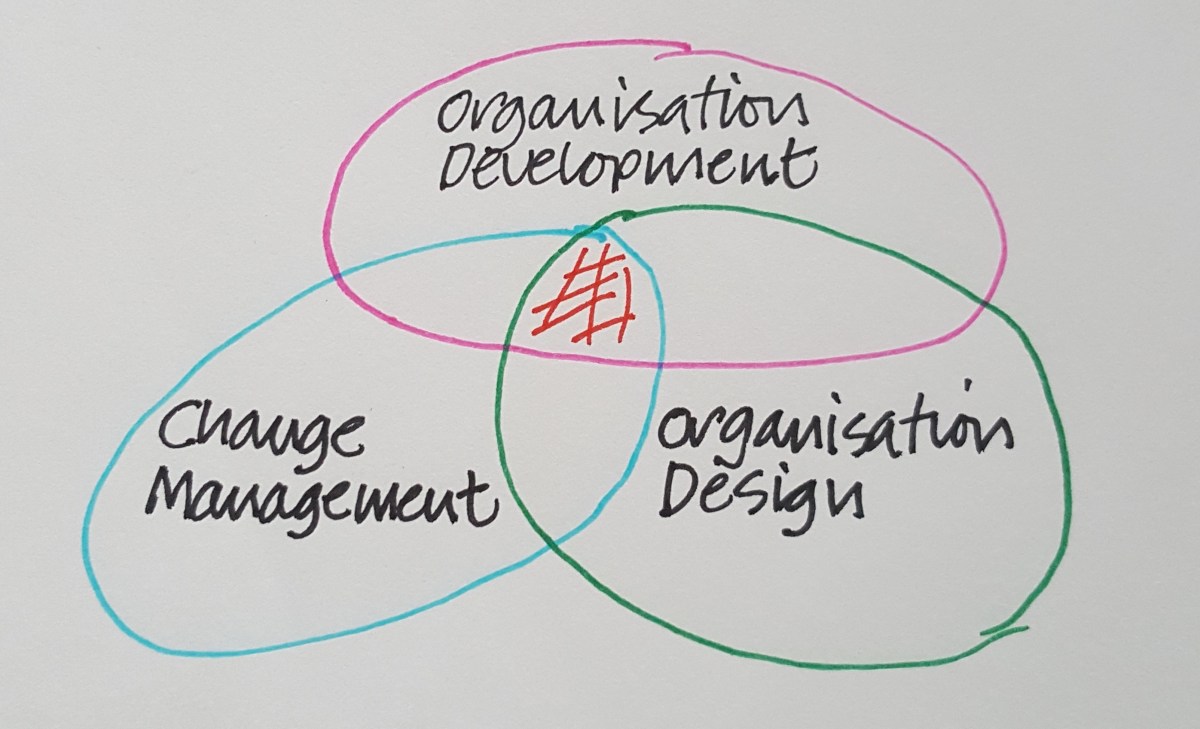
To simplify it a bit, consider a Venn diagram with three sets: ODV, CM, ODS. They intersect as follows: CM + ODV, ODV + ODS, ODS + CM, ODS + CM + ODV (See graphic).

This representation suggests that there is both overlap and distinction in elements of each of the sets. This makes it easier to talk about the three fields from numerous different angles e.g. discussing which theories intersect, where the same tool can be used by all three sets, what is only in one set. I can imagine a three-way discussion with a ‘true believer’ representing each one of the three sets debating with the two other ‘true believers’ on what belongs – theories, tools, approaches – in one set over another and where the common ground amongst the three sets is.

Thus, the Venn diagram representation both clarifies the scope of the three fields and brings some risks that commenters on the blog bring up (I’ve edited some of them a bit – I hope that’s ok).

Client risks

  • ‘The paradox in this debate is that the highlighting of differences between the fields helps each to understand better the other, but also raises the risk of each claiming supremacy over the other in a competition for the client’s affections.’ (Tony Nicholls)
  • A consultant may have deep expertise in only one of the sets but will be working with consultants with deep expertise in one or more of the other sets: ‘Can they explain their approaches to each other, can they accommodate differences – some of which might be quite fundamental in terms of values and even ethics – and can they present a combined account of themselves to the client which doesn’t feel self-involved but doesn’t gloss over important and potentially fertile differences?’ (Jonathan Potts)

Consultant risks

  • Unless leaders/catalysts/facilitators of change understand the philosophical differences – modernist vs post-modernist – that underpin ODV (particularly dialogic ODV) vs OCM v ODS, they can become tangled in these potentially complementary methods by combining them in incompatible ways: e.g. project planning an entire change journey at the outset, rather than using PM/OCM methods to help manage resources of highly emergent processes. (Tom Kenward)

Organisational risks

  • More often than not, ODV, CM, ODS fail to take seriously the underlying (complex social) dynamics of organization. So, for example, managers and practitioners often work on the basis that change and/or development only happens when ‘management’ says that it should; that, however defined, these are within the gift of managers/specialists to manage in planned and predictable ways; that, success can be assured, provided that people do the prescribed things ‘better’ and ‘get them right; and that, in determining what actually happens in relation to change and performance, it is the ‘big things’ that matter most (i.e. the plans, programmes and other structured interventions) rather than the everyday, self-organizing conversations and interactions through which organization is enacted moment to moment and ‘outcomes’ emerge in practice. (Chris Rodgers)
  • An either or reductionist approach only skates across the surface of what is happening in organisations (Emma Taylor).

If the Venn diagram works to explain to people that there are three distinct fields and that there are specialists in any one of them then it becomes easier to suggest that someone could be drawn to one of them over the others and could also make choices about whether their consulting would be ‘better’ if they were also familiar with the others.

This approach is supported by several people commenting on the blog. (I’m assuming their view on connecting ODV and CM would accommodate the integration of ODS with these two. If I’m wrong let me know).

  • ‘Maybe we should aspire to adopt an equally integrated OD people and CM systems [+ODS] approach rather than one being more dominant. (Sue Duncan)
  • I’ve worked closely with OCM professionals and when exposed to OD theory and practice the result is a coming together of the benefits of both fields that adds immeasurably to the overall effectiveness of change activities and general org health. (Tony Nicholls)
  • It is unfortunate that CM has become more tech focused and ODV more psych focused – I think it undervalues both fields. A skilled CMer must appreciate the human dynamics involved in change and be comfortable working with it. A skilled ODVer must be equally appreciative of and comfortable with the technical project delivery arena. (Glenn Jacob)

If you are wondering whether to develop or deepen skills in one of the three fields then Fred Nickols questions could help you think this through:

  • What kind of ODV/CM/ODS work do you do most of the time?
  • What kind is called for by the current situation?
  • What kind of ODV/CM/ODS work are you asked to do?
  • What kind of ODV/CM/ODS work are you really good at?
  • What kind of ODV/CM/ODS work do you want to do?
  • What kind of ODV/CM/ODS work do you get paid to do?
  • Which of the ODV/CM/ODS capabilities are you most comfortable applying?
  • Which of the ODV/CM/ODS capabilities are you the least comfortable applying?

NOTE: The Venn diagram distinctions and overlaps still may not sufficiently address Chris Rodgers point about the underlying social dynamics.

Do you think the Venn diagram is a helpful way of illustrating the ODV/CM/ODS fields? Let me know.


Change management or organization development

Sparked by a conversation this week on change managers v organisation development practitioners, and fanned into flames by my starting to write something on this topic for the revised edition of my book (see my Ship of Theseus blog) I thought I'd rough out my thinking here and seek feedback from readers.

What seems have happened is that 'change management' is now the territory of tech and project people, while 'organisation development' is getting further linked to behavioural sciences, neuro-stuff and the field of individual and group dynamics.

This view has some evidence. Take a look at http://www.indeed.co.uk a jobs vacancy site. Vacancies related to 'change management' are almost all in the tech and project management space. Here's a fairly typical one that mentions both projects and IT:

  • Purchasing are in the process of a significant transformation throughout the function on a global basis, and this transformation requires strong change management across several key projects. As the Change Coordinator, you'll be responsible for planning and managing business change projects into key Purchasing business groups, ensuring process and IT projects land successfully in the business.

Several of the roles I looked at require the ability to implement OCM. This is an acronym I had to look up. It turns out to be Organizational Change Management. The Californian Government IT Leadership Academy has a good set of resources around it although at a first glance they look pretty prescriptive as they are aimed to align the OCM lifecycle with the project lifecycle.

Prosci (a consulting company) explains the change/project management alignment link like this:

  • 'When an organization introduces a change with a project or initiative, that change needs to be effectively managed on both the technical side and the people side. A technical side focus ensures that the change is developed, designed and delivered effectively. The discipline of project management provides the structure, processes and tools to make this happen. A people side focus ensures that the change is embraced, adopted and utilized by the employees who have to do their jobs differently as a result of the project. The discipline of change management provides the structure, processes and tools to make this happen.' (You can download free a whitepaper explaining further).

This form of change management isn't the realm of typical organization development practice in my experience and I was reinforced in this view when I saw that the Change Activation Toolkit – also a comprehensive set of resources but you have to pay for it – says that it 'supports organizational development'.

So what do jobs for organization development practitioners look like? Here's an extract from one vacancy again fairly typical.

  • To assist in building the organisation's ability to perform and thrive in a fast-paced and unpredictable environment. Specific OD activities include: Organisational diagnosis, using Systems Theory and theories of organisational culture and strategy. Design and facilitate OD processes with teams at all levels in the organisation, relating to: organisational change, strategy, team development; conflict resolution, leader development, organisational culture and values.
  • This role requires undergraduate Organisational, Social or Clinical Psychology qualification (with in-depth knowledge of organisation behaviour, group dynamics, unconscious processes in organisational systems); Psychometric testing and 'quantitative 'tool kits' will not be used.

My hypothesis is that 'change management' is about supporting planned change that is delivered through a formal project – often a technology based one – so it has a defined scope while 'organisation development' is about 'the activities engaged in by stakeholders in order to build and maintain the health of an organization as a total system. It is characterized by a focus on behavioural processes and humanistic values. It seeks to develop problem solving ability and explore opportunities for growth'. (Finney and Jefkins, 2009). As such, OD's scope is much broader than that of change management. It is much more closely aligned with learning theories and behavioural/neuro sciences (as in the role description requirements above) and is much less formal and 'frameworked' in its techniques and delivery.

Mapping the difference between the two shows that they are distinct but overlapping. They are both people focused but beyond that:

  • OD scope is whole system v CM scope is defined by specific project/programme
  • OD based in behavioural sciences and learning theories v CM based on popular change models (e.g. Kotter, ADKAR, Lewin, Bridges, Kubler-Ross)
  • OD practitioners require process consulting skills v CM practitioners require project management skills
  • OD underpinned by humanistic values v CM underpinned by efficiency/effectiveness criteria
  • OD Practitioners developed against OD practice framework v CM practitioners developed against Change Manager competency model

What's your view on OD v change management? Let me know.

Elites and the establishment

A couple of weeks ago, the Economist ran a piece on 'elites'. The writer cautions "Careful writers should avoid this word; it is becoming a junk-bin concept used by different people to mean wildly different things."

It's the same with the phrase 'the establishment'. The Atlantic ran a similar piece to the Economist's saying, "Of course, 'the establishment' has no agreed-upon meaning."

Wikipedia currently defines 'the establishment' as, "a dominant group or elite that holds power or authority in a nation or organization." I like the fact that their definition of establishment includes the word 'elite' because now we may be able to agree that both words might be consigned to the junk bin. I can't think many people would self-define as being either part of an elite or 'the establishment' particularly as both words have been flung about wildly as pejoratives in recent politics. But I may be wrong on the self-identification thought.

I'm thinking about these words because at the same time as I read the Economist piece someone sent me a question: 'How do we understand what lies beyond the establishment view? To clarify – this is about how we understand views from across the spectrum rather than just those we are most commonly exposed to.'

Junking the words 'elite' and 'establishment' misses the point that the words also carry a meaning of 'power' or 'authority' and this to me is the heart of the question. Power comes in many forms and is not only about hierarchy, or social status or money. Gareth Morgan in Images of Organization lists 14 sources of power.

Suppose we take the stance that it is less about elites or establishments and more about how do people with power learn to listen to and understand points of view and perspectives different from their own. From what we've seen in the press recently we could get an impression that people with power do not want to understand what lies beyond their view.

A 2011 BBC documentary 'The British Establishment; Who For?' explores that concern. 'From the City, to the police, to the press, to Parliament, and in cultural institutions including the nation's universities and even the BBC, a narrow elite, drawn from the least-diverse backgrounds, make the rules, socialise, and define what is and is not permissible among the nation's leaders.'

But let's assume they do what to understand what lies beyond their view. Why would they want to and how would they get the understanding?

Why would they want to understand what lies beyond their view? John Stuart Mill, a British philosopher, writing On Liberty in 1869, reasoned that: 'there needs protection also against the tyranny of the prevailing opinion and feeling; against the tendency of society to impose, by other means than civil penalties, its own ideas and practices as rules of conduct on those who dissent from them; to fetter the development, and, if possible, prevent the formation, of any individuality not in harmony with its ways, and compel all characters to fashion themselves upon the model of its own.'

Research on dissent led by Charlan Nemeth at UC Berkeley finds in favour of 'the value of dissent for cognition and decision making. In general, we find that dissent stimulates thought that is broader, that takes in more information and that, on balance, leads to better decisions and more creative solutions'.

For communities and societies to advance there needs to be a healthy level of dissent combined with a humility and willingness to listen generously and openly in order to understand other perspectives and experiences, rather than holding on to a view and/or looking only for information and opinions that will confirm it.

How can you get an understanding of other views? There are many avenues to explore. Here are three possibilities:

1. Generous listening, Krista Tippett explains: "Generous listening is powered by curiosity, a virtue we can invite and nurture in ourselves to render it instinctive. It involves a kind of vulnerability – a willingness to be surprised, to let go of assumptions and take in ambiguity. The listener wants to understand the humanity behind the words of the other, and patiently summons one's own best self and one's own best words and questions."
2. Taking a learner rather than a judger perspective is another: Judger questions are reactive and automatic, leading to defensiveness, win-lose relating, and a view of limited possibilities. Learner questions are flexible and adaptive, leading to questioning assumptions, win-win relating, and a view of plentiful possibilities. See the Inquiry Institute for information and resources
3. Inquiry and immersion: going to ask questions and immerse yourself in the world of those you are trying to understand. "Back to the floor' a TV series challenged the top executives [of large UK companies] to leave their rarefied position of power to spend a week at the sharp end of their business. Rude awakenings await the bosses as they get a taste of the frustrations, grievances and humour of working on on their own frontline."

How would you suggest 'the establishment' and those with power learn to understand other perspectives. Let me know.

Compassion

Each day I get an email from Gratefulness.org giving me a quote on a reason to be grateful I can't remember when or why I signed up for them but I enjoy them and often they have some linkage to whatever I happen to be working on.

A few days ago, (21 December) Gratefulness.org invited readers to 'rededicate ourselves to our vision of a peaceful, thriving, and sustainable world … One way we can do this is with practices which connect us to our core values, reminding us to live them – as best we can – in all areas of our lives. In this spirit, we invite you to join us this holiday season in lighting candles for 12 days to illuminate our individual and collective connection to the values of Grateful Living.'

Curious, I looked at the list of the 12 values. December 23 was 'compassion' which piqued my interest. It's a word, or maybe even a value, I've noticed that is creeping into organisational usage.

Huffington Post, for example, offers us 10 Principles for Designing a Mindful and Compassionate Organization. They are all laudable principles. You can't really argue with 'Use Constraints Appropriately: Whether explicit or implicit, organizational policies (design principles, meeting protocols, governance procedures, etc.) should be a help, not a hindrance.' But perhaps easier to say than to do.

Greater Good has developed a quiz to help you diagnose whether you work in a compassionate organisation That struck me as odd. If you are in a compassionate organisation wouldn't you know it without taking a quiz to find out? However, I then guessed that it might be less for the individual employee and more for the researchers to aggregate the data and discover whether there are any patterns or trends in organisational compassion. As they say, 'A new field of research is suggesting that when organizations promote an ethic of compassion rather than a culture of stress, they may not only see a happier workplace but also an improved bottom line.'

This 'new field of research' is gaining ground. Harvard Business Review, in an article Why Compassion Is a Better Managerial Tactic than Toughness (May 2015) links readers to several studies all suggesting (with some variations on what 'compassionate' means) that 'The more compassionate response will get you more powerful results'.

In an earlier (2004) article, Compassion in Organisational Life, University of Michigan researchers explore compassion in organizations. They 'discuss the prevalence and costs of pain in organizational life, and identify compassion as an important process that can occur in response to suffering. At the individual level, compassion takes place through three sub-processes: noticing another's pain, experiencing an emotional reaction to the pain, and acting in response to the pain.

The authors build on this framework to argue that 'organizational compassion exists when members of a system collectively notice, feel, and respond to pain experienced by members of that system. These processes become collective as features of an organization's context legitimate them within the organization, propagate them among organizational members, and coordinate them across individuals.'

In a beautifully understated and cautiously academic way they too find that compassionate organisations bring overall individual and collective benefits, among them 'we expect that developing a capacity for the processes of organizational compassion is likely to increase, rather than reduce, an organization's resilience.'

For organisations worried about bullying, harassment, well-being, stress, staff turnover, and other symptoms of individual and collective distress, fostering and enabling individual and collective compassion in organisations would be helpful. (Even without these symptoms compassion is a value worth nurturing).

If you're wondering how to nurture compassion in yourself or your organisation take a look at the Charter for Compassion's tool kit. It's designed to build compassionate communities and you can see the list of participating cities who have committed to building them. Another learning path is offered by Stanford's Medical School Center for Compassion and Altruism Research and Training who offer an 8-week training and also a downloadable e-book that gives preliminary background reading.

Do you think compassion is an organisational value worth fostering? Let me know.