Why organisation design matters

Design matters

This is the last of my blogs relating to the forthcoming third edition of my book “Guide to Organisation Design,”.  This morning, 31 May, I sent the entire book off to the publisher.  It will be published on March 3 2022.  I’ve still a bit to do – reading the proofs, choosing the cover design, thinking of a sub-title, but none of this right now:  it’s handed over!  This week’s blog is the foreword.  Each of my review/advice/suggestions group talking about ‘Why organisation design matters’.

Foreword

Each of the five organisation designers who worked with me to shepherd this book from start to completion, believe, as I do, that organisation design matters. 

Why they believe this, they explain in the paragraphs below. 

Jim Shillady: Occasionally organisations succeed by chance.  But, in general, success comes from thinking explicitly about what to do, why, and how – and then doing it.  Organisation design’s value has been in orchestrating that thinking process.  Yet until recently it has mainly had to tackle complicated rather than complex problems – essentially those requiring novel technical solutions rather than true innovation.

Now organisation design is evolving to take on complexity – challenges that are new in themselves, that are of great significance to people and the planet, and that emerge and interact in surprising, often alarming, ways.  In its contemporary form, organisation design matters more than ever; it answers tougher questions, involves participants more frankly and demands more of them, and values action over order. Arguably, no other discipline has such power to help people and their leaders confront new realities and create enterprises fit for a turbulent world.  

Rani Salman: The bridge connecting strategy to execution comes in the form of organisation design.  Misaligned operating models and poorly designed organisations are notorious for strategic failure.  Organisation culture can shatter the most ambitious and accurately developed strategies.  Making sound design decision can shape a supportive culture and mitigate the risk of strategy failure.

These decisions are not always easy to make, especially in a landscape where organisations have become more interconnected and complex.  Compounding the complexity is a never-ending array of dynamic choices that bring with them tensions, difficulty, and consequences both intended and unintended.  However, with a focused approach and a unique mixture of science and art, the design process can be challenging yet rewarding and culminate in organisations capable of high performance.

Most importantly, organisation design matters because it runs deep and touches the human experience and psyche, impacting people in profound ways that often transcend their organisational experiences.

Fiona McLean:   Organisation design matters because it urges us to put our human selves at the centre of our efforts. It offers us the possibility to think of organisations in different ways where we can see an organisation as a body of bodies, where our governance and processes are less bound by hierarchy, more inclusive, more transparent, where no voice is unheard.  Where decision making and information flows smoothly from strategy to design and back around in a dynamic feedback loop of human interaction moving strategy into action.  Where social interaction and conversation is valued as much as formal planning and where the essence of those social interactions act like a strong pair of lungs transferring life giving oxygen into the system for vitality, in order to create the conditions for continuous design.

Giles Slinger:  Organisation Design matters because it shapes people’s experience of work and whether an organisation can deliver to its customers.  In a perfect world, organisations would sense the need for change and would adapt continuously from one stage to the next. But our reality is never perfect. Organisations face a never-ending challenge of balancing continuity (supply) and change (demand). Continuity can be efficient, and human brains love routines, so organisations would by default supply ‘the same as before.’ At the same time, people value change – they value things that are new and better, so organisations must adapt to this demand. Happily, humans also have a restless curiosity, such a capacity to wonder and invent that supply can effectively be unlimited in meeting new demands. The challenge is moving organisations of such wonderful humans from one stage to another fairly, efficiently and quickly. Organisation design helps gather the evidence, helps develop the options, helps find the agreement and helps deliver the transition, on to the next stage.

Milan Guenther: Companies, institutions and other organisations run those endeavours that enable human action at scale. They bring together teams and their ambitions, resources and ways to use them, products and people’s needs: to be successful as an enterprise, they have to be designed to build relationships and enable dynamics that constitute successful outcomes. 

Responding to big challenges requires organisations designed to be fit for purpose, to perform and deliver. This applies to a disruptive start-up just as much as to a large corporation, or a public health effort such as a vaccine rollout.

So how do you design successful organisations? You can design business models, information systems and operational processes, product and service portfolios, or team responsibilities and collaboration. Going beyond optimising these individual elements, purposeful organisation design will help you understand how they can be organised coherently as a system, and how to reshape their interplay to bring about a desired future. Designing organisations well matters.

Why do you think organisation design matters?  Let me know.

Organisation design book: the prelims

foreword.preface.intro

Continuing the alternate week pattern of posting extracts from the forthcoming third edition of my book “Guide to Organisation Design,” this week’s extract is the start of the prelims, together with some musing on them.

To my joy and some surprise, it looks as if I’m going to get the third edition of the book into the publisher by the contracted submission date – 31 May 2021, which is due to be published March 2022.

The nine chapters are written and this week I’ve been reviewing them, tidying them up, and looking out for obviously dotty or incorrect writing. Fortunately, someone else is going to do the detailed editing: checking the spacing after a full stop, making the headings and sub-headings consistent, confirming that the words in bold (that are explained in the glossary) are actually in the glossary, ensuring references are correctly cited and not a mish-mash of different citation styles, etc.

Now the time has come to write some of what the publisher calls the ‘Prelims’, including acknowledgements, foreword, preface and introduction.  The second edition only has acknowledgements and preface – but this time there’s definitely going to be a foreword, and I’m wondering whether there needs to be an introduction too.

In search of guidance on whether I needed an introduction I found some firm words: ‘the foreword, a preface, and an introduction are three separate and very important elements that appear in the front pages of books, and they each have their own specific functions. The roles of these pieces are often confused.’  

  • A foreword is written by someone other than the author and tells the readers why they should read the book.
  • A preface is written by the author and tells readers how and why the book came into being.
  • An introduction introduces readers to the main topics of the manuscript and prepares readers for what they can expect.

Last week, I invited the review/improvement group, who are supporting me with the book,  to write a para each for the foreword. All five have gamely agreed and we discussed what they would/could say in our bi-weekly meeting.  This ranged from developing an org design Manifesto, to views on what we would like organisations to be and not be e.g. to be open, fair, just, and onwards into what organisations we wouldn’t want to design for and the value of developing design criteria.  We seemed on the verge of heading towards the Mark Twain quote ‘I didn’t have time to write a short letter, so I wrote a long one instead’ and reined ourselves back in.

The upshot of this is that all five will each write around 150 words stating ‘why organisation design matters’ (and, by implication why you should read the book). 

This leaves me with the preface and the decision on whether or not to write an introduction. One of the two may be nixed by the editor who is getting antsy about the book’s word count. However, I’ll give the preface a go and see if I can slip the introduction into it – ignoring the firm words about their different and specific functions.   Here’s my first shot at the preface. 

Preface  

I promised my family that I would not write another book. They want to see more of me than my back facing the computer.  They had already supported me through my PhD and several books.  When invited to do so, in mid-2019, I refused to write a third edition of this book. Then I changed my mind. 

The trigger for this was the start of the coronavirus pandemic – around February 2020 – which rapidly ramped up into lockdowns, remote working, and an extended and shared vocabulary that was evolving at hyper-speed and quickly becoming a core part of the language.

 Oxford Languages was unable to suggest a single word of the year for 2020, instead issuing a report ‘2020:  words of an unprecedented year’. The words were not just those spawned by the coronavirus pandemic but those new to technology and remote working, the environment, social movements and social media and, politics and economics.

What, became obvious and clear to me was that this unprecedented year was going to have a profound impact on organisations and the way we thought about them, worked in them, and designed them. I thought it would be fascinating to revise the second edition in the light of what I was experiencing, observing and getting to grips with.  

This has proved to be the case. We are thinking differently about organisations and the way we work in them and it has been a fascinating journey of reflection, discussion, learning, challenge, signal detection, pattern recognition and meaning-making. 

This third edition is has some very different content from the second edition, including a new chapter on continuous design. Almost new chapters are those on leaders and design, and designing culture. And there are major revisions of all the other chapters. Throughout, the examples and cases are new and the impact of the pandemic is threaded through.

However, writing this third edition is not simply a swift reaction to an unprecedented year. It draws on both my three-plus decades in the field of organisation design and the things I’ve been talking about and urging for over the past 7 years. 

The coronavirus pandemic has served to throw into sharp relief my strongly held beliefs that organisations that are continuously designed to be human centred, good places to work, well-led by ethical and curious leaders who are purpose and outcomes driven, will be better able to weather the changing contexts than organisations that focus on hierarchies, structure, procedures, targets and objectives.

The coming years will see the ripple effects of the pandemic, and I am reminded now of fiction writer, Kim Stanley Robinson’s quote, ‘We have come a long way. We have a long way to go. In between we are somewhere.’  We are at the somewhere between traditional, hierarchical command and control organisations and organisational forms that we have not yet seen come into the mainstream. 

If organisations are designed to become flatter, foster respect and autonomy, promote equal opportunity, equal treatment and equal outcomes and if, at the same time, organisational leaders and other stakeholders design with the recognition of our interdependence, fragility and vulnerability, and of the impact of our current lifestyles on our environment then the learning from the pandemic will show it is being applied.  

In writing this third edition I am hoping that leaders and managers, in their capacity of organisation designers (which they are whether they recognise it or not) will find value in learning more about their role in designing organisations and putting that learning into practice. This book gives them the information, methods, examples, case studies and tools that will help them do so.  

Image: https://www.thebookrefinery.com/planning/foreword-preface-and-introduction-what-they-are-and-where-they-are-put-in-your-book/

Organisation design book: progress review 2

progress review

Regular progress reviews are something I advocate in organisation design work.  Applying this advocacy to myself, this week’s blog is the second progress report on the writing of the third edition of Guide to Organisation Design. I wrote the first progress report 9 weeks ago.  As last time, I’ve used a simple template ABCD that I use on projects – usually as weekly report. But today’s is a longer time frame, covering the 10 weeks from then.

Achieved

All 9 chapters are completed in the first go-round and have been submitted to the publisher’s content editor for comments.  She’s sent back 8/9 and I’ve spent the last 2 weeks re-writing chapters 1-8 to reflect her comments and the comments of my splendid review/improvement team. 

Several of her comments are about the jargon of it all.  It’s a salutary process as I try think of a way of explaining ‘leverage points’, and ‘content moderator’, and ‘open-source code’ and ‘jump the s curve’, and many others, in simpler terms.  Originally, I thought a glossary might be redundant.  Now it seems essential.  A couple of people reviewing the whole book are going to highlight the words and phrases they think should be in the glossary, and I’m doing the same.

This language hurdle does raise the question, ‘Do organisation design practitioners confuse potential clients with difficult language?’  

We’ve achieved a blog contribution from each of the 5 review/improvement group members. (Thank you for this).   The way it’s worked is that I post a chapter extract one week and the following week one of the group writes a blog on the topic.  Seeing the different takes, writing styles, and then reader comments on their blogs is lovely (and I enjoy taking a blog-break!)

It’s felt a bit like a book club – we all read the book/chapter and then discuss it and then someone writes about it.

It’s another all-group achievement that the bi-weekly meetings have continued past the point of the final chapter being written.   It’s turned into a form of action learning group.

Another achievement is that the book is not a ‘how to’ guide.  It probes and challenges thinking about organisation design and its inherent tensions, complexities and possibilities.  Nevertheless, it has practical tools, ideas to try out and examples of where things have and haven’t worked.  (The content editor rejects the word ‘things’ which has also caused me some searches of synonyms and several moments of displacement activity while I ponder an alternative).

Benefits

What benefits have been realised over the last 10 weeks?  (Ed: please explain what you mean by realised.)   Well, I guess there have been benefits – is it ok to say that one of the benefits of having written the full 9 chapters is that I can see the book publication in sight and thus some time released for me to do other things than, as my dearly beloved says, ‘hunch over the computer’. 

Also, I have got a treasure trove of new resources – articles, references, contacts, insights, and fresh thinking as I’ve worked with people on the book.   Many of them are now nestled in the rewritten first draft, which I think is much improved over the first draft.  (I’m awaiting editor’s comments on this last point).   

And I’ve developed my knowledge and thinking on systems and complexity.  I came across a very good, free. Open University, downloadable course that is a good intro for people who want to dip their toes in the systems water.  And on complexity – just to show you the complexity of it – the wonderful complexity sciences map by Brian Castellani.  Looking at that, I did pause to wonder if I needed to challenge my thinking that the complexity sciences are dominated by white western men.   (I think not!)

One of the group, Jim Shillady, did a quick analysis of the LinkedIn ‘likes’ on the blogs so far.  He’s observed that the audience have been most/more interested in the pieces on ‘What is OD?’, on structure, on alignment, and on systems.  He says, ‘It feels as though the focus of their concern (or puzzlement) is still on how to deal with complexity, dimensions, interconnections and the like. They seem to want to comprehend frameworks before they can think about behaviour and important, but fuzzy, notions such as values’.   The book is organised in that order so hopefully will benefit the readers.

Concerns

It isn’t exactly a concern, but the scope of the book came under discussion,  triggered by a conversation I had with a couple of Equality, Diversity, Inclusion (EDI) researchers who were asking is it possible to design EDI into organisations.

I touch on EDI in the book but doesn’t explore it in any depth.    (My view is that the three things –  E,  D,  I –  are not amenable to being lumped together and need very different design approaches). I wondered if I had sufficiently acknowledged it, as it is a topic on almost everyone’s agenda right now. 

Which led to another discussion on fads – is EDI a current fad? Is hybrid working?  What is the role of organisation design in responding to ‘hot topics’ like these?  One of my books had a chapter on trends and fads, and I’ve written several blogs on them. Given the book has to be current for a few years the concern is to make it so and not fall for what might be a bandwagon.  

Sidenote on hybrid working:  I am joining a panel discussion on this on 27 May, 09:15 if you would like to register.

Do next week

The list is long for doing by 31 May.  There are the detail things – not my forte.    The glossary will take time.  I also have the detail of checking every reference and citing it correctly.  Then there’s the permissions I have to get for various graphics and images – this can be a difficult, long-drawn out process, and I hope I haven’t left it too late – some organisations want to charge for giving permission.  I have to get all the figures and tables out of the draft and into separate files, correctly numbered and referenced. 

Then there are the publicity things –  I must invite some people to provide back cover endorsements for the book.  And think about how to launch the book. (First step find out publication date).

Finally, there’s what are called the ‘prelims’ to write – acknowledgements, foreword, preface, and so on. And I mustn’t forget I still have to do the next go-round of chapter 9.

Closer to the time there’ll be the book sub-title and jacket to consider – then I’ll really feel the end of the process is in sight.   I wonder if I’ll stick to the ‘never again’ statement I made so firmly after the second edition?

Image: https://knowyourteam.com/blog/2019/02/15/should-you-use-an-employee-performance-improvement-plan-pip/

Who leads on culture? Four stories

Week 18.culture

Last week I posted an extract taken from Chapter 9, Culture,  from the forthcoming third edition of my book “Guide to Organisation Design,”.  The group I am working with discussed the chapter, raising the question – who leads on culture? Rani Salman, one of the group, has picked up on this in his guest blog below.  Many thanks to Rani.

The Battle of Santiago

The year was 1962, the “beautiful game’s” peak moment had arrived centre stage, as football’s highly anticipated World Cup was being hosted in one of the most southern points on earth- Chile.  

One of the favourites to win it all was Brazil, led by Edson Arantes do Nascimento, better known as Pelé; a maestro on the pitch, and who many argue is the greatest player to ever play the game.  The Brazilians collectively knew that having a cohesive and high performing culture, especially, in such a tense environment was paramount to the success of the team. The prevailing view was that Pelé’s brilliance and star power on the pitch underscored by the 77 goals he scored, was the driving force of leadership on the team that truly shaped Brazil’s winning culture.

However, surprisingly, Pelé was never made captain of the team nor did he ever lobby for it.  The team’s captain was little known Hilderaldo Bellini, a gritty and humble central defender who, during a nine-year stint, never scored one single goal.  While Pelé attended to the pressures of the spotlight and was the face of Brazilian football, Bellini took care of the daily, hourly grunt work of unifying the team and building their winning culture. He cleaned up their mistakes with his fearless defence, often leaving the pitch bruised and bloodied, and calmly urged them forward when their confidence sagged (Bellini).  His job wasn’t to dazzle on the field but to labour in the shadows of the stars, to carry water for the team, to lead from the back.  

Brazil eventually won the 1962 World Cup in spectacular fashion, and in an iconic moment, Bellini raised the trophy emphatically above his head, an extravagant gesture for the time (Trophy Lifting).  Maybe the unassuming defender was finally soaking in the glory of his role; the unsung hero, a backstage leader, a cultural firebrand, who many of his peers dubbed as the real foundation of the team’s winning football culture.      

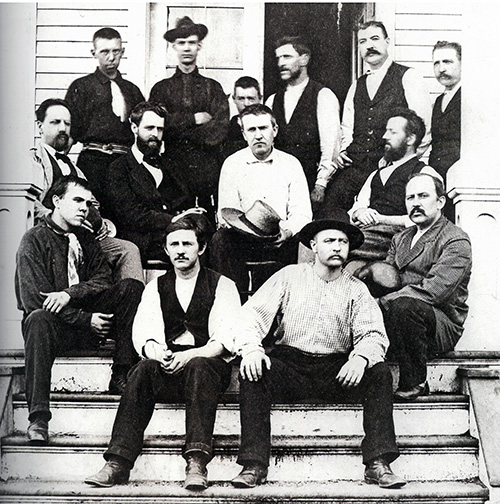
The Lonely Wizard of Menlo Park

Thomas Edison is one of the greatest innovators of our time.  He was often referred to as the lonely “Wizard of Menlo Park” tinkering alone arduously in his lab into the late night, cranking out invention after invention with his tireless brilliant mind.  He produced 1,093 patents and a trove of creations that helped shape modern history, such as the light bulb, phonograph, and motion picture camera.

He is also credited for cultivating one of the most powerful and iconic innovation cultures at the world renowned “Invention Factory” located in Menlo Park, New Jersey (Menlo Park).  A location, which many claimed fathered the birth of modern-day start-up culture and powered the rise of innovation.  His famous line of “I haven’t failed, I just found 10,000 ways that won’t work,” encapsulates the mindset and behaviours that formed such a unique culture, where inventions like the talking doll, electrical pen, cement, and vote recorder took off.  

However, the essence of innovation culture at the Factory was not all down to Edison. It really stemmed from a small group of skilled technicians and craftsmen dubbed the “Muckers.”  These gifted young men travelled across the US and Europe, to join forces with Edison (The Muckers).  They were responsible for testing, experimenting, and iterating many of the ideas and are often considered the real magic, fabric and lifeblood of innovation at Menlo Park.  If “genius is 1 percent inspiration and 99 percent perspiration,” as Edison famously says, then the Muckers should be credited for the 99%.

Sledgehammering Your Way to Cultural Change?

Formal leaders’ role modelling of targeted behaviours and their symbolic acts are a crucial ingredient to any cultural change effort.  The sight of Zhang Rumin, CEO of Haier, brutally smashing 76 fridges with a sledgehammer, brought employees to tears.  But, the message was loud and clear, the need to have all employees driving production of high quality products in a high quality cuture.  The act of sledgehammer symbolism initiated Haier’s quality culture, elevating it to a 16-billion-dollar business (Haier Article).  The sledgehammer is now on display in the permanent collection of the Chinese National Museum in Beijing.     

A FedEx story

FedEx, the logistics company known for its on-time delivery and which had a slogan of “The World On Time,” uses powerful stories and imagery to drive behavioural change, some of which has become company folklore.     

As company legend has it, early in the 1970’s one of the company’s drivers was out late one snowy night in the hinterlands of the Midwest to check a drop-off box for any packages. Only, when he got to the box, the lock was frozen solid and the key broke off in the lock. After trying in vain to reach the packages inside, the driver finally made the decision to drive to a nearby auto garage where he borrowed a blowtorch, which he then used to cut the legs off the box. The driver then put the box into his truck and delivered it to the airport where a maintenance team was able to drill it open, remove the packages inside and get them on the plane to their final destination “On Time.” 

You can’t find many things more powerful to communicating and shaping FedEx’s culture than this timeless and engrained story.

Navigating through cultural change

Cultural change, evolves through multiple routes:  symbols, leadership role modelling, systems, processes, structure, and others (Cultural Web).  Ultimately, if you want to change an organisation’s culture use a mix of interventions, choosing those that you think will have the most impact for your organization and its current context, while focusing on a critical few behaviours at a time.

If you can make real behavioural change happen then you are on the way to cultural change.  Yes, there are many other elements that constitute/influence culture (both internal and external) and those include values, mindsets, beliefs, attitudes, perceptions, etc. But at the end of the day, behaviours are observable, and typically managing and acting on something that can be seen and measured is a better way to make an impact.

Symbolic actions serve to set the stage for what is required, but they are insufficient.  People are more likely to change behaviours, in an organization, by seeing others, and by copying behaviours of their colleagues and peers, especially those they have strong relationships with or admire. 

This is where the role of influencers and informal leaders (such as the Muckers and Bellini’s of this world) come into play- informal leaders’ cross organizational boundaries and come with some form of power – social, information, personal. Identifying and working with the informal leaders enables a more scalable and viral spread of the behaviours targeted.

In fact, cultural influencers can have close to 60-70% more reach than formal leaders have in an organization with frontline staff (Influencers and Culture).  These individuals can often be the real cultural leaders of any organization, thus identifying, leveraging, and engaging informal leaders and influencers to propel change (although not always at the top of the agenda in a cultural change effort), can often prove to have the most impact. 

Image: https://counterpointsarts.org.uk/about/core-beliefs/

Designing organisational culture

Continuing the alternate week pattern of posting chapter extracts from the forthcoming third edition of my book “Guide to Organisation Design,” this week’s extract is an edited section taken from Chapter 9, Designing Culture.  Next week will be a discussion related to this chapter.

Designing organisational culture is difficult as it is in constant movement by virtue of random human interactions.  These interactions are embedded simultaneously in, not one but three key, cultural contexts, each with their own artifacts, espoused values and tacit assumptions related to:

  • A national culture
  • An occupational culture e.g. accountancy or software development which can be internal/external or both
  • A social culture e.g. a shared interest group or a friends’ network which can be internal/external or both

The way in which these interactions occur, and the extent to which they can and cannot be shaped are significant factors in an organisation’s culture.  

National culture

Partick Collison, co-founder, Stripe, mentions three aspects of his Irish background and Irish culture that shape his thinking on Stripe and its culture:

  • Ireland is very outward looking
  • Ireland has had very high rates of immigration
  • Irish culture places a lot of importance on just a kind of warmth

In Collison’s statements the three levels of culture, described by Edgar Schein, are evident – here showing at a national level.  The artifacts i.e. systems and processes that allow for high rates of immigration.  The espoused values that globalisation and open borders are good. And the tacit assumptions around warmth, interpersonal dynamics and helping people feel at ease.

Many other aspects of national culture shape organisational culture – language is one.  2020 – the year of Covid-19 brought an influx of new words indicating dramatic cultural shifts. Oxford Languages, customarily produces a ‘word of the year’, but for 2020 was unable to do that, instead producing a report with tens of new words.

These national societal changes reflected in language use were matched in organisation design work by the need, for example, at the artifact level to develop remote working policies and protocols, and learn how to manage fluctuating workforce numbers as employees had to self-isolate or caught Covid-19.  At the espoused values level many employers developed wide ranging health and well-being programmes to help staff manage their lives.  And at the tacit assumptions level workforce members unconscious attitudes to contagion had to be factored into workplace design and working practices as people returned to face-to-face working.

National politics is another external cultural factor that impacts the culture of organisations.  For example, in 2021 China’s tech firms reportedly started testing software that allows them to continue to track iPhone users in spite of Apple’s iOS 14 privacy update which forbade apps from gathering user data unless they had been granted explicit consent to be tracked.   In this example the artifacts of tracking and tracking ‘ownership’ are evident, as are the espoused values on whether or not tracking should be allowed – in this instance a national government at odds with a tech company, and the multiple and varied tacit assumptions around tracking are all in play.  

Looking at cultural factors in the external context that help shape an organisation’s culture highlight the difficulties of making good on a statement ‘we must change our organisation’s culture’.   Organisation culture change (redesign) is always subject to uncontrollable factors in its external context.

Occupational culture

Within most organisations there are groups of people from similar disciplines. Often, they identify as belonging to a ‘job family’ i.e. a grouping of jobs related by common role content, that requires similar knowledge, skills and abilities.  Typically, the job family will have a fairly clear career path and pay structure, that differs from that of another job family. 

One example of occupational cultures comes from a report Culture First: how marketing effectiveness works in practice[1] that talks about the corrosive silos between marketing, financial and commercial colleagues, giving several reasons for this, including use of marketing terminology that is not easily understood by other disciplines and competing interests and objectives between disciplines, for example on decisions related to marketing investment.  The artifacts exist in the language of marketing and the systems and processes of it, the espoused values of all three disciplines discussed included good customer service, and the tacit assumptions revolved around what good customer service meant in practice, how good investment decisions are made, where good investment lies, and how language use served to stoke difficulties.   

Social culture

The informal networks of connections among employees create culture.  Over time it becomes a complex system of shared beliefs and behaviours, continually evolving to reflect the organization’s shared experience.  These connections cut across national and occupational networks, extending into shared interests or simply friendships. 

As an example, many organisations have running groups. These organisational interest groups not only meet face to face, in the running example, for training and group runs, but also meet on Slack or Teams, Whats App or similar channels, using the organisational and social media technologies to help build the network and the community camaraderie.

Additionally, many of the runners competing under their organisation’s banner are also runners in their local communities – belonging to clubs and groups there, thus extending the community of interest outside the organisation. 

Specific shared interest groups are not the only form of creating organisational culture creation, there are people who simply become friends through chance encounters at work. In whatever way the interactions form and evolve the informal networks created from these interactions have a profound, but often overlooked, influence on organisational culture.  Again, these networks extend out of the organisation and into the external world and from the external world into the organisation.

The pandemic impacted roles that were previously workplace based but then moved to remote working.  Employees in this situation found they had to rapidly adapt to the new mode.  Without the ability to interface, network, schmooze and even chat idly about the weather, many started to feel adrift during this period of indefinite remote working, especially at larger companies with more diffuse networks or if they were new joiners to the organisation.

With the knowledge that remote working was feasible for many and did not negatively impact productivity, came suggestions that a hybrid working patterns would become common, with employees working from home a percentage of their time and in a workplace a percentage of their time.   Related to hybrid working patterns came challenges to traditional 09:00 – 17:00 set hours contracts – the prevailing view being that contracts should focus on agreed outcomes the role and not on hours worked.

Covid-19 adaptations impacted not only office-based roles, but also proximity-based roles, for example in roles with on-site customer interaction e.g. retail stores, banks, and post offices, medical care, personal care, leisure, travel, and hospitality/food service.  Many of these roles are being transformed by automating aspects of them, in order to reduce proximity and workplace density. 

Changes to working practices, on the pandemic induced scale, affect social interactions and informal networks at the artifact, espoused values, and tacit assumptions levels. 

Covid-19 impacted many of the artifacts of social interaction as face to face, sometimes random, and sometimes planned real time social interactions transformed to virtual and often asynchronous forums for meeting.  This had both positive and negative effects. 

Positively, people were able to extend their networks, develop new friendships and participate in communities on-line.  Negatively, where meet-ups were face to face they were constrained by social distancing and face mask wearing, the latter causing particular difficulties in picking up the social cues of facial expressions, lip reading, and hearing speech clearly.  

These shifts in the artifacts of social context have organisational design and culture consequences.


[1] https://www.cimaglobal.com/Documents/Research%20and%20Insight/Culture-First-Final.pdf

Image: Source unknown.

Leadership in organisation design

Organizational Leadership Blog Thumb

Last week I posted an extract from Chapter 8, Leadership,  from the forthcoming third edition of my book “Guide to Organisation Design,”.  The group I am working with discussed the chapter, raising the question – can you design organisations to foster the type of leadership needed now?  Jim Shillady, one of the group, has picked up on this in his guest blog below.  Many thanks to Jim.

————-

Today’s organisations are moving away from a seemingly stable and rigid simplicity towards an evolving, more purpose-driven complexity.  And leaders are being judged on more than pure business outcomes – for example, on sustainable development goals, inclusion and diversity, and the values associated with their company’s brand.  Indeed, their success in achieving results is increasingly seen as a consequence of their ability to adopt broader roles and develop new behaviours, not just to drive directly for performance. 

Part of this shift is summed up by Michael Lurie, McKinsey, who talks about the leader as visionary, architect, catalysts, and coach.  He calls for a new approach to leadership that, “must focus on co-creating meaningful value with and for all stakeholders, expanding beyond shareholders to include customers, employees, partners and our broader society”.    And, in another recent McKinsey article, Carolyn Dewar and others build on this idea of a new role and exhort CEOs to, “elevate ‘to be’ to the same level as ‘to do’”.  In other words, behaviour now matters in leadership’s success.

Realising this, organisations have created competency frameworks and behavioural definitions to guide leadership’s development and ways of acting and deciding.  But, against that background, the idea has also emerged that context has a profound impact on behaviour; the turn of events can suddenly render some existing behaviours irrelevant and call for others that weren’t foreseen.  We need look no further than the Coronavirus pandemic.  Leaders were forced to do what the external context demanded and did it best when it recognised what the internal context, the people they lead, could accept. Not all succeeded in doing it well.

Then, just as leaders are wrestling with behaviour and the pressures of a changing context, new findings emerge about what it takes for leaders to develop.  It turns out that 70% of what leaders learn comes from “challenging experiences and assignments” and only 10% from formal learning, with the remaining 20% from coaching and mentoring. (The Center for Creative Leadership expands on this).  Standardised leadership programmes have a strictly bounded impact; the learning that leads to behaviour change comes mainly from personal growth, gained through experience.  And not just by passive acquisition, but through active learning and a commitment to personal change.  (David Lancefield captures some of this shift in his article)

In sum, it seems ‘design for leadership’ may need to reflect at least three big current ideas – that leadership success demands behaviour change, that context shapes behaviour, and that experience shapes learning.  These need to be joined with a truly rigorous approach to formal leadership systems that avoids the illusion of rationality while achieving the right degree of planning and control.  So, what kinds of organisational design features might reflect these ideas and increase contemporary leadership success?

First, leaders need to know how they are doing in terms of their behaviour and its impact on others.  They need system designs to provide them with information for reflection, insight, and response – information that should ideally be offered in the same positive spirit with which leaders ought to receive it.  Which means that people throughout the organisation have to be equipped to give and receive feedback appropriately. And it takes the discipline of declared values (another design element) to provide a touchstone; leaders cannot simply react to what they hear in an attempt to keep everyone happy. 

Next, they require the means to make sense of their context – external, organisational, and personal – and to weigh up how it may affect how they behave and how far they will choose to let it.  (If you can, access Professor Gary John’s paper, “The Essential Impact of Context on Organizational Behavior” for some real insights into how context actually works and how it changes the forces acting on leaders.)  This is not simply a question of designing ‘environmental scanning’ systems to detect trends and likely events.  Rather, leaders need help and tools to work out what changes in behaviour – for example in risk tolerance or speed of decision making – they must come to terms with or achieve.

If leaders are to make sense of what’s around them, it cannot be left to chance.  Building on the 70/20/10 principle, leadership development can be designed to provide explicit support for learning from experience, coaching to offer a sounding board, and training in the methods and frameworks for analysis.  Not many senior people get this kind of help and even those that do may not all be able to make the desired change.  Effective organisational leadership can only be assured long-term by talent management that’s designed to identify those with the potential and the willingness to grow.  (At the limit, the gulf between effective leadership in traditional and contemporary organisations can be too big for some individuals to bridge.)

Then there is the issue of balancing responsiveness with authoritativeness.  Employees, particularly at times of stress, now want leaders to display distinctly humanising characteristics like vulnerability, authenticity, and empathy.  But they demand the reassurance of leaders who are decisive too.  This tension might be resolved through leadership processes designed to signal when certain ways of being and behaving are most appropriate – for example, emphasising logic when choosing between limited strategic options, but prioritising human values in innovation and exploring new ideas.

Whether traditional or contemporary, organisations have to deliver and it remains the job of leaders to ensure that they do.  But we are abandoning the idea of the performance driven leader (at the top of a hierarchy) in favour of the coaching leader  present throughout an organisation who  helps others give their best.  This means organisation design must combine the rigour of systems, structures, processes, and measures with the nuances of social organisation if it is to foster these new approaches to leadership. But how is that to happen?

Organisation design for effective leadership is ideally guided by ambition but rooted in pragmatism.  For example, given the leaders you have now and the likely speed with which that group can develop (or be changed), try to aim for a realistic but stretching vision for a new future.  Discover what it is about the current organisation that is likely to frustrate leaders’ efforts to behave differently and start to design it out.  Try to understand what can reinforce their efforts and must either be preserved or built from scratch.  And consider the leadership dimension of those aspects of organisational life which affect how they work.  For example, does your performance management system cast your leaders as judges, handing out prizes and punishment, or as coaches and, at times, the recipients of feedback about their own behaviour?  Similarly, will the decision rights and processes you are designing tend to over-concentrate power at the top of your organisation and reduce its responsiveness elsewhere? And does structure reflect the levels of cross-functional teamworking you are aiming for or might it mean that leaders will have to spend time removing barriers that need not be there in the first place?

My conclusion is that organisation design can indeed help today’s evolving forms of leadership to succeed, but that, at a minimum, ‘Does this foster effective leadership?” must also be a test applied to all aspects of an organisation’s design.

Image: https://www.brandman.edu/news-and-events/blog/what-can-you-do-with-a-masters-in-organizational-leadership

Leadership

Continuing the alternate week pattern of posting chapter extracts from the forthcoming third edition of my book “Guide to Organisation Design,” this week’s extract is the opening section of Chapter 8, Leadership, followed by an extract on external formal leaders from later in the chapter.  Next week will be a discussion related to this chapter.

Chapter opening paras

Organisation design success hinges on the complex interactions of four broad leadership groups:

  • Internal formal leaders – those appointed to a leadership role within an organisation
  • External formal leaders – those in government, regulatory or expert advisory roles
  • Internal informal leaders – those who take on a leadership role within an organisation but have no formal appointment to it
  • External informal leaders– those by virtue of visibility and/or credibility head movements or sway opinion

The way the power is wielded by the four groups of leaders continuously interacting is an important determinant of the passage and outcome of design work often raising challenging tensions, paradoxes and dilemmas that call for sensitive handling. 

Each of these groups is likely to have at its disposal four sources of power. 

  • Power over:  ability to control or dominate e.g. Power over people, Power over communication and messaging
  • Power to: individual ability to act to make a difference e.g.Power to use own expertise, Power to make meaning
  • Power with: ability to act with others to build across different interests or bring together resources and strategies, e.g. Power to develop collaborative relationships, interpersonal alliances and networks.
  • Power within: individual sense of self-worth, value, dignity e.g. Power to manage uncertainty, reputation, credibility

The chapter then discusses each of the four groups of leaders and the way they wield the four sources of power.  Below is the section on external formal leaders.

External formal leaders

The impact of external leaders on an organisation’s design is less frequently factored into the design work, except perhaps through stakeholder mapping and interaction. Nevertheless, it can have a powerful impact.  Using ‘power over’ government leaders and regulators can direct organisations to do something. This may well result in the initiation of a redesign project in order to comply. 

For example, the Chinese Government, in late 2020 suddenly ‘halted the $37bn flotation of Ant Group, the payments affiliate of Alibaba, China’s biggest e-commerce giant, days before it was due to list in Shanghai and Hong Kong’. [1]   Ant Group did not respond to questions on what this meant for them, but it is likely that a considerable amount of redesign work came into play. 

The shifting international geo-political landscape led by governments puts a burden of continuous design on organisations: the US’s sanctions on Huawei, was reported to have crippled Huawei’s smartphone business and curtail its international networking division. The UK government banned telecoms providers from installing Huawei equipment in the UK’s 5G mobile network from September 2020, other countries did similarly.  These rulings have led Huawei to look for other business opportunities, and several telecoms companies to determine how to re-design their operations in the absence of a planned for Huawei presence in their country’s 5G networks.

Other government rulings, for example on issuance of visas to immigrants, net-zero emissions targets, or disasters and emergency responses require ongoing re-design of aspects of many organisations’ operation.  

In the early part of 2020 US President Donald Trump used the powers of the Defense Protection Act to compel some manufacturers to produce supplies to support the response to the coronavirus pandemic.  Companies forced to comply included General Motors, General Electric, Hill-Rom, Medtronic, ResMed, Royal Philips, Vyaire Medical, 3M.

Vyaire Medical’s compliance response involved retooling and expanding its manufacturing capacity and scaling up the workforce dramatically, with the goal of increasing output, in CEO Gaurav Agarwal’s words to ‘exponentially, and as quickly as possible, to help frontline responders and health systems manage and treat critical conditions due to COVID-19’.[2]

Leaders of activist funds, using ‘power to’, can force design change.  In 2021, Emmanuel Faber, the Executive Chairman of Danone, a French, multinational food producer, was dismissed following what was termed a ‘revolt by activist funds unhappy at the group’s performance under him.’[3]  This triggered large scale re-design as Danone struggled to restore competitiveness. 

In much organisation design work, external consultants use their expert power to advise on and propose options for new designs, for the most part to senior leaders.  This can be beneficial, although over-reliance on external consultants can be detrimental as their own business models and the way consultants are required to meet their organisation’s objectives, may not always mesh with the best interests of the organisation they are providing advice to.

Trade Union leadership also has power to influence organisation design in various ways.  The Uber example (Chapter 6) of union leaders making the successful legal case that drivers be considered employees of the company rather than self-employed contractors is one example.  In the UK Union leaders helped the Government draft the Job Retention Scheme (part of the Government’s response to the Covid-19 pandemic), having significant impact on the way organisations were able to adapt their designs in response to the pandemic.

These types of external formal leaders typically use somewhat different power sources from internal formal leaders. Nevertheless, they can have a significant impact on an organisation and its design.  Usually, they appear on stakeholder maps but one of the limitations of stakeholder maps is that they are typically drawn from the perspective of the organisation to the stakeholders.  Stakeholders may have their own maps working, as it were, in the opposite direction, in many instances organisational leaders may not be able to dominate or manage the external leader relationship. 

Reflective question:  What external formal leaders beyond those discussed can have an impact on an organisation’s design?  What is the role of internal formal leaders in relation to these stakeholders? (NOTE the discussion of internal formal leaders precedes the discussion of external formal leaders)

Image: Transforming narratives. https://www.britishcouncil.pk/programmes/arts/transforming-narratives


[1] https://www.economist.com/business/2021/01/14/beijings-approach-to-business-grows-increasingly-muscular

[2] https://www.vyaire.com/news-events/vyaire-medical-steps-operations-response-coronavirus-pandemic

[3] https://www.thetimes.co.uk/article/clash-of-cultures-blamed-as-danone-boss-gets-the-sack-tddpm8tzp

Why interact with stakeholders?

Last week I posted an extract from Chapter 7, Stakeholders,  from the forthcoming third edition of my book “Guide to Organisation Design,”.  The group I am working with discussed the chapter in a Zoom meeting and then by email, with some differing and interesting views on the question,  ‘Why interact with stakeholders?’   Our more or less agreed answer to this is ‘to achieve, at best, mutual benefit.’  The premise being that stakeholders can create value working with organisations.   Giles Slinger (one of the group) mentioned a paper he’d written Spanning the Gap: The Theoretical Principles that Connect Stakeholder Policies to Business Performance, identifyingcreativity, authenticity and rich information’ as being the economic concepts driving the value that stakeholders could create with organisations.

However, the discussion also raised the question of ‘value to whom?’   In my view, some stakeholders are winners and others losers in value creation and the task of organisational leaders and designers is to make the trade-offs, deciding – on some agreed criteria – that they would rather create value with/for stakeholder x  than with/for stakeholder y. 

A rich email discussion followed our real-time Zoom discussion on this ‘value to whom’ question, initiated by a link I sent to an article on Amazon and their Bessemer warehouse where staff are seeking to unionise and Amazon is trying to stop this.  

I said, assuming that employees are stakeholders in Amazon where can we see value being added (and to which groups of stakeholders) if Amazon is successful in thwarting unionisation.  And where can we see value being added (and to which groups of stakeholders) if the warehouse is unionised?  

Jim Shillady (another of the group) replied:  I guess that, if Amazon is successful, its customers might benefit from lower prices because of Amazon’s lower costs and/or (more likely) the shareholders might secure higher profits from both lower costs and higher sales.  If the warehouse were to be unionised, the employees should benefit from higher pay and Amazon and its shareholders should benefit from employees’ improved engagement, with knock-on benefits to customer service, retention and sale.

But, in the event of unionisation, Amazon would likely cut staff numbers – and perhaps increase automation – to compensate for a higher wage bill.  Overall, I find it hard to see how Amazon would not ensure that it emerged as the ‘winner’ in any fight with the union that’s conducted essentially at local level.  The only way would be for the union to engineer strike action at a scale to match that of Amazon itself, i.e, global.  

To Jim’s email I replied:  Thanks for your comments.  Amazon is fighting extremely hard against unionisation. 

The ballot closes tomorrow so I guess there’ll be an outcome sometime next week. (I’ve left a blank in the relevant chapter paragraph to fill in the result!)  I’m writing about informal internal leaders and have used this as an example.  [NOTE: On 9 April it was announced that Amazon successfully resisted unionisation and a legal challenge will be mounted by the Retail, Wholesale and Department Store Union (RWDSU)]

I think there are winners and losers amongst stakeholders the value creation (if any) is not equally beneficial.

Giles then put his perspective:  The long-term question to have in mind here is: how is more value being added?

Big retailers vs employees: Which stakeholder wins in this battle? In the short term, the battle is between employees vs the shareholders and customers. It depends, as Jim says, on how the benefit is split. But in the long-term, setting pay low or high is not the answer. That is a zero-sum game.

An economy wins by adding more value. That changes things into a positive-sum game.  So, the question for any business is – in what parts of our business can we generate positive gains, or new value?

How do you make retail into a positive-sum game? Retail is tough but there is space for innovation. Long-term solutions are going to combine – in some ways – online shopping, home delivery, visiting stores in person

These solutions will give you: (1) better products (2) high stock availability (3) fast delivery (4) lower prices (5) a better service experience, and perhaps (6) helping you get rid of the waste you do not want… who knows? These are some of the parameters of the offering in which Amazon has already innovated and could explore further. If it chooses to make its relations with the warehouse employee group very transactional, that may be because it doesn’t see warehouse employees as a source of much new value. Is that a good choice or not? It depends on whether other sources of value in the business are better able to generate improvements. I don’t know, and Amazon doesn’t know, but it is very good at sensing and responding, and we will find out how good in the next 10 years.

A similar battle is going on between a retailer and its in-store staff here:  Kroger supermarket, by some measures the biggest supermarket chain in the US, has seen some cities mandate extra ‘hazard pay’ for in-store staff. Its response has been to close stores.

Kroger’s business has grown 10% in the last year during Covid, and in 2020 it returned ‘nearly $1.9bn to shareholders, [nearly double its] return to shareholders in 2019 of $951m.’ However, it appears to have a pattern of closing down stores in cities which enact a ‘hazard pay’ rule. If the report is accurate, it seems like a brutal approach, warning other cities not to change local by-laws – but looking at the fundamentals again, this can only make sense to the business if the sources of new value are elsewhere.

Another interesting example – making car manufacturing into a positive-sum game:  In 2010-11, the Jaguar Land Rover management in Liverpool’s Halewood plant under Operations Director Michael Straughan worked closely with local unions to bring 2 new LandRover lines to be built there.

Halewood had been known as one of the lowest productivity, lowest quality plants in the country but in 2010-11 close co-operation with unions convinced senior management to invest in the factory and what the team there could achieve together. The change in working atmosphere can still be seen in very open articles on co-creating value on the Halewood website today (2021), even though the team is now having to deal with the double shocks of Covid and Brexit:

To Giles’s email I responded:  Thanks very much for your reply.  I guess one of the implicit questions is value or values.  Is there any moral imperative that aims for a more win-win (ref Krogers)?    Have you seen Mark Carney’s new book Values: Building a Better World for All

Giles’s follow up: The simple moral case would be something like ‘to treat people as ends-in-themselves’, which comes from plenty of moral and religious sources, including Kant.
This means hoping people have the satisfaction of actualizing their selves, being the best they can be. This could be built step by step as:

  • to help people actualize themselves by discovering their own capabilities and peculiarities
  • to help people experience the joy of novelty and creation: discovering new things, discovering new ways of doing things
  • to help people create more with others, so they find they can make more together than they could have done alone
  • to give people through co-operation the joy of shared human life.

So, aiming for win-wins could be seen as a moral injunction as it is a good rule of thumb supporting all four of the steps above:  learning what you are capable of, discovering new value, adding even more new value with others, enjoying the process… and it is what the Dutch do after all.

……..

What’s your view on the value stakeholders can add? 

Stakeholders

Continuing the alternate week pattern of posting chapter extracts from the forthcoming third edition of my book “Guide to Organisation Design,” this week’s extract is the opening section of Chapter 7, “Stakeholders”.  Next week will be a discussion related to this chapter.

Chapter 7 Stakeholders

If we want to make progress in key areas now, we have to build a multi-stakeholder process, harnessing the appropriate energies. So not only the politicians but also business, the wider civil society, and the trade union movement all have a contribution to make, whether it is at national or at international level. Mary Robinson[1]

Stakeholders are those individuals and groups who have the power to affect positively or negatively an organisation’s financial, social responsibility, governance and environmental performance.  Each has a different interest in and perspective of the organisation.  Ideally, organisations should serve stakeholders by offering good value to customers; supporting their workers with learning and development; being inclusive in matters of gender and race; dealing fairly and ethically with all their suppliers; supporting the communities in which they work; and protecting the environment.[2] Private sector organisations should do all of these and, in addition, provide value to shareholders.

Dutch cooperative bank, Rabobank’s Planet Impact Loan is an example of the bank working with stakeholders to support the sustainability of the Dutch dairy industry and the wider environment.  In an industry-wide collaboration between Rabobank, Sustainable Dairy Chain, World Wildlife Fund and Royal FrieslandCampina, the bank developed the Biodiversity Monitor.  Based on their Biodiversity Monitor scores, farmers reap a financial benefit for conserving the environment. Farmers receive both preferential interest rates on the Rabobank Planet Impact Loan and a premium price for their milk from FrieslandCampina. The Planet Impact Loan creates an incentive for farmers to promote biodiversity, a concern that is otherwise often trumped by challenging market conditions.[3]

This example is described as a ‘collaboration’ which implies something co-created with all the participants benefiting either as a calculative choice, opted for because all participants benefit, or a moral commitment, to behave towards people, in this case dairy farmers, in a way which opens opportunities to them.  Perhaps it is both a calculative and a moral choice.[4]

The notion of co-creating with stakeholders is different from the more usual approach of ‘engaging’ with stakeholders.  Sainsbury’s, a UK retailer, in its 2020 Annual Report presents a 3-column table with the column headings Stakeholder Groups, Why is it important for us to engage with our stakeholders? And How do the Board and management engage with our stakeholders? [5]

Engagement at this level is often more a form of information giving than a deeper collaborative involvement.  Engagement can be one way – Sainsbury’s may tell customers about a product withdrawal, or two-way – Sainsbury’s may ask customers to rate their satisfaction with a newly introduced store layout.

In the UK there is also a compliance requirement on stakeholder engagement. In 2018 the revised UK Corporate Governance Code (2018 Code) and the Miscellaneous Reporting Regulations (MRR) were issued. These aimed to restore trust in business, including by requiring that boards demonstrate how they have discharged their section 172 duties – to promote the success of the company – under the Companies Act 2006.[6]  (See blog image).

The 2018 Code states that “in order for the company to meet its responsibilities to shareholders and stakeholders, the board should ensure effective engagement with, and encourage participation from, these parties.”  This principle elevates the importance of thoughtful and intentional interaction with stakeholders.[7]

The 2018 Code also introduced a requirement for the Annual Report and Accounts to describe how the interests of a company’s key stakeholders have been considered in board discussions and decision-making.

Supporting the 2018 Code are the six Wates Principles.  These offer ‘all companies that are not subject to a formal corporate governance code an opportunity to consider their approach to governance and aspire to meet the Principles. They help companies demonstrate good practice and link it to long-term success of the company.’

Principle Six on stakeholder relationships and engagement reads: ‘Directors should foster effective stakeholder relationships aligned to the company’s purpose. The board is responsible for overseeing meaningful engagement with stakeholders, including the workforce, and having regard to their views when taking decisions.’

The US Business Roundtable (BR) in 2019 published a similar code of governance statement endorsed by 183 of its 192 members.  This says that “BR members share a fundamental commitment to all our stakeholders and commit to doing well by our customers, employees, suppliers, and local communities. Each of our stakeholders is essential and we commit to deliver value to all of them, for the future success of our companies, our communities, and our country” (BR, 2019a).[8]

The 2018 code, the Wates Principles and the BR statement all confirm and require effective stakeholder interactions – and although developed with particular types of organisation in mind, the intent behind them is applicable to all organisations – for organisation designers doing either project-based and/or continuous organisation design this means making choices and decisions on how to identify and interact with stakeholders and for what purpose.

Interaction can take many forms – co-creation, collaboration, consultation, engagement, as a compliance requirement and so on – but all forms require intentional activity to achieve workable stakeholder outcomes.  This is not easy.  Stakeholders have competing interests and what they want may be at odds with what is good for the organisation or for wider society.    The example of the RHS (Royal Horticultural Society) and deer culling illustrates the types of complexity involved in stakeholder interactions:

‘The deer would not be moved. Tens of thousands of shrubs, trees and flowers had been planted and these brigands plundering England’s fifth national RHS garden, [Bridgewater] would not budge.

All options were considered. … However, amid the pandemic, resources were limited. …  Options exhausted, the sharpshooters arrived. The band of about nine rogue roe deer were humanely dispatched, the authorities said’.

Once news of the cull leaked, though, residents in Salford were outraged. … The incident threatened to tarnish the prospective opening of RHS Bridgewater, which had been delayed by the pandemic. After 8,000 people signed the petition [against culling].  The RHS apologised “We are very sorry for the mistakes we have made in our communication to the people of Salford over the deer. We know we should have got in touch with our local community and Salford city council and discussed these challenges at the time and are sorry that we did not do this.”[9]

The newspaper report attracted 172 comments variously putting the case for and against culling, including one person saying, ‘The only tragedy of this story is that the RHS has thought it appropriate to apologise’.

Reflective question: What constitutes ‘meaningful engagement’ with stakeholders?

[1] https://www.egonzehnder.com/what-we-do/leadership-solutions/insights/interview-with-un-high-commissioner-mary-robinson

[2] https://www.economist.com/briefing/2019/08/22/big-business-is-beginning-to-accept-broader-social-responsibilities

[3]  https://www.accountingforsustainability.org/content/dam/a4s/corporate/12567_FFTF%20Rabobank%20case%20study%20v1.pdf.downloadasset.pdf

[4] https://onlinelibrary.wiley.com/doi/abs/10.1111/1467-8683.00142

[5] https://www.about.sainsburys.co.uk/~/media/Files/S/Sainsburys/documents/reports-and-presentations/annual-reports/sainsburys-ar2020.pdf

[6] https://assets.ey.com/content/dam/ey-sites/ey-com/en_uk/topics/assurance/ey-deconstructing-the-section-172-1-statement.pdf

[7] Ibid

[8] https://www.researchgate.net/publication/339062111_Analyzing_the_business_roundtable_statement_on_the_purpose_of_a_corporation_and_linking_it_to_corporate_governance

[9] https://www.thetimes.co.uk/article/royal-horticultural-society-apologises-for-salford-deer-cull-g5zlfzrmq

Measurement and Organisation Design: three paradoxes

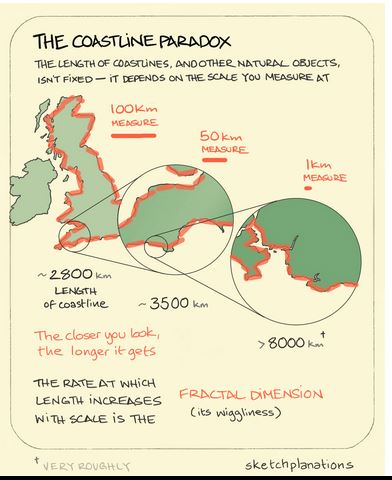
coastline paradox

Continuing the alternate week pattern of posting blogs picking up themes from the previous weeks’ chapter extracts from the forthcoming third edition of my book “Guide to Organisation Design,” this week’s blog, drawing on Chapter 6 – Measurement,  is written by Giles Slinger, an OD expert and member of the group I am working with on the book.  Next week will be an extract from Chapter 7.

Measurement is vital to most organisational life. Take the example of the Olympics. Much of athletes’ training is guided by measurement: the time taken, the height or distance jumped, the power produced. They seek to achieve a qualification benchmark or to break a record. It is just the same for the organisation that delivers the Olympics. The LOCOG (’Local Organising Committee of the Olympic Games’) must meet its own metrics in an extraordinary organisation design performance: 5-10,000 staff must be hired then made redundant again in a 1-3 year period, and their employment and allocation must be co-ordinated along with 70,000+ volunteers. Without measurement, this organisational design wonder could not occur.

Measurement in organisation design is especially interesting because it contains three inevitable paradoxes.

The first paradox is that you can’t measure an organisation… but you have to try. Anyone designing an organisation wants to understand their starting point, and must do so in the knowledge that measuring the full nature of the organisation, the full detail of what we supply, what we do, who we have, how are we organized – how the whole system fits together, is impossible. The CEO of SAS airline said that their business was composed of “50,000 moments of truth” every day. Even this was a gross simplification. The richness in the interactions between people, between employees and customers, and the variations possible are unmeasurable. So any organisation designer with an eye for measurement must swallow their pride, and simplify to accept that they must choose to measure only some basics: for example, how many people do we have, where are they, doing what, at what cost, and with what impact for customers?

The second paradox is that you can never get to the To-Be. You would love to be able to stop, point and say ‘we have arrived at the future!’, but it is never ‘done’. Is this like Xeno’s paradox, where the arrow never quite reaches the target? Not quite – it is because the world changes continually, and the design must continually evolve. Business leader and politician David Sainsbury has brilliantly explained that contrary to market-based views of economics, business life is forever in disequilibrium.[1] People continuously collaborate and innovate. Novel things are by their nature unplanned and undesignable. So measurement in organisation design must tread carefully: by specifying very precisely what ought to exist, and measuring very precisely our progress towards achieving it, we might become very good at delivering in future what would have been perfect in the past. Famously, armies are often re-designed to win the last war. Again, the organisation designer must swallow their pride and accept that designs of the future organisation should be incomplete.

The third paradox is that tracking against plan is vital, but potentially misleading. The purpose of tracking is not so that you can achieve conformity. It is not to spot variations, correct for them and control. The purpose of tracking is especially so that you can learn from places where the organisation starts to vary from the plan, because there will always be reasons why this is occurring. The differences can start to help you, the designer, learn from the organisation, your teacher.

So we have three principles:

  • Full measurement is impossible, but some measurement is necessary
  • Full design is impossible, and future designs should be incomplete
  • Ongoing measurement is vital, not to force the organisation to get it right, but to help the organisation designer learn from what the design got wrong

The three principles here argue for at least three moments for measurement in any organisation design work: (1) measuring an As-Is, (2) creating a quantified version of a To-Be, and (3) tracking progress against these two reference points. People typically ask for a host of questions during organisation design work but will almost always ask about these three moments and what metrics can be applied.

The full chapter sets out an 8-step approach to using measurement, starting with the purpose of measurement and the measures to use, finishing with presenting results and converting to action.  There are discussions of examples all the way, from Uber and Microsoft to healthcare, airlines and retailers.

I find the examples very useful – they make me ask myself whether I would have used the same measurement techniques, and to choose which metrics I would find worth the data-collection effort.

As a rule of thumb, which metrics are worthwhile? Briefly: outcome data – always. Examples: CSAT, mortality, output, revenue. Resource data – always. Examples: headcount, cost, hours used. System data: sometimes. Examples: activity data, skills data, location data, time data, engagement data. Qualitative information: always. Examples: atmosphere, alignment, energy. The qualitative information orients your choices of what quantitative information are worth collecting. Diversity data? Always. In an equal world we could ignore it. Our world is not equal, so diversity data is core resource information.

What do we put into the organisational system? What comes out of the organisational system? Measurement is critical to our ability to interact with organisations. As organisation designers, we have to be comfortable too with the idea that most projects will need to start with understanding the As-Is, will use reasons (design criteria) that guide us in choosing a quantified version of the To-Be, and that along the way we must track so that we can notice, learn and respond when things start to develop in unexpected ways.

This is not just a theoretical argument about how to think about organisations. Right now, some of the world’s largest organisations are having to redesign themselves. Automotive manufacturers are confronted with Tesla (established 2003) being worth as much as every other car company in the world combined. The stockmarket may be over-reacting, but its message is that it is more prepared to back Tesla to survive than all the others.

Meanwhile, an 80,000 person bank that ten years ago was rated ‘the most influential corporation in the world’ (Barclays, 2011)[2] is valued at less than half of a 2,500 person company started by two brothers in 2010 [March 2021: Barclays $43bn, Stripe = $95bn].

The banks, the automotive manufacturers, the retailers, the hoteliers, the airlines: a host of very large organisations have to think through what they are, what they do, and how they can move from a disappearing profitable position in one market disequilibrium to find another profitable position in a new market disequilibrium. For that move to work, a whole group of people need to be inspired by the purpose, the vision and the excitement of creating something new. And at the same time, the challenges of measurement to help with the transition are serious and worth engaging with. Organisation designers have to love the unmeasurable: the innovation, the novelty, the energy – and they have to be willing and ready to measure to deliver it.


[1] David Sainsbury, 2020, Windows of Opportunity

[2] Vitali, Stefania; Glattfelder, James B. & Battiston, Stefano (26 October 2011). “The Network of Global Corporate Control”

Image: https://sketchplanations.com/the-coastline-paradox