Organisation design measurement

Country engagement score

Continuing the alternate week pattern of posting chapter extracts from the forthcoming third edition of my book “Guide to Organisation Design,” this week’s extract is the opening section of Chapter 6, “Measurement”. Next week will be a discussion related to this chapter.

Measurement is important in organisation design.  It is a crucial part of assessing how to improve the design to improve performance.  Ideally, measurement prompts reflection on what is being done, how it is being done, the effects in the organisation and the wider world, and how things could be different. The purpose of measurement is for learning and reflection in order to improve the design and how it is delivered.[1] 

That can include measurement for control:  to check, for example, whether accountabilities are being discharged effectively, or whether targets are being met, or where progress or performance is not as expected. When measures are used for learning or control, it is important that they are considered in the context of the design, the organisational system and the wider ecosystem.

Organisation design measures usually include resources used (who, where), business processes (doing what); outputs (how many things produced, how quickly); and real-world outcomes (revenues, client satisfaction, employee wellbeing etc). Some of these will be leading (real-time) measures, some will be lagging (only measured after the fact).[2]

Starting out on organisation design work, whether project-based design or continuous design, people generally want to answer some key questions, and most of these benefit from metrics of one kind or another (marked below with [M]):

  1. Where are we now: can we measure our baseline in headcount, costs, locations, activities, skills [M]
  2. What outcome measures indicate that a new design is needed? [M]
  3. Are we sufficiently aligned on our mission and values? [M – or by qualitative observation]
  4. What should our new design be? To what extent can we quantify our to-be state in terms including headcount, costs, locations, activities, skills? [M] To what extent must we leave our to-be state under-determined? [qualitative assessment]
  5. What measurable gaps do we need to close? [M]
  6. What can we measure during the organisation design change process to make sure we are on track? [M]
  7. What can we measure as an outcome of the organisation design change to confirm whether or not it has delivered? [M]

Most organisation design work has to start at least with a sense of ‘where we are now.’ And that is certainly possible to achieve: measurements are available inside most organisations on financial performance, customer data, workforce profile and so on though with varying degrees of consistency, reliability and cleanliness. This means that many organisation design initiatives start off with a house-cleaning exercise on the organisational data. 

The challenge of getting the baseline right, and managing data of mixed quality from multiple measures and sources often overwhelms the good intentions of the organisation design team. Yet people have always had to make decisions and to move forward, sometimes knowing the data to be incomplete or imperfect, and sometimes knowing that the future is still to be shaped, so that data cannot yet exist. So, a key skill for an organisation designer is to know when to declare the data ‘complete enough’ to go forward.

As Carlo Rovelli, a physicist, says, ‘In this uncertain world, it is foolish to ask for absolute certainty. Whoever boasts of being certain is usually the least reliable. But this doesn’t mean either that we are in the dark. Between certainty and complete uncertainty there is a precious intermediate space – and it is in this intermediate space that our lives and our decisions unfold.’[3]

Quantitative data derived from measurement can support decision making, if their limitations are accepted and factored in.  Organisations are complex systems in a constant state of flux, of creative evolution and not in laboratory-controlled conditions or market equilibrium. Thus, many quantitative organisational measures are only indicators at a point in time and must be interpreted in their own context.

This is especially true of data coming from surveys. For example, Gallup, an American analytics and advisory company that tracks employee engagement, found that in early May 2020, employee engagement in the U.S. accelerated to a new high.  One month later, came the most significant drop in engagement that they had recorded in their history, dating back to 2000, of tracking employee engagement. They attributed this drop to various combined stressors including the ongoing pandemic and related restrictions, mounting political tension as the election neared, the killing of George Floyd in late May with the subsequent protests and riots and societal unrest surrounding racial tensions.[4]

By the time of the next measuring of employee engagement, the context, or attitudes, may well have changed and the sets of measures are not directly comparable.  The interesting point about the change in score is not the score itself, but investigating why it has changed – what are the possible (multiple) reasons for this, what does a change mean?  The score in only relevant to prompt questions and discussion.

The blog image[5] shows a single score for which countries have the most engaged workers.  However, the relationship between engagement and, for example. country productivity is not made begging the question whether countries lower on the ‘average engagement’ chart below – such as Singapore, Germany and Japan – have grown less strongly in the last 50 years than countries ‘higher’ on the list, such as USA, France and Canada. This leads to the further question of what engagement means:

  1. Is it about feeling happy at work?
  2. Is it about being absorbed in what the work is?
  3. Is it about being energized by the work?
  4. Is it about having work that is meaningful?
  5. Is it about improving productivity?
  6. Or is it all of the above? [6]

As this example shows, a focus on the number doesn’t tell the full story.  Additionally, it is often the case that organisations present a single ‘score’ on, say, engagement with any outliers in the measures contributing to this removed. But there is always the possibility that one of the outliers is the “black swan” – the rare event that brings large consequences that cannot be ignored.[7]  

For greater impact, an organisation should look into the detail behind, in this example, overall ‘engagement’ metrics, in order to understand what the driving factors in engagement are: leadership, strong mission, alignment to company values, fairness of pay, diversity, line manager impact and so on. These can help to shape organisational design decisions, in a way that a single overall score cannot.

In any event no particular score should determine the next action – the numbers cannot ‘drive’ an organisation’s design. Using quantitative measures as general indicators and sources of feedback to spur reflection is sensible. But analysing and interpreting the data depends on individual perspectives. Statistician Nate Silver reinforces the point saying, ‘The numbers have no way of speaking for themselves. We speak for them. We imbue them with meaning.’[8]

Qualitative data is useful to add depth and richness to the quantitative data – to give the human experience and surrounding story, to understand alignment around the organisation’s vision and goals, and the perceived effectiveness of the existing system.  Focus groups, interviews, listening circles and similar are worth including in the portfolio of measurement tools.

To measure design effectiveness, carefully consider selecting a few measures (and employee engagement might be one of them, or not) that will help tell a whole organisation story.  Use data sources and approaches that reflect the interdependencies of the organisational elements and their impact on human performance and well-being.

Reflective question:  What are the limitations and strengths of quantitative measures in assessing organisation design effectiveness?


[1] https://medium.com/centre-for-public-impact/made-to-measure-how-measurement-can-improve-social-interventions-2212a6ed6138

[2] ibid

[3] https://www.theguardian.com/commentisfree/2020/oct/26/statistical-illiteracy-pandemic-numbers-interpret

[4] https://www.gallup.com/workplace/321965/employee-engagement-reverts-back-pre-covid-levels.aspx

[5] https://www.qualtrics.com/research-center/employee-experience-trends/

[6] https://www.analyticsinhr.com/blog/measuring-employee-engagement/

[7] https://www.amazon.co.uk/Fooled-Randomness-Hidden-Chance-Markets/dp/0141031484

[8] https://www.amazon.co.uk/Signal-Noise-Art-Science-Prediction/dp/0141975652

Organisations as living systems

fiona picture

Continuing the alternate week pattern of posting blogs picking up themes from the previous weeks’ chapter extracts from the forthcoming third edition of my book “Guide to Organisation Design,” this week’s blog, drawing on Chapter 5 – Continuous Design,  is written by Fiona McLean, an OD expert and member of the group I am working with on the book.  Next week will be an extract from Chapter 6..


What would it mean if we could learn from living systems and apply that learning to organisational life?  How might it be if we were to see an organisation as a ‘body of bodies’ and how might we take the learning from living systems and apply it in particular to the key governance bodies within organisations?  What might it mean for governance roles, membership and, most importantly, the interplay and relationship between governance bodies?

Manoj Pawar talks about lessons we can learn about organisations from the human physiology perspective. He suggests organisations wishing to survive in today’s complex business environments must be able to adapt in the same way that living organisms evolve in response to changes in the environment.  His article considers five processes from human biology and proposes practical ways that may have applications for organisations.

Taking a whole systems design perspective alongside the analogy of an organisation as a living human being, I like to think about anatomy as the structure and psychology as the culture and behaviour.  I see governance as the physiology of an organisation – the flow of information that keeps the organisation continuously evolving and emerging just as the process by which the nervous system alerts the body to move or adjust in some way.

It is nothing new to compare an organisation to a living system.  In chapter two the author refers to organisations as being analogous to a living human being.  The various human systems (circulatory, digestive, organs etc.) of a healthy body work in harmony enabling interaction with their environment and, like organisations, have multiple parts that are interdependent.

In ‘ReOrganizationKarlöf/Helin Lövingsson draw the same comparison around organisational anatomy, psychology and physiology and go a step further to consider the human factors which affect the workings of an organisation but which are difficult to find in a traditional organisation chart.  Organisation Designers are generally agreed upon the limitations of design by organogram (simply put, don’t!) and to an extent traditional governance processes may mirror the hierarchy that the organogram makes visual but they conclude that for an organisation to achieve its best possible results, its physiology (information flow through governance and decision making) must go hand in hand with its anatomy (structure) and psychology (culture and values).

Pawar also talks about the importance of cellular turnover and regeneration in human beings, and I wonder how much organisations are at risk of stagnation if they haven’t developed sufficient capability to understand what is required of them in the future and so have no way of developing their own cellular renewal.  I am fascinated by the idea of organisational homestasis where, in my role as an organisation designer it can feel like we are constantly making adjustments (re-designs) in order to remain exactly the same – the human body is expert at this.  Whilst I am not expert on biology/physiology I understand the importance of homeostasis in humans in maintaining our body temperature, for example.  So what might the implications for organisations be?

Jeremy Miller, a strategist from an organisation called Sticky Branding, says that homeostasis in organisations is only a problem when you want to change and that you ‘have to build the habits and organizational capacity for the next level to get to the next level.’  He also implies that the ability to get to the ‘next level’ may succeed or fail on a single individual entrepreneur, CEO, owner or leader’s individual and personal capability to change – I’m not sure that I agree with this when taken from a whole systems perspective and seeing an organisation as a body of bodies (including governance bodies) as this perspective would surely mean that there is no one single point of failure in such a system?

Where I find I do agree with Jeremy is on the three things that he believes to be important in order to overcome homeostasis:

 Growth strategy: where clear thinking drives results – how do we create the conditions for clear thinking?

Strategy implementation – are we falling into the trap of thinking that strategy is simply building plans around projects and tasks deemed as priorities for growth when we should be building organisational capacity to operate at the next level?

Leadership coaching: described as the ‘best offense’ to overcoming homeostasis – how do we understand our own worldviews as leaders?

Karlof/Helin Lovingsson also draw reference from the work of Gareth Morgan  on important sources of power and his description of the alliances, coalitions and networks that exist and that, in themselves, can create a chance of expanded organisational influence.  I believe that governance processes and bodies designed well create such influence intentionally and deliberately and can create an important condition for continuous design.

LIVING SYSTEMS – WHAT WOULD IT TAKE TO RE-IMAGINE GOVERNANCE? –

As a group, when we first discussed the chapter on Continuous Design Jim Shillady posed a great question – ‘how will we design non-structural aspects of organisation in a way that clarifies how we actually need to function?’  To me that must include the human factor – governed by collective leadership that may be tied not to hierarchy but where it makes sense to have a leader and where it makes sense to have a body of decision makers.

Visualising a flow of information that ran between groups/communities or governance bodies convened as the collective leadership of organisational success at the crucial moments could be a key to designing an important part of organisational life in a non-structural way.

If good governance is about strong alignment to organisational strategy and direction the infinity loop of governance boards (see blog image) may be a good place to start. It is in that configuration of flow that a dynamic feedback from strategy to action/delivery and back in to strategy develops. What that means is getting really clear about how strategic activity hangs together coherently, making stronger connections between strategy, design, delivery and corporate performance

The infinity loop success is predicated on the constant interplay of individuals as part of a community of decision makers. Balancing vertical functional leadership with the right horizontal accountabilities means creating a platform that enables the development of distributed leadership where decision making is more diverse.  Governance community members are individually responsible and collectively accountable for outcomes.  In this way it shifts leadership behaviour to a flow rather than vertical silos of decision making and shifts the power dynamics from ownership to belonging, to seeing your part in a larger social field or whole.

There is a role for such governance communities in ‘signal detection’ where pattern recognition may lead to mitigating the risk of design decisions made without understanding the impact on the wider enterprise – a vital role in the ‘counterforce against the common decay of Enterprise Design.’  I see the role of the organisation designer to sit along side such an effort towards the final step in the sequence – meaning making.  OD Practitioners have well-honed skills of listening well, revealing hidden patterns and bringing new perspectives to life and helping people in organisations to reshape their worldviews and as the author says ‘not just of business, markets and competition – but, their own humanity and their respective places in the world’.

Ending…

How could you see your organisation as a living system? Where governance bodies and processes are less bound by hierarchy, more inclusive, transparent.  Where decision making and information flows smoothly from strategy to design and back around in a dynamic feedback loop that results in strategy being delivered into action.

What would it take to design your governance bodies and processes to be the strong pair of lungs transferring life giving oxygen into the system for vitality, in order to create the conditions for continuous design?

Continuous organisation design

continuous

Continuing the alternate week pattern of posting chapter extracts from the forthcoming third edition of my book “Guide to Organisation Design,” this week’s extract is the opening section of Chapter 5, “Continuous organisation design.” Next week will be a discussion of this chapter.

Chapter 5

Evolution … starts from an existing design and alters it progressively by a series of small changes over many generations … every stage in the evolutionary sequence must be capable of holding its own in a competitive world. R. McNeil Alexander, Bones

Deliberate organisation designing takes two forms, project and continuous.  Project design, discussed in Chapter 4, is usually undertaken to deliver a specified outcome by a given date.  Continuous design is an ongoing activity driven by having to respond to current or potential internal and external context changes.  In that sense, as principle 5 discussed in chapter 1 states, it is a fundamental continuing business process, not a one-off repair job. 

Adoption of the principle means establishing a business process that delivers continues design and redesign.  Effective organisations develop and hone continuous design capability alongside their project-based design capability.

Failure to adopt the principle does not stop the organisation design changing.  It does so regardless of any intentional design interventions.  An organisation is constantly changing and evolving as the internal and external context changes.  For example, over the past few years employees have set up colleague WhatsApp groups, which are outside the control, and perhaps awareness, of the employer. 

This is part of a wider shift as employees increasingly use their personal smartphones in the office, and/or access social media and messaging platforms via their workplace IT systems. This raises risks and issues for employers. Some that have cropped up are bullying and harassment, use of privileged information, inappropriate comments, exclusion from a colleague group, rights to privacy, and out of business hours use for business purposes – leading to stress and, in the UK breach of the Working Time Regulations 1998. [1]  

The rise of social messaging platforms and the mixed personal/business use of them by employees has design consequences, including changing networks of interaction and influence, changing behaviours and changing knowledge and information flows.

Unless this more or less spontaneous change is noted and an intentional response to it activated, the organisation may well suffer the consequences of inattention.  Intentional and continuous design enables an organisation to evolve advantageously over time. 

In continuous design, designers look for clues and evidence that the design is delivering intended performance outcomes, that potential opportunities, disruptions and risks are on the radar and that the organisation is has the capability to adapt beneficially to meet changing circumstances. 

Netflix is an example of an organisation well versed in continuous design.  They have been practicing for more than two decades, reinventing the organisation from DVDs by mail to streaming and most recently from licensing shows and films to creating them.[2]  Since going public in 2002 the firm’s share price has risen 500-fold and in 2020 Michael Nathanson of MoffattNathanson, a consultancy, observed ‘every time that Netflix faced a roadblock it found a clever way to work around it and emerge stronger.’[3]

Whether Netflix can maintain the ability to continuously redesign and evolve as its operating context changes remains to be seen.  It faces three pressures – two internal and one external.   The first internal one relates to the speed of growth – by 2020 the organisation had grown globally four-fold in five years.  Assimilating a global workforce into what is, essentially, a Silicon Valley culture typified by a flat hierarchy, autonomous teams and local decision making presents a challenge. 

The second internal pressure relates to ‘sectoral girth’, moving beyond streaming into film making, where Netflix is competing with Disney among others, may mean having to expand into new industries.  Disney, for example has theme parks, merchandising and TV networks.   

The external pressure comes from the public, increasingly pushing for inclusion and diversity across society – witness the rise of the #BlackLivesMatter, and #MeToo movements.  In 2019 comedian Mo’Nique brought a case against Netflix for ‘a discriminatory low-ball offer [made to her in 2017 for a stand-up special] in comparison to her colleagues, particularly those who are white and male.’[4]  In July 2020 a federal judge denied Netflix’s motion to dismiss her race and gender discrimination lawsuit allowing it to go forward.

In 2018 Netflix appointed Verna Myers, their first VP of Inclusion Strategy. Whether or not this is related to the then impending court case is unknown.  The noteworthy point is that a discrimination case and a new inclusion VP occurred at much the same time. Societal pressures against discrimination had reached a tipping point.  In this specific case, it may be that Netflix was alert to discrimination risks they faced with the societal mood shifting and took action on that assumption, or it may be that they reacted to news of the forthcoming case by making the appointment.

Either way, their first Inclusion Report, published in January 2021 was ambitious in its reach, recognising that the process of continuous design for diversity ‘is not about perfection – it’s about humility, vulnerability and unlearning as much as it is learning.’  This extends not just to Netflix’s workforce but also to the products and services they offer.  Part of their ambition is to continue to influence which stories get told and by whom.  Myers notes some examples of doing this, saying, ‘We’re uplifting stories about Black British lives. We’re chronicling the life of a gay man with cerebral palsy on TV, a first. We’re moving some of our cash into Black banks’ and by doing this Netflix is helping change societal attitudes to inclusion and diversity.[5]

The Netflix evolution illustrates both the need for, and the power of, continuous design and also some of the potential challenges to it – in terms of being prepared for potential context changes.  As the Netflix case illustrates, the pressures for organisations in general to continuously design come from both internal and external sources.

Reflective question: What is the value of intentional continuous organisation design?

This chapter continues by discussing three critical skills needed for continuous OD – signal detection, pattern recognition and meaning-making.  It moves on to consider where to focus the skills and concludes by describing what a continuous design business process looks like. 

Image: Tyler Foust continuous line drawing.


[1] https://www.hrmagazine.co.uk/article-details/whatsapp-in-the-workplace

[2] https://indianexpress.com/article/technology/opinion-technology/netflix-ceo-reed-hastings-covid-19-crisis-6589504/

[3] https://www.economist.com/business/2020/09/12/can-reed-hastings-preserve-netflixs-culture-of-innovation-as-it-grows

[4] https://www.nbcnews.com/pop-culture/pop-culture-news/netflix-loses-motion-dismiss-mo-nique-s-race-gender-bias-n1234167

[5] https://about.netflix.com/en/news/netflix-inclusion-report-2021

Progress review

project.flow

Regular progress reviews are something I advocate in organisation design work.  Applying this advocacy to myself this week’s blog is a report on how the writing of the third edition of my book, Guide to Organisation Design is coming along.   I’ve used a simple template ABCD that I use on projects – usually as weekly report. But today’s is a longer time frame, covering the 9 weeks from 1 January.

Achieved

Well in quantitative measures I’ve now written, and submitted to the editor five (of nine) chapters. From experience I know that chapter submission is not the end but the beginning of a whole process of re-drafting, re-thinking, switching things around and so on.  But I’m trying not to think about that too much.  My focus is on getting all nine chapters written.

The schedule that I prepared last November – for chapter completion and blog posting – I have amended in the light of slower progress than I anticipated.  I was originally planning to have chapter 6 completed by the end of February but have not got to that – I’m about a third of the way through it right now.  I start re-writing each chapter with optimism that it doesn’t need much work, just ‘tweaking’.  Not the case.  Each chapter has seen major changes to the second edition chapter.   Amending the schedule, I think is an achievement (Ed: Really, why !!??) – reflecting the reality of other stuff going on in my life.  I think I’ll still make the end-May deadline assuming sticking to the new schedule and helped by a project flow chart my daughter sent me – see the accompanying graphic.

A lovely group achievement is maintaining the alternate week discipline of a 30-minute meeting with the five people helping me think through the book.  For me, it’s a fantastic, energising, learning, fun discussion, each of the six of us contributing from various angles, and examplifying one of my messages about the value of diverse views.

The blog posting of extracts and commentary feels like an achievement in that there has been a posting each week.  Writing the blogs feels less like a distraction and more like a focus for refining my thinking and a related achievement, not mine though, is that it generates really helpful discussion/comments from readers.   (More on this in next paras).

Benefits

Hmm, what is the benefit in writing a book?  The Project Management Institute defines benefits as ‘Value that is created for the project sponsor or beneficiary as a result of the successful completion of a project’.   For me, first it is an opportunity to really think about how I practice organisation design, what it is, why it has that label, are organisations designable, what is its value … ?  (I can hear voices saying, ‘Stop over-thinking, just get on with it’). Second, it’s an opportunity to learn from the comments and additional sources of information people are posting on the blogs. Thanks you readers for that.   I had to buy the book Jim Stockmal referenced, Orbiting the Giant Hairball. I loved the title.  It reminded me of another book I enjoy ‘Sacred Cows Make The Best Burgers’  – a good design principle to consider.

In ‘book-as-project’ terms the publisher, I guess, is the project sponsor, and the beneficiaries are the readers of the final book.  My task as ‘project manager’ is to ensure ‘benefits realisation management’ i.e. the ‘Collective set of processes and practices for identifying benefits and aligning them with formal strategy, ensuring benefits are realized as project implementation progresses and finishes, and that the benefits are sustainable—and sustained—after project implementation is complete’.

So, the processes and practices of blog posting, collaborative working with the book group, encouraging myself to write something everyday, and saying ‘no’ to other stuff coming my way are ways of aligning with the strategy of ‘get the book written’.  I think these various processes and practices are contributory to benefits realisation as the book progresses.   They are honing my thinking and giving rise to quite a different take on organisation design from the current second edition.  From this, I’m hoping that the benefits to readers will be sustainable in the next few years.  Sidebar: I make an exception on saying ‘no’ to extra  grandchild care i.e. beyond what we’ve agreed, as I learn a lot from being with a 3-year old.  The jelly-snake negotiation I got involved in the other day required employing tactics that may be applicable to leaders at impasse as each holds their own ground.

Concerns

Concerns are several:

  • Those reading the extracts/blogs don’t have a full map of the book – the chapters, the preface, the approach, the target audience, etc. So, comments on what I’m posting relate only to the extract.  I wonder if it would be helpful to give more info on the map – the chapters, the rationale, my thinking/’philosophy’ of organisation design, and also the territory that the book covers, otherwise the comments feel a bit like the story of the blind men and the elephant.  (But see above on benefits).
  • Readers of the blog post seem to be in the field of organisation design/development/systems but those are not the target audience. The target audience is organisational leaders and line managers who reach for an organisation chart when trying to solve an organisational issue/opportunity.
  • The swiftness of the context change makes it hard to position the book for a shelf-life of 3 – 5 years. Every time I give an example of an organisation a couple of weeks later the example becomes out of date.
  • The examples are skewed towards well-known large private-sector organisations – where are the SME’s,  the big players in smaller countries, the non-profits, the governments, etc. The well-known examples are often not generalisable e.g. not every organisation can, or should, copy the Spotify model (which in any event has come in for criticism).

 Do next week

Doing next (this) week is Chapter 6, on measurement,  I’ve started work on it – the article by Toby Lowe ‘Made to Measure’ stimulated my thinking, as did the video ‘Quantify the Un-quantifiable’.  I’ll also be following up on some of the comments and taking them into consideration as I both review the written chapters and write the subsequent ones.

Additionally, I’ll be keeping my eyes peeled for good organisational examples to illustrate points made in coming chapters. I keep a running list of useful ideas, articles (popular and research), quotes, references, and so on.

And, I’ll be continuing discussions with people about the chapters.  (The four left to write are Measurement, Comms and Engagement, Leadership & Organisation Design, Culture).  The fifth chapter, just completed, ‘Continuous Design’, I’ll be selecting an extract from for next week’s blog.

Project based organisation design

Project phasesJPG

Continuing the alternate week pattern of posting chapter extracts from the forthcoming third edition of my book “Guide to Organisation Design,” this week’s extract is from Chapter 4, “Project-based organisation design.” Next week will be a discussion of this chapter.

Extract from Chapter 4

Designs that effectively deliver desired business results do not just happen.  They are the outcome of deliberate attention involving:

  • Assessing the context, problems and opportunities confronting the organisation and its need for a design change.
  • Being clear about the current and proposed design purpose and desired outcomes.
  • Getting support for any OD work so that the design process runs smoothly (as far as is possible).
  • Tracking the progress of design activity against appropriate measures that enable corrective action to be taken if there are signs of it not achieving the intended outcomes.
  • Staying alert to clues, anecdotes and chat about the organisation’s design and its effectiveness.
  • Bearing in mind the constant organisational flux and change – which is running simultaneously with any planned design change, for example, a merger or an Initial Public Offering (IPO).

Deliberate organisation design (OD) takes two forms, project and continuous, as the information in the John Lewis Partnership (a brand of high-end department stores operating throughout Great Britain) 2018 Annual Report illustrates.  During that year the organisation saw a greater level of internal change than at any time in over a decade contending with what it described as Brexit-fuelled inflation, the extra costs of investing in IT, and having to cut prices because of widespread discounting by competitor retailers.  These market and context conditions led to a profits slump and workforce redundancies.  However, along-side these ongoing challenges requiring a range of OD responses, John Lewis Partnership continued with shop investment plans, completing 127 projects of varying scale in Waitrose shops and 91 projects in John Lewis shops.[1]

Project design is usually undertaken to deliver a specified outcome by a given date.  For example, the 31st December 2020 was a significant date for UK and EU businesses as it marked the end of the transition Brexit period (when the UK left the EU).  From that date UK businesses had to be ready to follow new rules on exports, imports, tariffs, data and hiring.

The Confederation for British Industry (CBI) surveying member organisations in 2018, in the lead up to Brexit, found that the majority of businesses were treating it as a major and significant formal project, with the related governance to oversee their design-for-exit planning and management of preparations.

Project-based OD uses project management approaches, protocols and conventions as provided by, for example, the Project Management Institute.[2]    Continuous OD is less project based and more iterative and emergent.  This chapter discusses project based OD and Chapter 5 discusses continuous OD.

In practice, most large organisations are doing project organisation design and continuous organisation design simultaneously, and as the 2020 pandemic has shown, the need for having the organisational capabilities to do both effectively is critical.

As an example, Just Eat Takeaway.com was formed in February 2020 a merger of Just Eat and Takeaway.com, Just Eat was launched in Copenhagen in 2001. Takeaway.com was founded in Holland in 2000 by Jitse Groen, now chief executive of the new company.

In June 2020 Just Eat Takeaway announced an agreement to acquire Grubhub.  At the time of writing, the close date of the deal (agreed by Just Eat Takeaway shareholders) is not yet known, but expected to be in the first half 2021, pending approval from regulators and Grubhub shareholders.  This acquisition will create the world’s largest online food delivery company outside of China. This acquisition requires rigorous project management capability to ensure the acquisition is finalised effectively on the agreed date.

At the same time as initiating this acquisition, Just Eat Takeaway saw its revenue jump 44 per cent in the first half of 2020 as consumers ordered food at home while restaurants closed during lockdown.[3]

CEO, Jitse Groen talks about the continuous design needed to respond to changes.   in consumer ordering patterns.  For example, during the early summer of 2020 Just Eat Takeaway reported a sharp rise in demand for breakfast and lunch as consumers adjusted to being in lockdown, while the hot weather boosted orders of Greek, Turkish and Thai food as well as ice cream.  Vegetarian and vegan options also increased, requiring delivery changes, signing up new vendors and so on.[4]

Additionally, reacting to ‘winds of change’ about the gig economy the UK part of the organisation announced a move away from a free-lance model of delivery to an employed model. Andrew Kenny, EVP, Managing Director UK, said: “In the UK, the incumbent model is primarily a contractor model. For us this makes couriers an integral part of our offering. It is a big step forward.” [5]

These responses to increased and different consumer ordering patterns, and society’s feelings about the gig economy are examples of the type of ongoing pressures and opportunities that effective organisations respond to by developing and using a well-honed continuous design capability alongside their project based design capability.

Reflective questions: How necessary is it for large organisations to have both project management and continuous design capability?  Why/why not?

Being able to keep an OD project to budget and schedule depends on many factors, including the business purpose and stability of strategy, the operating model, the scope and scale of the design, the number of third parties involved, e.g. platform providers[6], the amount and type of continuous OD going on, and the planning and implementation techniques used.  Thus, a merger with a specific close of deal date may get to the point necessary to close the deal on time, and yet have a further phase of the project (or start a new project) to see through the detailed integration.

Whatever type of end-date project, there is a consistent sequence of activity and a number of identifiable phases to it.  The number of phases may vary.  Figure 4.1, [not shown in this blog] for example, shows three phases for an M & A project, while the waterfall and design thinking methods discussed in Chapter 2 both have five high-level phases, and the agile approach has four.

The phasing suggested for OD projects is a 6 phase one shown in Figure 4.2.  [see accompanying graphic]. This phasing recognises that OD projects often begin with an OD consultant being invited to come and discusses an organisational issue or opportunity that a leader or leadership team feels may need a new design or a redesign.  Hence the first phase is entry and contracting, that is meeting with the person commissioning the project and agreeing the contract for the work.

[1] https://www.theguardian.com/business/2018/sep/09/john-lewis-made-1800-redundancies-in-the-past-year

[2] https://www.pmi.org/

[3] https://www.cityam.com/just-eat-takeaway-sales-soar-during-coronavirus-lockdown/

[4] https://bmmagazine.co.uk/news/surge-in-takeaways-is-the-prefect-recipe-for-just-eat/

[5] https://www.telegraph.co.uk/technology/2020/12/09/just-eat-turns-away-gig-economy-recruits-1000-riders/

[6] When adopting platform business models the operating model and the organisation running it are by definition beyond the boundary of the legal entity running the platform. All the internal/external, inside-out/outside-in, control/influence discussion is being challenged by this development.

Organisational Alignment

alignment

Last week I posted an extract from Chapter 3 Organisational Structures of the third edition of the book I am writing.  At two points in the chapter I use the word ‘alignment’ as follows:

‘They (Medium) found, however that it was difficult to coordinate efforts at scale – any initiatives, which required coordination across functions took time and effort to gain alignment.’

‘With this and the organisation values in mind, they consulted their team members and drafted a design and implementation plan that ensured alignment of all the organisational elements and supported the collaborative principles on which ATD was founded.’

I’ve also used the word ‘alignment’ twice in Chapter 1 and once in Chapter 2.  Chapter 4, which I’ll be sharing an extract from next week, also has two mentions of ‘alignment’.  I’m not sure yet how many times I’ll use the word ‘alignment’ in chapters 5 – 9, but I’m now on high alert to it.

I’m on high alert because Jim Shillady, one of the book group members I’m working with, made the point that:  ‘There are a couple of places in the chapter – more in the book generally- where we ask people either to align this with that or to check that two or more things are aligned.  This always makes me wonder how we would answer those readers who respond by asking ‘how do we align?’ or ‘how can we tell when we are aligned’?

Thus, last Thursday, at our bi-weekly meeting, we discussed these questions and the discussion is still going strong, now via email.

Alignment is a frequently used word in organisation design and Jim asks whether it needs more explanation than the general understanding of it – that things need to be running in sync.  An analogy is wheel alignment on a vehicle: vehicle owners know that hitting a pothole or kerb can put the wheels out of alignment resulting in excessive wear to tyres and problems with the steering or suspension.  They regularly check the alignment of the wheels.

An HBR article, authored by Jonathan Trevor and Barry Varcoe,  How Aligned is your Organization,  notes that ‘Most executives today know their enterprises should be aligned. They know their strategies, organizational capabilities, resources, and management systems should all be arranged to support the enterprise’s purpose.’

The article describes alignment as being a ‘tightly managed enterprise value chain that connects an enterprise’s purpose (what we do and why we do it) to its business strategy (what we are trying to do to fulfil our purpose), organizational capability (what we need to be good at), resource architecture (what makes us good), and, finally, management systems (what delivers the performance we need).’  They cite McDonald’s as being an example of a well aligned organisation.

Organisational alignment is defined and looked at in other ways, apart from through the value chain.  For example, strategic alignment is discussed in a bizzdesign blog describing it as ‘the ability to create a fit or synergy between the position of the organization within the environment and the design of the appropriate business processes, resources and capabilities to support the execution.

Similarly, a research article, Competing Perspectives on the Link Between Strategic Information Technology Alignment and Organizational Agility: Insights from a Mediation Model on the links between IT alignment and organisational agility (using the value chain as a generic outline of the processes in a firm) reports, ‘Our research reveals that alignment is a potent source of value and worthy of the priority status consistently afforded it by top executives.’

Jonathon Trevor co-author of the HBR article mentioned earlier has a long, but worth listening to, webinar ‘How to Lead Strategic Alignment‘, where he points out, “We know that the best aligned enterprises are also the highest performing enterprises—the most change ready, and the most resilient. We must therefore be developing within our corporations, the leadership capabilities required to achieve that strategic alignment, as a matter of urgency.’

So, at this point it seems fair to say that organisational alignment, i.e. having all the elements in sync, is ‘a good thing’?   However, that doesn’t help much with how do we align and how will we know that we are aligned?

On ‘how do we align?’, reading the research article, Competing Perspectives …,  just mentioned, I wondered whether focusing on IT as the ‘spine’ of alignment activity might act to impel other organisational elements towards alignment.  (This article  has a useful  illustrative table on where IT can align to business strategy in 5 business processes).

As started to amble down this path of thinking, I came across another article discussing product aligned v capability aligned organisation design  with the author, Nick Tune, discussing the pros and cons of each in some detail and yet ending up being dissatisfied by the distinction, concluding, ‘how do we actually find the perfect boundaries? I’m still working on that.’

And then I found an interesting ‘how to ‘ suggestion from Chris McDermott  on mapping alignment, including the chain of social practices and the quality of the relationships between them.  This comes closer to the discussion we, the book work group, were having.  This ‘how to design alignment’ is still being pursued by us, but as it currently stands (thanks to Jim Shillady and Giles Slinger for working more on it) we are discussing that alignment is brought about by designing:

  • Alignment in construction: hard design elements such as processes, information flow, metrics, role descriptions, team structures, incentives
  • Alignment in current reality: the shared understanding of the complex reality on the ground – how things are really being done now
  • Alignment in orientation: a common compass point or set of values, purpose, culture
  • Alignment in how construction, reality and orientation will be if we succeed in creating (designing) necessary changes

There is a model and there may be a checklist or other tool(s) to go with these four points.

The final question ‘How will we know we are aligned?’ led to a discussion on two approaches and we advise doing both. First is the technocratic/data driven approach where you focus on the hard design elements and see where there are disconnects, or gaps, or misalignments.  I’ve often used a radar chart as a tool to aid this activity.

As an example of the technocratic, an alignment disconnect that I frequently come across is a performance management and reward system designed to foster individual competitive performance with a value around ‘one-team’ and ‘collaboration’.  Another is a desire for a ‘seamless customer journey’, but one where you find the customer journeys through multiple handover points that require them to repeat information just given.

The second approach to finding out if an organisation is aligned is the human signal detection approach where you ask the question ‘What about the alignment of the design do you feel uneasy about?’  Or ‘What do we need to discuss further about this’.  This plays to more to instinct, intuition and experience and is a helpful complement to the more technocratic/data driven approach – in essence you are getting a quantitative and a qualitative view of alignment.

In discussing alignment I began to wonder whether constantly aiming for it – which is necessary as things change so rapidly – is really continuous design.   I’ll be developing this idea (or not!) in Chapter 5 which is on continuous design.

What’s your view of what alignment is, how to design an aligned organisation and how you know when you have one?

Questions to ask about structures

Continuing my plan to give an extract from a chapter of the to-be-published third edition of the Guide to Organisation design, this week’s extract is from chapter 3 Organisational Structures. Next week I’ll pick up on the discussions the group I’m working with have had on organisational structures.  NOTE that in the book I’ve equated structures with organisation charts as this is what people seem to do.  But there are other views on what organisational structures are.  See my blog on this.  

———

Starting with the structure is not the best way to do OD but asking a range of questions about structures helps in making sensible structural decisions when the time comes in the design process.   Useful questions include:

Speed

  • How often and how much restructuring is necessary to keep ahead of competitors?
  • What structures make for fast decisions and delivery of product or service?
  • What structures will enable keeping up to speed or ahead of the curve with changes in customer and market requirements?
  • What structures minimise bottlenecks without incurring risk?

Integration (size and shape)

  • What structure will maximise the flow of knowledge and information through the organisation?
  • What effect do particular structures have on the relationships among business units, divisions, headquarters, customers, suppliers?
  • Does the way a department, business unit or organisation is structured get in the way of efficient and effective workflow?
  • What is the best balance between centralisation and decentralisation?
  • Does the structure allow everyone’s voice to be heard (high participation)?

Flexibility (role clarity)

  • How will jobs and pay levels be described and classified to maximise workforce flexibility?
  • What levels of autonomy, accountability and participation go with each of the potential structures?
  • What are the job designs that go with each type of structure?
  • How well do the relationships between individual departments and between departments and headquarters work?

Innovation (specialisation/organisation identity)

  • What structure will best support the desired culture?
  • What structure will best support organisational values?
  • Does the organisational structure attract the best and the brightest staff (and help retain them)?
  • Will structuring differently help develop the organisation’s market position and competitiveness?
  • What structure would maximise the flow of knowledge and information through the organisation?

Control

  • How will the balance between local and central control be attained?
  • How many layers of management make for effective and efficient control?
  • What is the optimum span (ie, number of people any one person can supervise) of control in a given set of circumstances?
  • How can structures be used to drive the desired/required behaviours?
  • What should be the chain of command/decision-making?
  • Who will report to whom and why?

Because the structure of an organisation is only one design element, there are no straightforward answers to these questions as each has to be answered in relation to the other organisational elements. However, comparing the structures starts to give some useful information on the relative capabilities of each. (In the book there is a table comparing capabilities of the structures).

Combining this information with the advantages and limitations of each structure (in the book there is a table showing this info) gives a reasonable start-point on which to base discussions about current structures and structural alternatives. Repeating a point made earlier, the thing to bear in mind is that even within one organisation there may be a need for several structures. For example, an internal audit function may require a different structure from a research and development group, which may in turn need a different structure from a marketing network.

Layers and spans

People in self-managing organisations do not have the same concerns with layers and spans that people in traditional hierarchical organisations have and it may be that discussions on them gradually fade away as traditional organisations evolve.  However, for the moment it is still a live topic.

Layers in a traditional hierarchical organisation refer to the number of levels of staff there are from the most junior to the most senior – typically varying from 7 to 12.  The trend is to reduce the numbers of layers by merging or removing them in order to place accountability at the lowest possible layer. A span is the number of employees that a single manager is responsible for, usually in terms of allocating work and monitoring performance. The relationship between spans and layers is not straightforward either, although wide spans of management are typical of organisations that have few layers.

There are two frequently asked questions related to structure to which people are anxious to get a ‘right’ answer:

  • How many layers of management should there be?
  • What is the right span of control?

Unfortunately, neither of these questions has one right answer. Layers and spans are structured to help managers get work done, so the first part of an organisational decision on the number of management layers and the span of a manager’s control requires discussions and agreement on what managers are there to do in what context.

In general, managers plan, allocate, co-ordinate and control to achieve what the late Peter Drucker described as their three tasks:

  • To contribute to the specific purpose and mission of the enterprise.
  • To make work productive and the worker achieving.
  • To manage the social impacts and social responsibilities of the organisation.

Clearly, determining what configuration of layers and spans is likely to work in a given organisation depends on the situation, organisational purpose and a host of other factors related to the interpretation of what the three tasks entail and the weighting given to each of them.  In general layers should:

  • be flexible and adaptable enough to enable managers to forward plan in a context of constantly changing operating environments;
  • facilitate co-ordination between business units including leveraging know-how; sharing tangible resources; delivering economies of scale; aligning strategies; facilitating the flow of products or services or information; creating new business;
  • have appropriate control and accountability mechanisms (note that any task, activity, or process should have only one person accountable for it and accountability and decision-making should be at the lowest possible level in the organisation; overlap and duplication, fuzzy decision-making and conflict resolution processes are all symptoms of lack of adequate controls);
  • enable its managers to allocate effectively the range of resources (human, time, equipment, money, and so on) they need to deliver their business objectives.

If these four attributes are working well, it is likely that the layer is adding value to the organisation, in that it is facilitating speed of operation, innovation, integration, flexibility and control. If it is not evident that the layer is doing this, it may be redundant and the reason for its existence should be questioned.

Determining a sensible span of control is possible (though infrequently done) both for an individual manager and for the type of work carried out in a business unit or organisation. The method involves considering, the diversity and complexity of the work, the experience and quality level of the workforce, the extent to which co-ordination or interdependence is important between employees and groups, the amount of change taking place in the work environment, the extent to which co-ordinating mechanisms exist and are effective, the geographic locations of the workgroups, the extent to which job design and tools allow direct performance feedback to the employee, administrative burdens on each level of management, and expectations of employees regarding development and career counselling.

Reflective questions: What is the design impact of de-layering an organisation? How do span considerations relate to size of a self-managing team?  (Note: The reflective questions are a new addition to the book. I am how useful people will find them?)

Image:  https://bridges.eng.monash.edu/analysis/

Designing with systems: design is attitude

At the start of the year I mentioned that some of blogs in the coming months would be written by members of the group working with me on the third edtion of the book I’m writing. This is the first of these, written by Milan Guenther, a co-founder of Intersection Group, a not for profit association dedicated to helping people create better enterprises.


This blog post relates to Chapter 2 of the upcoming 3rd edition of The Economist Guide to Organisation Design, find an excerpt here. I, Milan Guenther, am part of the team of reviewers.

“Enterprise Architecture is the issue of the century”, were the words of John Zachman, the “founding father” of the field. What did he mean?

In his seminal 1998 paper, he described how any enterprise, any ambitious human endeavour, is in need of architecture and engineering to accommodate today’s extreme complexity and rate of change. And this is obviously the case today: all around us, we see humanity’s need to establish well organised agency at scale

Just think of the pandemic and who we count on handling it: government institutions, healthcare providers, insurance and pharma companies. To tackle such an immense challenge, they need to be architected, designed, engineered, or better: co-created so that they are fit for purpose and actually deliver treatment, vaccines or financial support. There is no short supply of similar big challenges to look into.

Some time back, my design school PBSA Düsseldorf published a book about their famous alumni and typographer Helmut Schmid, titled Gestaltung ist Haltung, or design is attitude. The point he made when coining this quote: design always represents an idealised future, and it is up to us to take a stance and define what future we would like to see.

Designers of all types set out to do just that. Create better products, services, businesses, strategies and organisations: the field evolved from crafting useful things to designing better outcomes. This inevitably challenges us to redesign the enterprise itself, its organisation and operations to actually deliver on such a promise. We need to design from the experiences we wish to reshape back to the necessary changes in the systems that make them happen.

In chapter two of her upcoming book edition, Naomi suggests that one way of dealing with enterprises, their organisation and their interplay, is thinking in systems. Both a rich and diverse tradition and a loaded term, the abstraction of all those moving parts to a set of systems expressed as boundaries, relations and interactions can help us understand the emerging behaviour. To do so we need to apply this thinking to a representation of the reality we want to change, or in other words create a model of this reality.

I first encountered Naomi’s thinking about this when my friend Sally Bean pointed me to her blog post on metaphors we use for Organisation Design. When dealing with companies, institutions or similar organisations, we apply an analogy that makes it easier to grasp. Naomi included an example that pictures the enterprise as a human body we can treat and heal. Other common models try to describe it as a machine to be engineered and optimised for performance, or even a sort of swamp supporting many competing lifeforms (referred to as an ecosystem). 

More than simply a way to explain or describe what’s going on inside or around an enterprise, these models shape the way we think about the enterprise, how it is organised and goes about its business. Even when consciously applying systems thinking principles, such a model provides us with a way to understand and talk about this non-tangible, dynamic thing we are supposed to design.

The models we use determine to a large degree if we will be successful in our attempt to design better organisations. It makes a huge difference if you see the enterprise as a set of numbers in a spreadsheet, as a portfolio of projects and initiatives, as a group of people trying to achieve something together, as a collection of machines and processes to be automated, or as a set of products and services delivered to customers.

In my experience, these models correspond to the views of typical functions and their teams – think Marketing, HR, IT or Innovation. They originate from different traditions, and correspond to prevalent metaphors present in these teams. They also stem from the simple fact that different actors are concerned with different things, so it seems natural to focus on those and ignore others. These filters are what enable us to design in the first place:

“(…) it is not possible or feasible to represent everything about an entity (in our case a product, system, or sub-system) in a single encapsulated description. When you are designing a takeaway coffee cup for example, you are interested in how well it holds liquid—it is unlikely that you are concerned about the permittivity of the material to light.” From A Function-Behaviour-Structure design methodology for adaptive production systems

In Organisation Design however, this is known to create some big challenges. The infamous silos, inflexible and rigid bureaucracy, dysfunctional customer relationships or a lack of team engagement are not cause but symptom. They can be linked to the limits of the underlying model people applied when designing and managing the organisation. Consequently, Naomi presents a wide choice of potential models to choose from, from management classics to new approaches of self-organisation. What models to use depends on the context, and not least personal preferences, experiences and appeal to the designer.

This brings us back to the original challenge: designing enterprises and their organisation in a way that they are fit for purpose and deliver value. What perspective, what model, or their combination, will help you get to this – together with your co-creators, in the given context? That is the designer’s greatest challenge and biggest opportunity. A quote by George Box in the beginning of this chapter says: “All models are wrong but some are useful”. Instead of presenting another attempt at the ultimate model, it is up to the designer to choose and apply them in their environment. True for something as intangible and abstract as an organisation, it applies to any design practice.

Just as product, service or fashion design, Organisation Design is a deliberate creative act. Systems thinking and models might give us the elements to consider or useful perspectives to apply, but won’t solve that task for us. What’s more: design is always incomplete, never captures or describes the entire system we want to change. This requires multiple models to guide the change required, and interaction with the system to be changed. Naomi explains this using the story of a merger between two councils in the UK, effectively blending and hacking several models and viewpoints.

To do so, we need to 

  • be comfortable with many incomplete models, 
  • acknowledge the fact that organisations are co-created by teams organising themselves to achieve something, 
  • seek external inspiration, experiment and validate, and 
  • treat this as an open inquiry into the future. 

More important than a neutral or correct model is one that helps you get through this process, develop your personal attitude, and chart a way forward together. What is a well designed organisation? This needs to be figured out by those who can imagine the future.

References

John Zachman: The Issue is the Enterprise

Helmut Schmid: Gestaltung ist Haltung

Len Fehskens: Designing Ambitious Endeavours 

Naomi Stanford on metaphors

David Sanderson, Jack C. Chaplin & Svetan Ratchev: FBS Ontology

Enterprise Design Patterns

Organisation design systems models

A couple of weeks ago I said I’d alternate an extract a chapter of the coming third edition of one of my books with a reflective blog on that chapter.  This week is an extract on Models from Chapter 2, followed next week by some reflections related to that chapter.

MODELS

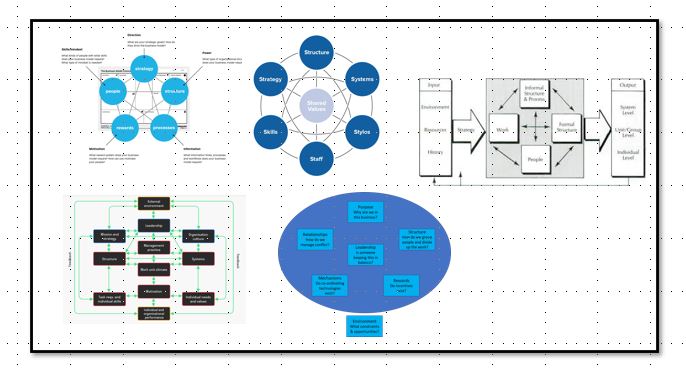
To support the application of systems thinking and systems approaches, organisation designers use ‘systems models’.  These are simple visual representations of an organisation’s elements and the links between them.  

There is sometimes a difficulty in explaining what a systems model is and what it is for.  It becomes clearer by thinking of an organisation as analogous to a living human being.  A human being constitutes 

  • systems –  e.g. the circulatory and nervous systems (note that a ‘system’ is both the whole system, in this case the human body, and sub-systems within it)
  • processes –  e.g. the digestive processes
  • organs – e.g. heart, brain, kidneys, liver and lungs
  • chemical elements – e.g. oxygen, hydrogen, carbon, nitrogen
  • tissues – e.g. muscle tissues, connective tissues

When the human is healthy these systems, processes, etc. work in harmony enabling interaction with their environment.

To explain these body constituents and their inter-relationships, medical educators make use of anatomical models.  Different anatomical models illustrate different constituents of the human body.  For example, Mixed Dimensions’ intricate models ‘show the minute details of the human body’s muscles, bones, and skin’ while SynDavers’ model includes bones, joints, muscles, organs and tendons, major nervous system and vascular components. Similarly, systems models differ in which organisational elements they feature.

Organisational systems models are used similarly to anatomical models.  They enable a step back from the day-to-day organisation – aiming to foster an impartial objectivity, that facilitates constructive discussion on the organisational elements and their relationships to:

  • the external ecosystem and environment (market)
  • the way teams, roles and tasks are organised (organisation)
  • the way business processes are run and the way value is delivered (operations)
  • the way the elements are interdependent

As with anatomical models, there are several different organisational systems models in common use in organisational design work.  Choosing one that is appropriate for a specific organisation’s design intent involves consideration of the strategy, the operating model and the problem or opportunity a new design is intended to solve. 

In cases where none of the off-the-shelf models seem appropriate, a bespoke model can be developed, although this takes time and energy that may be better spent on adapting one of the existing models to fit an organisation’s particular context.

Table 2.1(Note: in the book) compares the five systems models organisation designers most commonly use, noting the elements referenced in each model and some strengths and limitations of each. (Note: these are: McKinsey 7-S, Galbraith’s Star Model, Weisbord’s 6-box model, Nadler and Tushman congruence model, Burke-Litwin model).  This is not an exhaustive list.  There are other models in use some from the related fields of business architecture and enterprise design – for example, the Business Architecture Guild model, the Zachman framework and the Viable System Model. 

Comparing the models helps leaders and designers decide which one is best for use in a specific organisation in a specific context. The choice of model depends on several factors, including:

  • Whether there is a preference for model developed and tested from theory or a model developed and tested from practice (or both). Warner Burke in a paper discussing this point notes that, ‘from the perspective of both research about organisations and consultation to organisational clients, we have experienced some frustration about most, if not all, current organisational models that do little more than describe or depict. A case in point is the 7S model developed by Pascale and Athos (1981) and further honed by Peters and Waterman (1982).’[5] i.e. the models are not derived from empirical research or based in sound theory, but are practitioner or consultant developed, and gain credibility and use through association with a brand.
  • Whether there is a known organisational priority – for example if there is a general feeling that leaders do not give enough strategic direction and guidance, then a model with ‘leadership’ as an element might be chosen as this will drive the need to make an element explicit in the model
  • Whether the outside environment is important – some models do not show external context
  • Whether it can be easily and simply adapted if appropriate.

Further factors for model choice are suggested by researchers Falletta and Combs[6]

  • Whether it meets the organization’s current problem or need;
  • Whether leaders are comfortable with it;
  • Whether it fits the organization’s culture;
  • Whether it is sufficiently comprehensive to capture all of the factors and variables of interest without overwhelming or confusing key stakeholders in the organization.

The models shown Table 2.1 are still in use after 6 decades from first development, giving rise to debate on how appropriate they are for this decade when speed of adaptation to rapidly changing contexts is that much more than in the relative stability of the 1960 and 1970s contexts.  A current major challenge for organisation designers is dealing with so many different and changing types of businesses.  The ’traditional’ organisation and the ’new/evolving’ organisation exist side-by-side and sometimes within the same organisation. This suggests that adherence to one model throughout an organisation may not be appropriate if business units have different operating models, and different products and services.  

Most models force the clear declaration of the organisation’s function. The choice of model to develop the design is more a question of fit. But to help choose the model for the specific organisation, ask diagnostic questions such as:

  • Does the model package the organisational elements in a way that stakeholders will recognise (are there enough, are they ones that are important in the organisation)?
  • How will stakeholders react to the presented model (is it jargon-free, and simple to understand and communicate)?
  • Will the model find favour across the organisation or will it compete with other organisation design models?
  • Does the model harbour implicit assumptions that might help or hinder design work? For example, does it include or exclude factors such as local culture (both national and organisational) and human factors (such as personalities), or does it suggest ways that elements may relate to each other?
  • How adaptable is the model to the specific context and circumstances in which it will be used? Does it enable any new perspectives or innovative thinking? Is it scalable to small work-unit design and whole organisation design?
  • Does the model work with other models in use in the organisation (for example, change management or project management models)?
  • Are the costs to adopt the model acceptable (for example, training, communication and obtaining buy-in)?
  • Does the model allow for new and unconventional organisation design that will help drive the business strategy?
  • Does the model have a sponsor or champion who will help communicate it appropriately?
  • Does the model allow for transformational design as well as transactional design? (Transformational means a design developed in response to environmental forces either internal or external to the organisation – for example, creation or closure of a business unit or a merger – that affects the mission, strategy and culture. Transactional means changes related to the business or work-unit structures, systems, processes, and so on that might be needed to carry out the mission and strategy but do not change them.)’

[5] W W Burke & G H Litwin. (1992). A Causal Model of Organizational Performance and Change. Journal of Management. Vol 18. No 3 (1992) p 529

[6] Falletta, Salvatore. (2018). The Organizational Intelligence Model in Context, OD Practitioner Vol 50 No1

Introducing organisation design – part 2

Introducing organisation design sounds more straightforward than it is in practice.  Each time I’m asked to do something on introducing organisation design I ask myself what exactly it is that I am introducing. 

‘Organisation design’ is both a process – the process of designing an organisation, and an outcome.  Once the process is complete you have a designed organisation.  Except, more often than not, you don’t. 

Organisation designing is not like product designing.  You don’t end up with a definable ‘thing’ – a hairdryer or a notebook or a software module.     Organisations are not very definable, and certainly not in the ‘thing’ sense.  Common themes about what an organisation are include groups of people, acting together, in pursuit of common goals or objectives.

But this isn’t very satisfactory.  I won’t go into why this is the case, as Paul Griseri has covered it brilliantly in Chapter 1 of his (2013) book, An introduction to the philosophy of management

He opens the chapter asking ‘what exactly is an organisation? We can distinguish the two following senses of this question:  What is it for something in general to be an organisation?  How can we decide whether a specific ‘thing’ is an organisation or not?’  After 21 very readable pages he concludes without defining an organisation and without being able to confirm that organisations exist.  You can read the whole chapter here .

On the one hand, I take comfort from this as it illustrates the kind of conundrums I come up against when I think about introducing organisation design.  On the other hand – having been told many times in my career that I am ‘too academic’ – I take the view that I’ll raise challenging questions as and when and aim to keep myself in a position of equilibrium on the Perceived Weirdness Index. (I wrote about this Index a few years ago).

Thus, I plunge into Chapter 1: Introducing Organisation Design, of the book I’m writing, boldly side-stepping the indefinability of ‘organisation’ and whether or not organisations exist and start from the assumption that organisations are somehow ‘there’ (or ‘here’) evidenced by people getting pay-cheques and putting the name and logo of the organisation they get them from on their Linked In page.  And further assuming on this basis that organisations can be intentionally designed, at least in some aspects. 

As an aside, I was never able to explain to my mother’s satisfaction what organisation design is.  When I told her I had been asked to write another book on organisation design her immediate response was, ‘I don’t know how anyone can write one book on organisation design, let alone two.’  However, she proudly displayed all my writing on her bookshelf. 

What I learned from my mother’s response was to use familiar analogies and examples to illustrate points and stick to plain language.   I’m going to carefully check the book draft against George Orwell’s five rules of writing.

In introducing organisation design I suggest that the work of organisation designing should be effective, continuous and reflective.  To help make sure it is, I propose five principles to bear in mind when designing:

  1. Organisation design is driven by the business purpose and strategy, the operating model and the operating context
  2. Organisation design requires systems thinking: about the many elements of the organisation and the connections between them
  3. Organisation design takes strong, thoughtfully used, future-oriented mindsets and methods.
  4. The organisation design process involves social interactions and conversations as much as formal planning.
  5. Organisation design is a fundamental continuing business process, not a one-off repair job.

The set is not empirically researched, rather it is born out of the practitioner experience of the group working with me on the book (ed – is the group an organisation?) and their responses to the set in the second edition of the book which had six principles. 

We spent time discussing and refining that second edition set into the set of five above.  There are not major differences i.e. there are no different principles – the changes are of focus and some of the wording. 

On the first principle we all had different views on whether organisational members need a shared purpose or not.     Note that the concepts of shared purpose(s) are debated in Griseri’s chapter mentioned earlier. It could be fun to host a debate on ‘What’s the value of having a shared organisational purpose?’ – or similar title and hear all sides.

On the second principle, we abandoned the word ‘holistic’ which was originally in principle 2 as it is hard to be clear, as one of the group I’m working with, said, ‘on what holistic thinking actually is, because we all generally think about individual items and connections between them in turn, not about all of them simultaneously.’  Instead, we maintained the thread of systems thinking which is carried throughout the book. 

The third principle we are still debating!  And are thinking of offering an alternative, but similar, one ‘Organisation design takes intentionality, well-chosen methods, and thinking that is rigorous, open and forward-looking’.   We were challenged by a group member who asked: ‘Would principle 3 be the same if it said “OD requires future-oriented methods”.  Currently, it includes a few smuggling words: strong, thoughtfully used, mindsets – in each case, why? What would be wrong with a weak, thoughtless, mindless approach, as long as it were future oriented (!) ?’  What’s your view of principle 3?

Principle four has also been a focus of attention. We have agreed that we need to enable co-creation and collaboration – both in the OD process itself and in the capabilities of the resulting organisation.  But we haven’t specified those two words in order to allow for other aspects of ‘social interactions and conversations’.   Does the principle, as written, adequately include co-creation and collaboration?

This discussion took me into thinking more about designing organisations that are inherently collaborative.  Do they have particular design characteristics?  There’s a research article by Paul Adler and Charles Heckscher exploring this topic that I found helpful – Collaboration as an Organization Design for Shared Purpose.  The article discusses ‘the organizational form that could create and sustain a widely shared commitment to the organization’s ultimate purpose in large, complex, business enterprises facing dynamic environments’ the form they come up with is the ‘collaborative form’.

Adler and Heckscher offer four designable attributes for collaboration in support of shared purpose:  ethic of contribution, interactive process management, participative centralization, T-shaped skills.  On the T-shaped skills the authors say ‘the collaborative organization deliberately plans members’ skill development to support their ability to contribute to the organization’s ultimate purposes’, which runs counter to some arguments that people are in charge of their own career and skills development.     

They warn that ‘the collaborative organization is costly to create and difficult to maintain. It depends on reliable mechanisms for establishing and updating reputations; but we know that these mechanisms are vulnerable to opportunistic manipulation. The high level of participation in collaborative organizations requires considerable meeting time; but such meetings are costly and burdensome. The collaborative form requires openness to diversity, difference, and disagreement; but it offers little assurance these will not explode the collectivity or seal the organization off from the outside world as a closed sect.’ 

We do tend to toss around the word ‘collaboration’ or the phrase ‘a culture of collaboration’ and I wonder if we have thought carefully enough about what this means in practice. 

The fifth principle  emerged unscathed from our discussion of it and remains pretty much identical to the second edition version. 

In conclusion, the way I have used the principles in the past and the way I will continue, I think, to use them is as thought provokers to encourage reflection and intentionality about designing.  

What’s your view of the five principles?  How would you use them?  Let me know. 

Image:  Design management  Author/Copyright holder: Wiki4des. Copyright terms and licence: CC BY-SA 3.0