
Organisation design:  ownership and positioning

The question that appeared in my inbox this week was, ‘What articles can you point me to that challenge the positioning of org design under HR v COO/Strategy?’

The quick answer is that they are thin on the ground.  A scan of the 92 open access articles in the Journal of Organisation Design has none.  Neither does a search under keyword ‘HR’ of all the journal issues.   Therefore, onwards to DeepDyve and Researchgate

Deepdyve showed 52k results for the keywords ‘organisation design’ which seemed like a long list to trawl through.  I added HR as a keyword and the list reduced to 1,900 becoming much more manageable. But skimming down the list they were mainly about the design of HR functions. 

Researchgate doesn’t tell you how many items are found under the keywords entered (at least I couldn’t see it).  However, numerous pages down, the search yielded Organisation Design & Development and the Relationship with HRM, Reason Chivaka, February 2018. The author doesn’t tackle the positioning issue though.

In the absence of articles (if you know of any let me know), here’s my  take.  

Think of organisation design both as a noun and as a verb.  The organisation design (noun) is, in my view, owned by the CEO/Executive as it is they who are accountable for the effective operation of the organisation.   But they have to accept that they are the ‘owners’ and take an active part in keeping the design optimum.  It requires continuous attention and monitoring. 

According to Tom Peters, “Design should be on the agenda of every meeting in every single department”.  As I say in my forthcoming book, curiously, however, executives rarely talk about it as an everyday issue, and even more rarely reflect on the interactions between the organisational elements and complex social dynamics in order to redesign their business for success.   Peter Senge, in his book The Fifth Discipline, points out why intentional organisation design work is uncommon:

Part of the reason why design is a neglected dimension of leadership: little credit goes to the designer. The functions of design are rarely visible; they take place behind the scenes. The consequences that appear today are the result of work done long in the past, and work today will show its benefits far in the future. Those who aspire to lead out of a desire to control, or gain fame, or simply to be “at the centre of the action” will find little to attract them in the quiet design work of leadership.

Where leaders perceive a need to design or redesign, they tend to delegate that work to designers, consultants or others. In the first instance, this is usually, not HR.

It is the organisational positioning of the people, processes and activities involved in this design work i.e. designing (verb) that my questioner was asking about.

Many functions lay claim to owning the organisation designing work:  enterprise architects, business architects, strategy functions, HR functions and service designers are amongst them.  Each discipline has a legitimate claim to owning it and each often has a methodology to use to work through it.  These competing claims and different frames through which to view the design work can lead to fragmentation of approach across an organisation which can bring less than optimal results.

The fragmentation challenge is greater if external consultants are used, each with their own way of doing design. The organisation will benefit by identifying and communicating one set of OD methods for use by the whole organisation – wherever the designers are from, but the set has to be generated from a genuine and ongoing collaboration between the various parties that feel they own doing the design work. 

Again , in my forthcoming book, I discuss the question of who owns and does the design work, noting that the answer to this is influenced by the assumptions, beliefs and cultures of the organisational members.  

For example, in some organisations the CEO and/or the leadership team crafts the high-level design ‘in a darkened room’ i.e. not involving employees or other stakeholders.  In others, leaders simply mandate a design change without co-creation, rigorous data analysis or insight into how to make their decision work in practice, handing the design and implementation task over to someone else. 

In some cases, consultants are brought in to lead on a developing a design, which is then presented to the CEO/leadership team. While in others the employees fully participate in co-creating a new design.

A 2020 report by Metalogue, surveying the organisation design landscape noted: ‘At one extreme, design was undertaken by the CEO with no consultation with the executive [team]- and at the other, there was wide involvement of a range of internal and external stakeholders. In general, not involving critical stakeholders led to problems at the implementation phase. However, involving too many stakeholders without careful consideration, led to disruption, slowing, or hijacking of the process.’

In day-to-day practice, the question of who carries out the design is a delicate balancing act. Margaret Hagan, who runs the Open Law Lab and is involved in working on how design can improve the justice system, refers to this as tensions between mandate and movement.  Mandate represents top-down directives from a core group, often the CEO and/or leadership team, while movement represents the involvement and participation of stakeholders.

Although HR is often associated with organisation design, and the UK’s CIPD has HR practitioner  competences for organisation design,  the HR function is only one of the players – usually handling only the ‘people’ aspects once a design has been chosen and there are plans to transition to it.  (I’ve frequently heard HR practitioners say they are brought into the design work far too late).   

Organisation designing is far more than designing the people aspects of the organisation.   Designing requires consideration of the work, the people, the formal organisation, and the informal organisation, all in relation to delivering the organisation’s purpose and strategy. 

There are several possible places to position organisation designing (verb):

  • Andrew Sturdy and Nick Wylie,  in a Bristol University policy paper on where to position change activity in an organisation (consider organisation design a change activity)  offer four possibilities around the managerial role, which are worth considering.   
  • Maintaining a multidisciplinary design team, led by the Chief Operating Officer or Strategy Director, works well in some situations.  The people on the team (both internal and external) being selected for the knowledge, skills and expertise related to that specific piece of design work, from a pool of designers.

In each of these possibilities HR is one of the design team but the skills are neither positioned nor (solely) held in the HR function.

 ‘Who owns the organisation design in your organisation?  Who owns the organisation design process?’  Let me know.
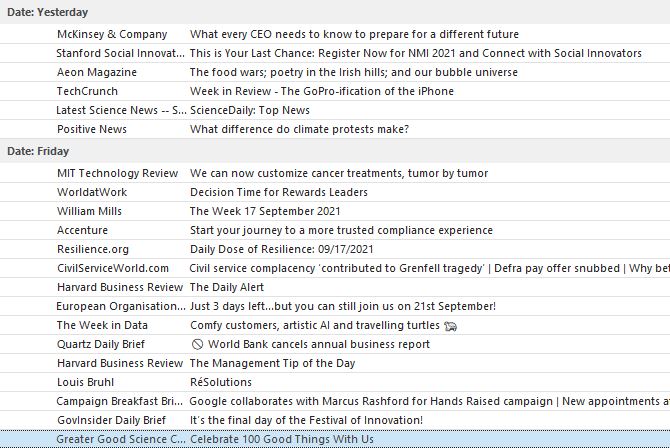
Image: https://www.nextgov.com/emerging-tech/2021/05/dod-not-prioritizing-development-gps-alternatives-gao-says/173993/

Organisation design: reading list

Last week someone sent me an email, saying: ‘I eagerly await your blog every week and set aside time to follow all the links you include.   It got me wondering – what blogs do you follow? What magazines do you subscribe to?  I’d love to get your reading lists, you make such interesting connections and my curious brain would love to follow what you follow.’

The hardcopy magazines I subscribe to are:  New Scientist, Economist, Big Issue, I read these three from cover to cover noting bits and bobs that catch my attention for a tweet, a link to a blog piece, or a thought I could pick up later.   

I have a folder on my laptop called ‘newsletters’, and it’s easy enough for me to answer the question “what am I reading?” by listing out all the items that drop into the folder. 

Skimming down it (see extract in image) I see I get about 50 different email newsletters per week – some are daily, some are weekly.   It’s a mix of topics, reflecting my curiosity and interests and the way I believe organisation design is touched, influenced and challenged by the interdependence/interactions of numerous interdisciplinary threads. 

The list isn’t static, I’m pretty ruthless on culling the ones I no longer read, or that have lost relevance to my work.  There are many others I’ve had over the years which I now don’t get. Sometimes I subscribe to a new one, perhaps one recommended by someone or one that I’ve come across in my blog research.  For example, two weeks ago, I subscribed to the newsletter from the Centre for Death and Society which I came across as I was writing my blog on death discussions in organisations.   (I think this topic will develop further in organisation design/development).

But the additions are not quite on a one in/one out basis.  What I’ve noticed is that I tend to keep the total coming in each week to about 50.  It’s a manageable number, and collectively provides a reasonable pool of ideas, challenges, insights and different perspectives.   The tweets I post each day are pretty much all sourced from the newsletters that come my way.

The newsletters and hardcopy mags I get I’ve put into rough categories below and given a few thoughts on why I get them. NOTE the categories also overlap somewhat in content. They are not discrete.

I haven’t put in all the links as it would take me too long and garden design calls, but they are all available for you to Google (google?) and take a look at. 

Technology:  All organisation designers (+ leaders/managers) must have a good grasp on what’s going on in the world of tech.  We live with it every day, we can’t avoid it, and our organisations, personal lives, and society as a whole, are utterly dependent on it.  We do read about the impact of technology on the world of work but that’s not really enough. Some technologies are being developed which are not currently talked about in relation to work, but I think will be. 

So, I get the daily TechCrunch, MIT Tech Review, Open Data Institute, Post*Shift Linklog, Information Week.  Take a look at Tech Crunch’s 18 September China Roundup, and see if you think this will what signals is this sending, what repercussions might it have in your organisation? 

News:  Keeping up with the news and business news (two different things) is hard.  ‘News’ selection is subjective, (why are plane crashes – people killed worldwide in 2020 = 229,  more newsworthy than road deaths – people killed worldwide in 2020 = 1.3 million?).  So what I consider news may not be what someone else does.  Nevertheless, it seems to be enough for my purposes to read The Economist, and get one of their daily newsletters, plus Positive News (we definitely need that), The Guardian, and Quartz.   Occasionally I look at the BBC website, or at the FT and WSJ -but the latter are both paywalled, although I have had a WSJ subscription in the past.

Business updates/comments:  Keeping up with what is going on in thinking around business and management is essential.  There’s a lot of info on business savvy, and I think it’s one of the areas of knowledge that organisation designers (+ leaders/managers) need to focus on.  It’s not enough to know about ‘your’ industry/sector – there’s much that can be learned from the way other industries/sectors do things.  In this category I get info from MIT Sloan Management Review, and Harvard Business Review (I’ve had subscriptions to these two in the past too), HBR Business Books,   Others I get are Stanford Business email (fortnightly), and some from the big 5 consultancies – Accenture, Deloitte, Bain, McKinsey, ReSolutions (I just subscribed to this a few weeks ago), Raconteur, Campaign, Workplace Insight,  De-growth, World@Work, knowledge@wharton, Insead knowledge,

‘Brain food’, culture, society:  I take the phrase ‘brain food’ from the FS blog of the same name.  That blog is thoughtful and provocative and was recommended to me a good while ago, and it’s one I’ve stuck with, although there are several others I enjoy of the same ilk – Brain Pickings, The Big Think, Action for Happiness, Aeon, Resilience.org, Greater Good Science Center, RSA (Royal Society of Arts), On Being.

Some in this category that are more specific to organisation design and development are Culturevist, The Ready, rebels@work,  Leandro Herrero’s daily thoughts (often make me laugh – they’re attuned to my experiences), Cognitive Edge, Stanford Center for Social Innovation, Complexity and Management, Systems Innovation Initiative, Intersection Group, Corporate Rebels.

Science:  I’ve already mentioned New Scientist, which I get as hardcopy and also get some of their other newsletters/updates.  I’ve long been a fan of Science Daily. It is a summary of research across the spectrum and there’s often some research going on that is fascinating and relevant to the organisational world.  Take a look at Leader effectiveness may depend on emotional expression

Think tanks/government/politics:  The external governmental geo-political arena sets a framework for organisational operation. I feel that organisation design/development depends on a reasonable level of awareness of the relationship between government decisions and the impact of these on an organisation’s design. For example, see the Apple/Google /Russian Government news this week – causing me to ask what are the organisational decision processes that led to that Apple/Google decision?  What are the design implications of the decision?  What are the stakeholder ramifications, etc. 

I also get newsletters from the UK’s Civil Service World, GovInsider (Asia Pacific), occasional news from the Doughnut Economics Action Lab, Strategic Reading, Reform (a UK think tank), Nesta (ditto).

Summary: All in all I spend some time every day skimming through what’s come in. You’ve got a taster of my current list.   What are you reading that relates in some way to organisation design?  Let me know.   

Organisation design and millennials

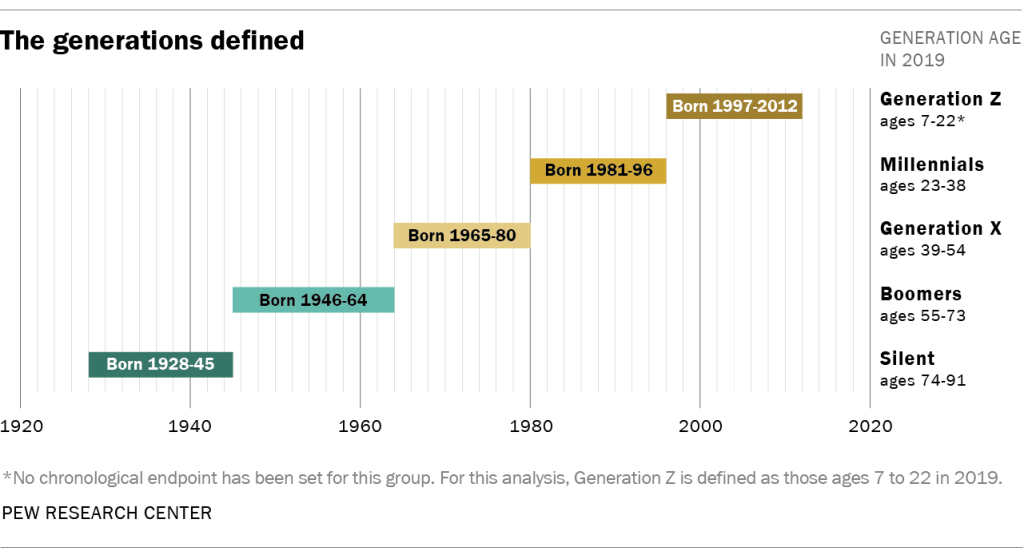
‘In order to keep the Millennial generation analytically meaningful, and to begin looking at what might be unique about the next cohort, Pew Research Center decided [in 2018] to use 1996 as the last birth year for Millennials for our future work. Anyone born between 1981 and 1996 (ages 23 to 38 in 2019) is considered a Millennial, and anyone born from 1997 onward is part of a new generation.’  25 – 40 now.

I looked up the birth years of Millennials when I was invited to be interviewed for a book that is being written.  The intent behind the book is to share a collection of strategies that will help the next wave of Millennial leaders find their next (or first) executive role.  In my case, the authors were particularly interested in helping Millennials, applying for an executive role, think about, and answer interview questions on their approaches to organisation design.   

Preparing for the interview, initially I wondered what the cultural boundaries are of ‘Millennialism’ i.e. is it a US/UK/Europe predominant label or is it global and are their common characteristics across nationalities, ethnicities, language, etc?

I don’t know the answer but the Deloitte 2021 Global Survey of Millennials and Gen  Z ‘solicited the views of 14,655 millennials and 8,273 Gen Zs from 45 countries across North America, Latin America, Western Europe, Eastern Europe, the Middle East, Africa and Asia Pacific’, and aggregated them into a single report, so I took that as a start-point.

It’s worth reading. The conclusion states.  ‘Emerging from one of the most difficult years of their lives, millennials and Gen Zs are more downbeat that at any time during the 10 years they’ve been surveyed … They’re tired of waiting for change to happen and are taking action to hold others accountable. But they understand their actions as individuals can do only so much to reverse climate change, create pay and wealth equality, and end racism and bigotry. They want organizations to work together—governments, educational systems, and business—to drive change on a much broader scale. … they want to work for companies with a purpose beyond profit—companies that share their values—and in ones where they feel empowered to make a difference.’

To my mind this argues for the millennials seeking executive roles to really question and probe whether they would have the power to change the organisation’s design, if it did not meet those sorts of aspirations (and whether they would want to work for an organisation that doesn’t share those aspirations).   

 But for the moment stick with the idea that it is the millennials being asked questions by the interview panel.  Below, I’ve briefly answered the list of interview questions the book people sent me, with the comment, ‘We likely won’t ask you these questions directly in order to maintain the spontaneous nature and energy of the interview authentic. We’re sharing these to help jog your memory and guide the discussion so we can keep the “spirit” of helping millennial leaders consistent.’   (It’ll be interesting to see the write-up/interpretation of the actual interview which was a lot more free-flowing than the q & a here). 

Why is org design important for people in executive roles? Tom Peter’s view is that “Design is so critical, it should be on the agenda of every meeting in every single department”  (Unfortunately, I can’t find the original source of this – if anyone knows it please let me know, maybe it was in the book In Search of Excellence) and I agree. Why?  Because good design translates an organisation’s purpose, strategy, and business model into execution, delivery and high performance.  Think of the bike race analogy – every element of winning a race is carefully designed to achieve that purpose.  (See the HBR article on this).

What is the difference between org chart and org structure? I’ve written several blogs on organisation charts and organisational structures.  For example, Talking about organisation charts, and What I talk about when I talk about structure . The chart and the structure are very different things. 

What is considered a bad org structure vs a good org structure?  I don’t know that there is a ‘good’ or ‘bad’. Some organisational structures (not charts) are better than others for a specific context and a specific organisation.  I have a handout on questions to ask about structure and also a blog on the topic, Questions to ask about structures,  which helps with some assessment. 

How do millennials answer and use the “Tell me about how was [XYZ] organization structured?” to their advantage in an interview?  This could only be answered well if the millennial was asked to talk about an organisation in their experience.  It’s a good question to have a prepared answer for.  There are thousands of case studies looking at organisations and the way they are designed.  Look for example at Business Case Studies  or Ivey Publishing . Reading through some of these would give the applicant ideas on how to frame an answer.    

How should millennials answer situational questions like “How would you structure our organization if you were to take this role?”   Assuming the millennial being questioned thinks the same way as those in the Deloitte survey, then they can pick up on aspects of the human centred organisation that Emanuele Quintarelli discusses in his organisation design work. Look too at the Intersection Group and Cocoon Pro .

What are some before and after case study stories of millennials who got org design wrong and what happened after it was turned around?   Words like ‘wrong’ are judger rather than learner centric.  A millennial could propose that ‘wrong’ could be framed as a learning event – look at the helpful resources on fail forward.  Stripe is an interesting case study of an organisation whose founders,  Patrick and John Collison are millennials, (born 1988 and 1990) appear to have this experimental, curious mindset that frames setbacks or failures not as ‘wrong’ but something to adjust/learn from.  Listen to an excellent podcast with Patrick, the CEO.  

What hacks, strategies, frameworks or words of wisdom would help aspiring executives in answering organisation design questions?   A person who can give examples of applying/not applying the following skills to any organisation design work they have led themselves or been involved in, be equipped with a basis for design awareness:

looking at the whole picture;

recognising that patterns change;

seeing that feedback loops exist, and that some nodes are more powerful than others;

acknowledging that different perspectives give different insights;

knowing that cause and effect can be delayed and chaotic, and may not appear related;

exploring the short-term, long-term and unintended consequences of action.

What is your 80/20 list for demonstrating organisation design experience/expertise.  It’s mostly about systems and people’s behaviours and interactions in systems.  I advise people to take a systems programme for example Systems Thinking in Practice

How would you answer the questions above?  Let me know.  

Organisation design: death discussions

In 2014 Tikker watches came to Kickstarter.  I bought one.   It was ‘designed to provide you with a constant reminder that life is truly short and we should take advantage of the time we have on this planet.   The Tikker System will give you an estimate of your life expectancy and then counts down every second so you can make choices that will enhance your life …  Buy one now and you will see how it immediately and positively affects you and those around you.    Start a new way of looking at life today!’  

I got it because I was doing a ToDo Institute Naikan programme, and there was some emphasis on how to live the 30,000 days of an average lifespan.  I wanted to know how many days I had left and stay alert to how I was spending the days and how I would like to have spent them or imagined myself spending the rest of them.  

Three years later, not because I’d lost interest in this but because it has become an ingrained and habitual way of thinking about my life, I put it on Freecycle and someone who had a countdown to launching his new business came for it. 

In fact, I got more interested in death and ways to approach it and last year trained to be a non-religious funeral celebrant.  But I am finding I am less interested in the one-off tribute at a funeral aspect and more interested in the social processes, systems, routines, rituals, planning and preparations for the ending of life.

Then, a couple of weeks ago, looking for some Humans Systems Dynamics Institute  (HSDI) resources for something completely unrelated to death or end of life, I saw a page on their website on Patterns with Death.  This resulted in two conversations – the first with Glenda Eoyang (HSDI)  and the second with Glenda and Liz Coenen about death – the rituals of it, the differing social attitudes towards it, the ripples that it precipitates, and the types of support people seek (or not) as they come into closer contact with death. (Note: there is an HSDI Facebook group on Patterns with Death)

These conversations have brought to mind a conversation I had sometime last year with Milan Guenther on the concept of hospices for enterprises.  We felt that there was too little recognition that organisations have a life cycle – they get stuck in the notion of phases of growth – per the classic Larry Greiner model. We wanted to see models of organisational lifecycle through decline to final ending become as commonplace as the growth model. Further we were interested in how these ending stages could be designed and managed well. (See the book: Organizational Pathology: Life and Death of Organizations)

Now, again wondering about this, I came across a special edition Culture and Organisation (2014, Volume 1, Issue 1) on exactly that topic.  Emma Bell introduced the articles in the journal saying, ‘Death is an integral part of organizational life, not only in talk and symbolism but also in a very real physical sense.  Despite numerous examples which illustrate the importance of organizational death as a meaning-making construct, scholars of organization have only rarely treated death as an explicit focus of study.’

Bell notes that, ‘The term ‘organizational death’ encompasses a wide range of individual and collective level phenomena. We were initially concerned with the metaphorical use of the term, either by researchers or by organization members, to account for the cessation of organizational function, for example, in situations of corporate closure or shutdowns of production units. Issues of organizational mortality, discontinuity and decline are particularly prescient in the wake of the global financial crisis; industrial and economic downturn, corporate failure, downsizing and plant closure have material, social and psychological effects on societies, organizations, groups and individuals. Organizational death can thus constitute a profound source of loss and suffering through the removal of fundamental structures of work-related meaning.’

As a note of caution, Tony Walter, Centre for Death and Society, University of Bath, in his paper Organizations and death – a view from death studies, which is in the special issue – says that speaking or thinking ‘of the ending of an organisation, or part of it, as organisational ‘death’, possibly followed by some kind of resurrection or reanimation ..  is a conceptually more problematic metaphorical use of the word ‘death’; and like all metaphors, may be useful for certain purposes if used appropriately, but misleading if taken too far.’

As well as the metaphorical death, Walters discusses four other forms of death in his paper:

  • Most obviously, individual members of organisations die and suffer personal bereavements; a member of the organisation or someone close to a member dies – with consequences not only for several individuals but also for the organisation or part thereof.
  • Organisations may cause, or at least contribute to, people’s deaths, for example through medical intervention, poor communication, harmful products, incompetent service, industrial accident, or suicide.
  • The food industry relies on the rearing of animals for slaughter and the subsequent processing of their remains
  • There is the question of whether, and if so how, awareness and/or denial of our mortal human condition affects the way people behave in organisations and what they expect from organisations.

Regardless of the form of death, talking about it of and in organisations often causes discomfort.  For example, the UK organisation Cruse Bereavement Care,  notes that, ‘For many employers, it can be difficult to know how to respond when an employee is bereaved, and how to ensure that the impact on both the individual and the organisation is minimised. With one in ten people in the UK likely to be affected by bereavement at any one time, employers can benefit from planning ahead.’

This ‘planning ahead’ is part and parcel of designing ways of working with and talking about death. Done well, it could support the purpose driven approach to organisation design that many advocate.  Emma Bell, again in her comments on the articles in the special issue of Organization and Culture, mentioned earlier, makes the point,  ‘It is only by coming to terms with the inescapable nature of death as a universal parameter and a constituent part of life that we can discard mechanistic, reductionist theories in favour of a more meaningful working life … all these writers show that death goes to the heart of what it is to experience life in organizations; we therefore cannot understand the meaning of organization without acknowledging death.

Knowing that individuals only have around thirty thousand days of life, and many organisations espouse notions of making work meaningful – should organisation designers introduce and work with concepts of death?  Let me know.

Endnote:  A London School of Economics blog, February 2021, estimates that 15.1% of UK businesses, registered and unregistered, are ‘at risk’ of permanent closure in 2021.  That is a lot of people affected by organisational ‘death’. 

Image:  Dying Matters