And now I’m Certified

‘Thank you for your CODP application and supporting materials. The review committee has evaluated the application and documentation combined, and found that you have provided all necessary means, as well as met all requirements for certification. Therefore, I am happy to inform you that the committee has granted you the certification – you can now refer to yourself as a Certified Organization Design Professional.’

That’s the email I got a few days ago.  It came as the result of evidencing that I met the criteria for certification and sending in the application payment.  (The 2018 payment is $150:00 but it is going up in 2019.  So, if you are interested in applying – go for it now to get the current rate).

The criteria info states:

‘As an organization design professional, you can become certified if you meet a set of criteria divided into education and practice – both criteria are estimated based on your achievements through the past two years.

You might be asking why I decided to apply for Certification?  I asked myself the same question – after all it’s a time and money commitment that is currently (as it’s a new certification) of uncertain value.  And, in applying I’d be making myself vulnerable to peer review.

The rational part of me kept telling myself I’m already over-committed to stuff and l need to practice saying ‘no’ to taking on anything that will take time – I didn’t need the added pressure of applying for Certification.  But as Mark Rowlands says, in his wonderful book, Running with the Pack ‘there was a small, sneaky, irrational part of me that always knew I was going to be standing at the starting line of this race’.  Though in my case it wasn’t in the starting line of a race, but the starting section of the application form.  (Helpfully this is ‘Your full name’ so I felt confident on that question).

The small, sneaky part of me that over-ruled the rational part of me did it by presenting four reasons why applying would be ‘a good thing’ to do. I’d be:

  1. Participating in a new venture that which is worth supporting
  2. Contributing to an effort to professionalize organisation design
  3. Reflecting on what I have learned and developed in the past two years
  4. Testing and learning from the application process and criteria for myself

I’ll discuss each of these in turn.

Participating in a new venture that is worth supporting.  Organisation design is what academics call a fragmented field that (adapting from a paper on knowledge management) ‘lacks a common conceptual core; it is cross‐disciplinary, it addresses a wide variety of organisational phenomena, and it has difficulty distinguishing itself from many related areas of organisational/consulting practice’.   In my view, any effort that in the words of the Organisation Design Community (ODC) helps ‘research, practice, and learning intersect to produce valuable design knowledge and applications’ is worth supporting.  The Certification is a new part of the several activities orchestrated, individually and collectively, by the ODC, the Organization Design Forum, and the European Organization Design Forum designed to do that.

Contributing to an effort to professionalize organisation design.   A definition of ‘a profession’ that I agree with says: A Profession is a disciplined group of individuals who adhere to ethical standards and who hold themselves out as, and are accepted by the public as possessing special knowledge and skills in a widely recognised body of learning derived from research, education and training at a high level, and who are prepared to apply this knowledge and exercise these skills in the interest of others.’  Over the years I’ve been involved in the field there has been no recognised endorsement of professionalism although there are numerous short and long programmes that teach organisation design (see my blog on this).  However, now organisation design is the ‘hot topic’ it’s time that it became a recognised ‘profession’ with a code of ethics and a process for quality assuring the practitioners in a way that gives confidence to buyers of organisation design work.  Note that this is early days on the ‘professionalizing’ road and the handbook of certification explicitly states ‘Certification does not warrant or guarantee the individual’s expertise in the field of organization design, nor does it signify that the individual is equipped to manage a given project within the field.’

Reflecting on what I have learned and developed in the past two years.   I’ve been in the Organization Design field for over 20 years and I think I have expertise in it.  With this, I’m conscious that, in the words of researcher Elizabeth Jones, ‘Expert professionals act at a level of automaticity with knowledge that enables efficient, effective and unselfconscious practice. They must also extend the theoretical and research knowledge that informs their practice and engage in critical enquiry into their own practice. Through these processes, professionals acquire new knowledge and skills as they develop a well-elaborated and improving theory of practice.’

My rational self pointed out that completing an application form hardly constitutes reflective practice.  (For more on that read the classic, and excellent, Donald Schon book,  The Reflective Practitioner: How Professionals Think In Action).  However, it did require me to look back over two years, see what I’d been writing about, working on and learning.  In that look-back process I did get some insights on how my practice has changed.

Testing the application process for myself.  Having got myself across the start line of form completion and completed the name, education, etc sections I tackled the 4 questions that form the meat of the process:

  • Describe your general experience with organizational design
  • Describe below how you meet the education requirement by providing information in the table with educational activity you have participated in
  • Using the table below, please describe in detail how you have achieved 1040 hours practical organizational design experience within the past two years
  • Describe how your background has supported your work as an organization design professional

This turned out to take quite a bit of time and effort (as my rational self had predicted).   Sifting through files, memories, and documents for the right combination of practical, theoretical, educational and developmental information resulted in a couple of trash-bags of documents I don’t know why I kept so long, a re-ordering of my on-line files to make info retrieval easier, and finally some paragraphs I felt happy enough with to submit.

In getting to this point I also ended up with ten questions about the Certification:

  1. Do trainers facilitating the accredited courses need be certified practitioners? (I think not).
  2. Who supervises the reviewer panel?
  3. The requirements for course accreditation are very detailed.  Are the reviewers looking for this type of information in the individual practitioner certification?
  4. How much value does individual certification process and the course accreditation process add to organisations wanting organisation design skills?
  5. Are there bursaries for people/organisations who can’t afford the certification/accreditation fees?
  6. Is three years too long before individual re-certification given the current pace of organisational change?
  7. Should the assessment process be more rigorous – for example the requirement to submit a portfolio of evidence?
  8. Should there be more emphasis placed on the ‘reflective practitioner’ in the assessment process?
  9. Should people being certified also agree to conform to a code of ethics? (Note: the ODC members agree to adhere to the Academy of Management Code of Ethics.  The ODF and EODF do not have a response when the term ‘ethics’ is entered into their search box).
  10. Is there a plan to start quality assuring the practitioners?

As I’m an Advisory Board Member of the EODF and ODC I can pick these up with the ‘relevant authorities’.

Meanwhile I can happily report that the certification process focused my mind on what matters in my OD work, encouraged me to reflect on my OD practice, and provided a lovely review point of the highs and lows in my recent OD career.

Do you think a Professional Certification in Organisation Design Practice is an individual or organisational value-add?  Let me know.

Puzzling over the hidden matrix

I’ve been puzzling over a matrix organisation again.  (See my earlier blog Matrix structures: the pessimism advantage) Talking about a matrix seems to elicit the Marmite response – love it or hate it.  Apparently whether you love or hate Marmite is down to your genes.  I wonder if the same can be said for a matrix organisation?

Marmite has an Australian equivalent, Vegemite, and they’re similar but different. That’s true for matrix organisations too.  There are similar but different ones.  I found a useful definition of terms on this:

Matrix  Any organizational structure in which the project manager shares responsibility with the functional managers for assigning priorities and for directing the work of individuals assigned to the project.

Balanced matrix   A matrix structure in which the project manager and functional managers share roughly equal authority over the project. The project manager decides what needs to be done; functional managers are concerned with how it will be accomplished.

Strong matrix  A matrix structure in which the project manager has primary control over project activities and functional managers support project work.

Weak matrix  A matrix structure in which functional managers have primary control over project activities and the project manager coordinates project work.

A formal matrix organisation of the type defined above is usually shown on an organisation chart as two dimensions – vertical and horizontal – with, for example, function or product on the vertical axis and project or geography on the horizontal.   The intended purpose of this dual reporting is to increase lateral co-ordination at the levels below the leadership team.

Nicolay Worren in a 2012 blog asserts that ‘When you examine a particular firm more carefully, however, you usually don’t find that people report to more than one boss (formally), although they of course may work for multiple managers in a variety of different roles. Yet this [reporting to more than one boss] was the defining feature of the matrix organization when it was first conceived.’

(If you feel so inclined, you can take a quiz testing your knowledge of matrix structures – which could feel rather similar to taking a blind Marmite/Vegemite test).

What that list of types of matrix doesn’t show is one which I, like Nicolay Worren, think is the most common – the ‘hidden matrix’ as he calls it:  ‘By that I mean governance processes and authority relationships that cross the formal units, but which are not shown on the official organization chart (and that are usually not deliberate)’.

In the Marmite/Vegemite test, the idea is that there’s a ‘winner’.  You like Marmite more than Vegemite or vice versa.  You’d think that this form of competition should not feature in a formal matrix organisation in which one-person reports to two ‘equal’ managers.   But  in practice people favour a hidden matrix (where they are working for, not reporting to, multiple managers) over a formal one because they favour whatever will allow them to get their work done in order to meet performance objectives.  Often the hidden matrix develops as a sensible workaround to a faulty formal structure whether it’s matrix or another structural form.

Many organisations now comprise several dimensions, for example:  functions, projects, geographies, and sectors (industry or product or service).  Add in governance systems and then add in an element that requires collaboration with a completely different organisation if the product/service is to be successful delivered and you have six dimensions to structure. How can these be structured?  Could they, for example, be structured as a formal matrix, like a mathematical one of rows and columns?

In this multi-dimensional organisation it is inevitable that the hidden matrix will be hard at work, aiming to combat some of the shortcomings of any formal organisation structure.  However, a hidden matrix also has shortcomings.

Worren outlines three difficulties with the hidden matrix:

  • It creates a difficult role for the middle manager.
  • It makes it difficult for top executives to assign real accountability to a sub-unit.
  • It introduces a conflict of interest, or a goal conflict.

These are almost identical difficulties to those identified in a formal matrix (one person reporting to two managers).   A research paper identifies multiple negative issues:

‘… the risks of loyalty conflicts and unclear accountabilities; and localised claims to authority (authority bias) and decisions and actions taken in isolation lead to the risk of poor decision-making. Overlaps in responsibility and authority can result in power struggles and conflict, leading to the risk of slow response time. Preoccupation with sectional interests and infighting can result in a tendency toward anarchy, leading to the risk of control problems. Dual reporting, role ambiguity and conflict, and competing objectives and priorities can lead to personnel issues, such as the risk of staff stress and turnover.’

My current puzzle is to do with multi-dimensional organisations.  I’m puzzling over  how to develop a formal structure and whether the ‘hidden matrix’ can emerge/be visible within a formal structure,  in a way that people understand, that marries the hidden matrix with the formal structure and that makes work more efficient, effective and enjoyable in practice.

This would not be such an issue if people were less interested in the visual organisation chart and more interested in enabling work to get done effectively and efficiently.   We could show organisational relationships, work flows, and interactions via network mapping or similar systems maps and then potentially adjust workflows and interactions in response to what we see.  However, the current reality is that the majority of people cling to the idea that they need an organisation chart and that changing the chart will solve organisational issues.

That tendency aside, assuming that a formal organisation cannot be structured easily from the multi-dimensions and that the hidden matrix organization, inherent in any formal organization structure brings problems and risks, what can be done to make the hidden matrix visible, and the formal organization more accommodating of the matrix within it?

In the case I am working on, I’m going to recommend we do six things:

  1. Brokering conversations about the attributes of the hidden matrix and the relationship of it to the current organisation structure
  2. Developing the positive attributes of the hidden matrix
  3. Minimizing the negative attributes of the hidden matrix
  4. Assessing ways of making the hidden matrix visible
  5. Encouraging people to stop looking at, then changing, organisation charts i.e. reporting lines as the sole means of solving issues
  6. Identifying and then reporting on measures of organizational structure performance

Hidden matrix structures are here whether you love them or hate them. We’re not looking for a winner but for an ability to work with, what two researchers called the paradoxes of a matrix:

  • increased frequency of lateral communication vs ambiguity over roles, responsibility, and conflict between functional managers and project managers;
  • improved motivation and commitment vs heightened conflict among employees; and
  • high ability to process information vs decision strangulation and slow response times.

How would you approach making the hidden matrix visible in order to make a formal organisation structure more efficient, effective and enjoyable?  Let me know

Image: Antony Gormley, Matrix II


Developing the transition plan

(Each of my blogs in August is an edited extract from my book Organization Design: the Practitioner’s GuideThis is the fourth – from Chapter 6)

Imagine that in the design phase the high-level design team has determined that the organization should no longer be a bureaucratic hierarchy, but be a ‘flatarchy

The characteristics of this flatarchy are very different from those of the current organization. As part of the design work, the design team has developed a ‘from–to’ description

Your task now is to develop the detailed design of the ‘to’:  how many people, what are their skills, what will they be doing, how will they be working, what technology will they be using, what work processes will they be following?

Start by arranging a ‘kick-off’ meeting with the people who worked on designing the high-level model and the people who are going to take this model and work it into a detailed plan for the transition that takes the organization from current to new design.

Think of the kick-off meeting as like passing the baton in a relay race between one team and the next. The difference is that the designing group tends to be one team (although that is not always the case) and the planning group tends to be several work teams, (although, again, this is not always the case).

The kick-off meeting should:

  • Review the work that has happened to this point.
  • Confirm the chosen high-level design option (consider retesting the design for workability and capability to deliver the future state).
  • Log any amendments, new ideas, issues and concerns.
  • Identify obvious areas of work to close the gap between the current and new design
  • Setup teams to work on each area of work with a designated team lead.
  • Do a very high level scope of each team’s work and develop the broad-brush initial actions and outputs envisaged by each work stream. Use activity cards or a Kanban board to keep track.
  • Schedule the next few meetings.

Each team’s task is to work out what, for their part of the system, has to happen to move from the current state to the new organization design. Their work must align with the work of each of the other teams to deliver something that is more than the sum of the individual parts.

Working through this gap-closing exercise to carry out all the tasks and activities needed and putting them into a project plan with milestones and resources required takes time and is an iterative process that starts during the kick-off meeting. Judging how much time is reasonable to allow for transition planning depends, among other factors, on:

  • the scale and complexity of the design project;
  • the level of comfort staff feel with more or less depth of detail and planning; and
  • whether stakeholders are willing to start transitioning some aspects of the design ahead of others.

Borrowing some of the methods of agile methodology and applying them to the transition planning is one way of speeding up this phase and entering the transition phase.  For example, the concept of ‘minimal viable product’ is helpful. In software development, this relates to a point when a new product is developed with sufficient features to satisfy early adopters. The final, complete set of features is only designed and developed after considering feedback from the product’s initial users.

For this phase of organization design, consider what are the absolutely key things that have to change in order to move from the current to the future desired state (determined by impact, or consequences of not changing, etc.)  Plan these first, and then start to action them as you continue with the transition planning.  Starting to act as planning proceeds prevents people from getting stuck in the planning.

Another agile concept that can be usefully applied during this detailed design work is that of ‘sprints’. One organization introduced a hybrid of agile methods, including sprints, to OD projects and explained the approach through a series of ‘Rough Guides’ – one for each phase of the design method. The Guide to Transition Planning opens with the statement:

We are increasingly familiar with agile methodology and terminology. Agile is an alternative to traditional PM, typically used in software development. It helps teams respond to unpredictability through incremental, iterative work, known as sprints.

This Guide shows you how to use the agile methodology and terminology in the transition planning phase of an OD piece of work.

In this approach, transition planning teams work in a series of sprints with daily stand-ups.  An OD lead and the project manager hold daily stand-up meetings with OD leads from the work streams. The OD team members keep track of consistency across the pieces of work and, as the detailed planning proceeded, liaise with the project manager on what should go on the plan.

At the end of each two-week sprint the teams meet in a workshop to review progress on the design, discuss what they have learned and/or tested, and agree the objectives for each team for the next two weeks. Usually after a 3 or so 2-weeks sprints most aspects of the high-level design have been detailed, tested further, verified and validated, and an implementation plan is ready to be signed off.

In a more traditional approach, each team lead reports weekly to the project manager and OD lead, who co-ordinate, monitor and support their activity. A straightforward and useful way of capturing weekly progress is through ABCD reports, where A = Achieved this week; B = the Benefit this activity has brought to the project implementation planning; C = any Concerns or issues that have surfaced during the week; and D = the planned activity for the coming week (to Do).

This is a simple format for keeping the detailed design teams on track and feeding information to the project manager that will go into the plan. Each team lead completes it for their team. The team leads circulate their updates to one another for discussion at a weekly face-to-face or telephone meeting with the project manager and OD consultant. Following the meeting (when actions have been agreed), the project manager consolidates the information in one document and circulates it to the project steering group members, along with the plan on a page from the starting phase to refer back to and discuss/amend in the light of reported progress.

As this detailed planning work proceeds, the project manager focuses on three things: ensuring that each work stream is delivering to target, populating and updating the transition plan, ensuring alignment with any parallel initiatives or other work going on in the organization that will affect the new design but is outside its scope.

Making the connections with interdependent projects and work is helped, not only by formal governance, but also by encouraging informal collaboration and transparency across the organization and asking questions, for example: ‘Are we making the connections?’, ‘What are we missing?’, ‘What are the possible impacts of what I am doing on other aspects of work I know about?’ Also ask employees to raise an alert if they see a ‘join the dots’ opportunity that may be being missed.

The ‘product’ coming out of the detailed designing usually includes the following:

  • a developed, articulated and communicable vision of the new organization;
  • clearly described and agreed business objectives and measures;
  • the detailed organization structure (levels, layers, spans, linkages, co-ordination mechanisms);
  • mapped core business processes/workflows with interdependencies and hand-off points;
  • defined units of work that feed into roles and jobs;
  • descriptions of the jobs and person specifications with decision and authority levels;
  • descriptions of ways of working (behaviours, principles, protocols);
  • a transition/implementation plan that closes the gap between the current and the new design state with a timeline and metrics.

How do you do the detailed planning to move from a current to a new design?  Let me know.

Image: Planning v improvisation

Evaluating organization design work

(Each of my blogs in August is an edited extract from my book Organisation Design: the Practitioner’s GuideThis is the third – from Chapter 8)

In organization design work there is often little appetite to evaluate whether the work has led to performance improvements.   But there are many benefits in doing an evaluation, for example:

  • It focuses the OD work on the context of the business strategy, because it forces people to answer questions like ‘Why did we do this?’, ‘How will are we achieving the return on investment in doing it?’ and so on.
  • It defines improvement in both qualitative and quantitative terms, and ties it closely to achieving business objectives using measures that feed into the overall organization performance measures.
  • It puts the design work in a timeframe and helps the client see what outcomes might be expected as ‘quick wins’ and what results will take longer to achieve and measure.
  • It places accountability for improvement in the hands of the line manager – which usually means a close eye is kept on progress and quick decisions are made if called for.
  • It fosters sharing of learning on successes and failures in OD work
  • It enables issues to be identified and action taken as needed.
  • It identifies where there are opportunities to take things further and deliver greater benefit than originally thought.
  • It suggests routes to building organizational resilience: that is, ‘the ability of an organization to anticipate, prepare for, and respond and adapt to incremental change and sudden disruptions in order to survive and prosper’ (Denyer, 2017).
  • It assesses whether and how the design is solving organizational problems and adding value as it does so.

Assuming agreement to conducting an evaluation, follow these seven steps:

Step 1 – Agree the evaluation need

  • Work with the business unit to help define what success would look like, not just at this point but into the next year or so. Because the context is changing all the time, there is a need to judge whether the design is on the right course to meet the goals set at the start, and if it will continue to do so as new goals emerge – or, if this is looking doubtful, what action to take.
  • Make sure that the sponsoring manager considers how the new design contributes to the overall organizational strategy and goals – and what other interrelated factors need to be considered when making OD changes in their area. This is important because it helps people remember that their piece of work is one element in a whole system. Clients often forget that what they do in their part of the organization is interdependent with other parts.

Step 2 – Agree who the evaluation is for and why

  • Discuss the reasons for doing the evaluation: as well as determining whether the new design is delivering the intended outcomes, there may be a need to decide something, seize an opportunity, learn something new or to assess the return on OD investment.
  • Agree who the audiences are for the information from the evaluation (e.g., customers, bankers, funders, board, management, staff, customers, clients, etc.). This will help decide what evaluation tools to use and how to present the information from the evaluation process.
  • Consider the kinds of information appropriate to the intended audiences. For example, is it information to help understand:
  • Encourage people to question the metrics they are currently tracking: are they inputs, outputs or outcomes? Quite often effort goes into measuring the wrong things or measures something that will encourage perverse behaviours.

Step 3 – Choose the evaluation methods

Determine which of the three types of evaluation data to collect: quantitative (numbers), qualitative (words and observation), or mixed (numbers, words and observation). The choice depends on the context, as each type of data has advantages and disadvantages, and none is perfect. Any data captured should be valid, current, relevant and reliable.

  • Assess the tools available in the market for design evaluation. Some tools will be better than others for particular jobs.
  • Bear in mind when making evaluation tool choices:
  • From what sources should the information be collected? For example, employees, customers, clients, groups of customers or clients and employees together, programme documentation?
  • How that information can be collected in a reasonable fashion? Through questionnaires, interviews, examining documentation, observing customers or employees, conducting focus groups among customers or employees?
  • When is the information needed? By when must it be collected? What resources are available to collect the information?
  • Agree, at an organizational level, a ‘basket’ of measures that leaders can pick from so that you will be able to compare one organization design with another. This ensures some consistency across the organization.
  • Ensure you pick measures which can be tracked on an ongoing basis, preferably from before the design work began, through its progress into the new design and beyond. This means thinking carefully about measures that will be appropriate throughout the life cycle of the design.
  • Avoid measuring the same thing in two different ways, so review any measures that are already in organizational use (e.g. on leadership, innovation, collaboration, etc.) to check that they are the right ones, and develop measures that fill any gaps.

Step 4 – Agree how the tool or tools will be applied

Remember, almost any tool, quantitative or qualitative, can be applied in a number of ways. For example, the choice of a quantitative survey raises a number of questions: should it be paper-based or web-based? Should it be administered to a sample of the population (what type/size of sample?) or to the whole population? Should it be at one time point or several time points, or should it be a continuous real-time data collection?

Step 5 – Prepare the ground for success

Be aware that there can be unexpected consequences of applying an evaluation tool, as the context is usually complex. For example, deciding to do a skills-level analysis could result in trade union intervention if it was felt the results of the analysis would be used to select individuals to make redundant.  Identify and manage the risks of things going wrong.

Step 6 – Decide who will do the evaluation

Selecting the right people to evaluate the outcomes of the design work involves finding those who are some or all of the following:

  • members of the department/consultancy conducting the review;
  • people with working knowledge of the business area under review and its processes;
  • people with relevant technical knowledge;
  • strategy planners with knowledge of the organization’s business strategy and the OD’s contribution to it;
  • people involved in meeting the objectives of the new design but not directly involved in its design and planning.

 Step 7 – Agree how the evaluation findings will be communicated and to whom

Evaluation yields different types of information and knowledge to share with other project teams and with stakeholders. Many large organizations describe themselves as ‘siloed’ and have difficulty learning from their own members. Communicating evaluation findings to the different stakeholder groups, using a variety of communication channels, helps spread good practice and develop common values and consistent approaches.

There are some common problems that may be encountered in evaluating but these can be minimized by:

  • harmonizing the measurements across business units (preferably in the assessment phase);
  • establishing protocols for capturing and retrieving design work documentation
  • making formal agreements with departments/BUs to participate in the review process (as part of the business case).

Done systematically, the evaluation will yield actionable information on things that must be addressed to optimize the new organization design.

Do you evaluate your organization design work outcomes?  If so, how?  Let me know.

Image: https://patternedpetals.com/home/2017/12/5/art-through-time

What triggers organization design work?

 (Each of my blogs in August is an edited extract from my book Organization Design: the Practitioner’s GuideThis is the second – from Chapter 4)

Organization design work starts in many different ways. Sometimes a practitioner is presented with a new organization chart and told to ‘make it like this’; sometimes it can be a casual conversation that results in a piece of work; at other times, it can be a feeling or statement that something needs addressing (an opportunity or a problem); and frequently it can be a planned piece of work developed out of a particular strategy – for example, a merger. Sometimes it is the practitioner who starts the conversation: ‘Does this need design work?’, and sometimes it is either the client or someone else in the situation who raises the question.

Almost without exception, behind the question ‘Does this need design work?’ is a changed, changing, or predicted-to-change organizational context. It is this context of change that is the trigger for design work. The question ‘Does this need design work?’ enters someone’s consciousness either as a reaction to a changed context or as a recognition of a current context in flux or as a prediction of an about-to-change context. In the example below, a consultant was approached by a board member of a multisite educational organization in the Middle East. The consultant summarized their discussion as follows:

‘You are clear that the Institute does need to change. It is federally funded and has a commitment to operate efficiently, offer a high-quality educational experience to students, and create ecosystems of innovation and entrepreneurship that help take the region into twenty-first-century growth and productivity. The government has stated that your emphasis now has to be on building future-facing capacity, capability, and hard and soft skills in the local workforce in order to reduce reliance on expats. What you are looking for, at this point, is support in:

  • Taking the agreed strategy and, from it, developing an implementable operating model and OD
  • Developing the detailed implementation plans with success metrics
  • Executing the plans and measuring the benefits realized by the new operating model and OD
  • Ensuring that Institute staff, students and stakeholders understand the need for change, how it is to be achieved, and their role in making the change successful. [/]

In this example, the conversation on design work was triggered by the recognition of a political and economic context currently in flux, resulting in the need to create ecosystems of innovation and to reduce reliance on expats by building local capability.’

In most cases, organization members are able to identify current and short-term context changes, but they have a harder time with long-term horizon scanning. However, this is what is most likely to sustain an organization’s existence and keep it thriving. Amazon’s CEO, Jeff Bezos, is well known for his rare skill in holding a long-term perspective, which has led to Amazon’s huge success. Amazon is continuously designed and redesigned with the long-term perspective in mind. Every year Bezos reissues his 1997 letter to shareholders stating his position on long-term thinking. The full letter is long, but its main point is that Amazon cannot realize the potential of its people or its companies unless it plans for the long term.

The desire to work to short-term around OD work is attributable to several factors, including the requirement to hit quarterly earnings targets, lack of management or leadership time to reflect and discuss a longer-term future, constant ‘firefighting’, being rewarded only for immediate results, and/or not caring about the future of the organization because current decision-makers will not be part of it.

Short-term design can be useful to help address an immediate problem – providing the problem is solved and is not just the symptom of the problem. Often, though, short-term decisions on design can compromise longer-term value and bring the risk of having to ‘unpick’ the work and redo it (See: Silverthorne, 2012).

One of the roles of an organization designer is to help clients and other stakeholders understand the risks of responding only to short-term triggers and to understand the value of taking a longer-term view. Ron Ashkenas, consultant and author, offers three points for developing and then optimizing designs that have a longer-term horizon (5–15 years).

‘1    First, make sure that you have a dynamic, constantly refreshed strategic ‘vision’ for what your organization (or unit) will look like and will achieve 3–5 years from now. I’m not talking about a strategic plan, but rather a compelling picture of market/product, financial, operational and organizational shifts over the next few years. Try to develop this with your direct reports (and other stakeholders) and put the key points on one page. This then serves as a ‘true north’ to help guide key decisions.

2    Second, make sure that your various projects and initiatives have a direct line of sight to your strategic vision. Challenge every potential investment of time and effort by asking whether it will help you get closer to your vision, or whether it will be a building block to help you get there. Doing this will force you to continually rebalance your portfolio of projects, weeding out those that probably won’t move you in the right direction.

3    Finally, be prepared to take some flack. There may be weeks, months or quarters where the results are not on the rise, or don’t match your (or analysts’) expectations. Long-term value, however, is not created in straight lines. As long as you’re moving iteratively towards the strategic vision on a reasonable timeline, you’re probably doing the right things. And, sure, you can always do more. But just make sure that you’re doing things for the right reasons.’

It’s important to keep communicating to stakeholders, as Bezos does, the reasons for taking a longer-term approach and to be continuously designing the organization.  It helps to back up the communication with narrative and quantitative information that ‘provides a holistic picture of the business, describing the economic, environmental and social performance of the corporation as well as the governance structure that leads the organization. By embedding environmental, social and governance (ESG) data into financial reports, a company achieves an effective communication of its overall long-term performance’ (Silverthorne, 2012).

People in organizations weak at horizon scanning, future thinking and forecasting can look for help in various quarters. As Thomas Frey, World Future Society, points out:   ‘Since no one has a totally clear vision of what lies ahead, we are all left with degrees of accuracy. Anyone with a higher degree of accuracy, even by only a few percentage points, can offer a significant competitive advantage’

Whether your perspective is short-term or long-term, the thing to bear in mind is that:

‘Any organizational structure should be temporary. Organizations have no separate existence; they function as tools of the business. When businesses change their priorities … then organizations must be changed, sometimes even discarded. That is why it is so wrong to encourage employees to identify with the organization – they need to identify with the business. If you are a Bedouin, it’s the difference between the tent and the tribe. As for building an organization, I think [Henry] Mintzberg got it right when he suggested that two things must be settled – the division of labor and co-ordination after that. But again, any division, any organization is always temporary.’ (Corkindale, 2011)

Do you think organization design is triggered by changes in the external context?  Let me know.

Image Hot topic: trigger points – myth or magic?


A leader’s role in organisation design and development work

(Each of my blogs in August is an edited extract from my book Organisation Design: the Practitioner’s GuideThis is the first – from Chapter 9)

Leaders play a critical role in three ways in relation to organisation design and development (OD & D) work: stating and explaining the ‘why’ of design or development; supporting people in making sense of the context that the OD & D work is responding to; and telling the stories of how it is going. Here I discuss these three aspects.

There is no value in doing OD & D work if the ‘why’ of doing it is not clear to people. Too frequently, unfortunately, the ‘why’ is not obvious – ‘if things are going nicely, then why change them?’ is a common response to proposed OD & D work. Reasons for doing OD & D work that are rather vague, for example, to be more adaptable’, ‘to be fit for the future’ or ‘to be more competitive’ are not enough to convince people that the value to be gained from OD & D is worth the effort.

It is an organization’s leaders to state the ‘why’ do an OD & D piece of work in words that are meaningful to stakeholders so that stakeholders understand how the new design will affect them.

Simon Sinek, who wrote a book ‘Start with Why’ , says that a ‘why?’ statement has two parts: first, a part that clearly expresses the unique contribution and second a part that conveys the impact of an organization. For example, the UK has a Financial Conduct Authority. Why? ‘To make financial markets work well so that consumers get a fair deal’. The organization’s contribution is ‘to make financial markets work well’ and the impact is ‘so that consumers get a fair deal’

Taking the same approach to an OD & D piece of work in the Financial Conduct Authority, asking the question, ‘Why do OD & D?’ might result in a statement like ‘To make our business quicker at identifying and responding to European Union regulatory changes so that citizens are well informed and prepared when the changes happen.’

A leadership team that spends time really thinking through the question ‘Why do OD & D work?’ – focusing on its impact on the work and the workforce – makes a big difference to the speed at which work can progress.

Explaining the ‘why?’ of  OD & D work helps people make sense of what is going on. Leaders often see more of the context, and have more of the ‘puzzle pieces’, than people who are focused on doing a particular task or role. Having access to the ‘bigger picture’ puts leaders in a good position to make sense of complex environments for themselves.  It is then the leader’s responsibility to help employees understand the ‘why’ make sense of it and put it into their own words so that within a short space of time a reasonably consistent and common view emerges of the reasons for the OD & D activity.

Sense-making is an important part of OD & D work.   People typically become anxious in situations that they are not expecting, or that come across as uncertain and ambiguous. They look to leaders to interpret and make sense of the situation for (or with) them. Failure to do this on the leaders’ part leads to heightened anxiety and multiple individual interpretations of the situation.

Deborah Ancona, director of the MIT Leadership Center at the Sloan School of Management, Massachusetts Institute of Technology, explains how leaders go about sense-making:

This sense-making ability is a particularly important predictor of leadership effectiveness right now. … It requires executives to let go of their old mental models and some of their core assumptions; to take in data from a wide variety of sources; to use the information they have to construct, with others, a ‘map’ of what they think is going on; and to verify and update the map – in part by conducting small experiments that provide the organization with more information.

Researcher Sally Maitlis found that leaders approach their role of supporting collective sense-making in one of four ways:

  • Guided, where they are ‘energetic in constructing and promoting understanding and explanations of events’;
  • Fragmented, where leaders are not trying to control or organize discussions but allowing stakeholders to generate alternative pictures;
  • Restricted, where leaders promote their own sense of what is going on with little stakeholder involvement; and
  • Minimal, when both leaders and stakeholders await some other interpretation of the issues.

If leaders of OD & D work take a combination of guided and fragmented sense-making approaches then stakeholders are more likely to feel involved in the design process. This is tricky to handle. The guiding sets the framework and the outlines; the fragmenting allows for local or individual interpretation within the framework.

Explaining the ‘why?’ and guiding stakeholder sense-making can be supported by storytelling. Be aware that although stories can be an effective and inspirational tool to make sense of what happens in organizations, or to inspire, provoke or stimulate change they can also be used to mask the truth or to manipulate.

Writer Chimamanda Ngozi Adichie, in her Ted talk ‘The Danger of a Single Story’,  reinforces this point, saying: ‘Stories have been used to dispossess and to malign, but stories can also be used to empower and to humanize. Stories can break the dignity of a people, but stories can also repair that broken dignity.’ She follows this by warning of the dangers of a ‘single story’ or (as a common organizational phrase has it) ‘one version of the truth’. (This phrase originally came from the technology world, in relation to having a data warehouse that was the single source of organizational data.)

Adichie goes on to say:

‘It is impossible to talk about the single story without talking about power. There is a word, an Igbo word, that I think about whenever I think about the power structures of the world, and it is nkali. It’s a noun that loosely translates to ‘to be greater than another’. Like our economic and political worlds, stories too are defined by the principle of nkali: how they are told, who tells them, when they’re told, how many stories are told, are really dependent on power.’

For her, ‘many stories matter’ – a single story does not illustrate a complex situation. When telling stories, leaders should recognize that there are many possible stories about the same situation. Effective leaders, who are good as storytellers, neither abuse their power nor tell a single story. They tell many stories – drawn from guided and fragmented sense-making – and they tell these stories from a position of equality and respect, illustrating organizational complexity, a diversity of views, and their own responses to uncertainty. Stories told this way – that explain the why, and acknowledge uncertainty and anxiety – help to build confidence in, and an emotional connection to, the new design. They also demonstrate authentic, transformational leadership.

What would help your organisational leaders do effective OD & D work?  Let me know.

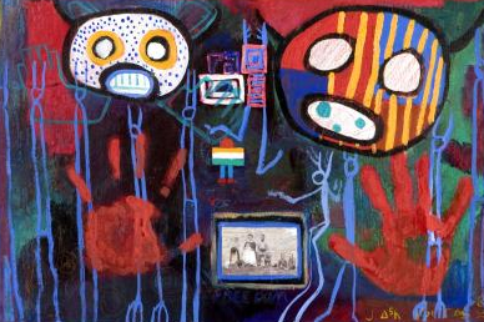
Image: Jane Ash Poitras

Designing OD & D learning: the criteria

What would you put in a 5 day internationally appropriate organisation design and development training programme, aimed at practitioners who have a basic view of the disciplines and who want to extend their skills, knowledge and confidence in these?

My task is to develop the outline for such a programme, and now I’m taking the first steps, eating my own dog food – as the saying goes – in doing this.

The first step, according to my new book (Chapter 4), is ‘Starting’ – blindingly self-evident yet easier said than done.  Each of the actions (recognising the triggers for the design work, meeting the client, agreeing the contract, finding out the context, getting commitment for the work, writing the case for it, starting the stakeholder engagement and risk management) takes time to complete.  In our case, they began 5 months ago in February.  However, we’ve now completed them and we’re into the ‘Designing’ phase.

This phase starts with the design criteria and I’ve roughed them out for the programme.  I’m now incubating them pending improvement and discussion, but here’s what they currently look like – with some questions I’m pondering shown in italics.

The course design must:

1              Be clear and simple in language, style, and content in order to work for people who do not have English as a first language.

(Note to design team: how will we test this?  Do we need a text analyser,  or someone specialized in English as a second language on the design team? Will we allow for activities to be conducted in the native language although the course will be in English – or will it be?  Could it be designed to be delivered in other languages – how would we train facilitators?)

 2              Show the relationships between organisation design, development and change management clearly throughout the 5 days in order to demonstrate that although they are independent disciplines they are interdependent in design work.

(Note to design team: we discussed 2 days of design, 2 days of development and one day of integrated case study, but is this right?  It feels too compartmentalised – maybe we need to show interdependence almost from the start, once we’ve discussed the different theoretical frameworks of each. There’s lots of info in Chapter 2 of my book we can draw on).

3              Balance the required level of theory with relevant/pragmatic practice and application in order to meet the needs of both the accrediting body and the day to day practitioner.

(Note to design team:  this needs thought.  Are we going to follow the 10:20:70 approach – or is it too ‘folklore to formula‘? We don’t want to spend too much time on the theory/theoretical frameworks as we know people want a ‘how-to’ guide but we do want to be academically rigorous and thoughtful).

4         Provoke participant (and facilitator) inquiry, reflection and conscious awareness of what they/we are learning and what insights are being revealed about their OD & D work in order to provide opportunities for applied learning and continuous professional development.

(Note to design team:  Critical reflection, on the theory and practice from an ethical and professional standpoint is essential.  Research shows that ‘‘learning from direct experience can be more effective if coupled with reflection—that is, the intentional attempt to synthesize, abstract, and articulate the key lessons taught by experience … [and] the effect of reflection on learning is mediated by greater perceived ability to achieve a goal (i.e., self-efficacy). Together, these results reveal reflection to be a powerful mechanism behind learning, confirming the words of American philosopher, psychologist, and educational reformer John Dewey: “We do not learn from experience … we learn from reflecting on experience.”  How can we build reflective elements into the design?  What form would these take?  How much do we think practitioners also have to be able to ‘teach’ reflective skills to clients who want a quick ‘solution’ to OD & D issues?)

5           Be readily adaptable to the VUCA environment in a range of international contexts and cultures in order to equip participants with up to date, relevant skills for their work.

(Note to design team: We briefly discussed how we could make this work well – a modular approach, supplementary materials, ‘slot-in’ case studies and examples for the different countries, etc. – and will continue this discussion. We didn’t discuss but we can talk next time about how we keep up to date on the use of new/emerging technologies in organisations and how these are impacting organisational operations e.g. AI doing work allocation instead of managers doing it.  On this, see ‘Should there be a computer on your organisation chart?‘.  These technologies are also increasingly being used in ‘doing’ organisation design/development work.  There’s a good article, by David Green, that looks specifically at organisational network analysis (ONA) who references a podcast on this topic that I just listened to.  It’s an interview with Michael Arena , author of a new book Adaptive Space. Keeping the programme continuously fresh and relevant over the coming 3 years or so is a challenge we’ll have to meet).   

 6           Offer a range of organisation design and development methods and approaches in order to demonstrate that there is no one right way or prescription to shape the design or development of an organisation.

(Note to design team:  Are we going to introduce notions of service design , design thinking , agile, lean, customer experience design , other types of design?  If so, how much weight will we give them?  If not, are we missing opportunities for ‘joining-up’ or connecting a wider design community that exists in most large organisations?)

The criteria listed have to work within certain non-negotiable constraints.  Constraints we have considered so far – the length cannot be extended beyond 5 days, the target participant group is the ‘doers’ of design work – those who will see it through implementation and evaluation, the programme assumes a basic knowledge of some of the theories that underpin organisation design e.g. systems theory, complexity theory, contingency theory.  It also assumes some knowledge of organisation development e.g. theories of change, culture, behaviour.  In other words, it is not an introductory course.

Once we have nailed down the non-negotiable constraints and the design criteria we can start on a high-level programme design.

What would you have as design criteria?  What do you think of those listed above?  Let me know.

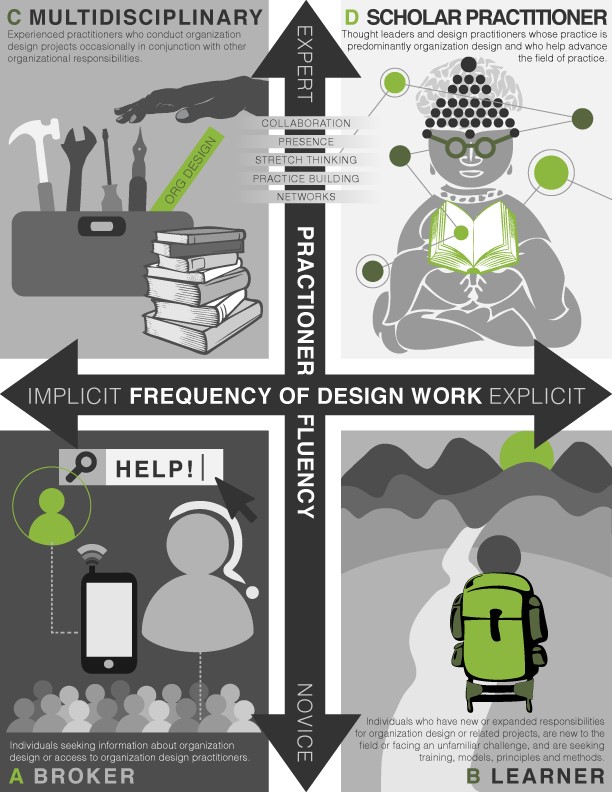
Image: Organization Design Forum 2×2 Practitioner Landscape

About

Looking at those ‘About’ pages that organisations have on their websites, which I was doing to construct an org design case study, leaves me wondering who they are directed at. They contain useful, perhaps factual, and certainly carefully chosen information that presents aspects people in External Comms Departments want other people to know.  But it’s not clear which people they are targeting – researchers, analysts, investors customers, employees?  Thus, in general, an organisation’s ‘about’ page tells a thin, partial story.

In some aspects the ‘About’ page is like an organisation chart.  It has some information but is significantly incomplete – an organisation chart doesn’t tell you what the organisation is ‘about’ and neither does the ‘About’ page.   As an example, compare two banks’ ‘About’ opening paras:

Triodos Bank is a global pioneer in sustainable banking, using the power of finance to support projects that benefit people and the planet. We believe that banking can be a powerful force for good: serving individuals and communities as well as building a more sustainable society’.

HSBC is ‘one of the world’s largest banking and financial services organisations. We serve around 38 million customers through four global businesses: Retail Banking and Wealth Management, Commercial Banking, Global Banking and Markets, and Global Private Banking’.

Although these paint very different pictures of each organisation and hint at different pre-occupations and organisation designs, they both miss what I think is a key feature of ‘Aboutness’ –  the feelings, behaviours,  experiences and human-ness that includes stories,  anecdotes and conversations illustrating answers to questions like  ‘What does it feel like to work in this place?  How do our customers experience our products and services?  How principled are we in what we do?  How do we relate to each other?  What makes us laugh?  How do we look out for each other’?

Last week when I was pondering ‘About’, I was also acting as a guide to a friend who was visiting the UK for the first time.  I took her to various places to give her a flavour of ‘about UK’. (Read the BBC version here.)  Heaven knows what she now thinks the UK is ‘about’ but we had a good time and she gave up the idea that we all ate buttered crumpets and drank tea from bone china teacups at 4:00 p.m. every day, sitting in Cotswold cottages with Farrow and Ball wallpaper.  (Possibly these ideas were gleaned from some other ‘About Britain’ page?)

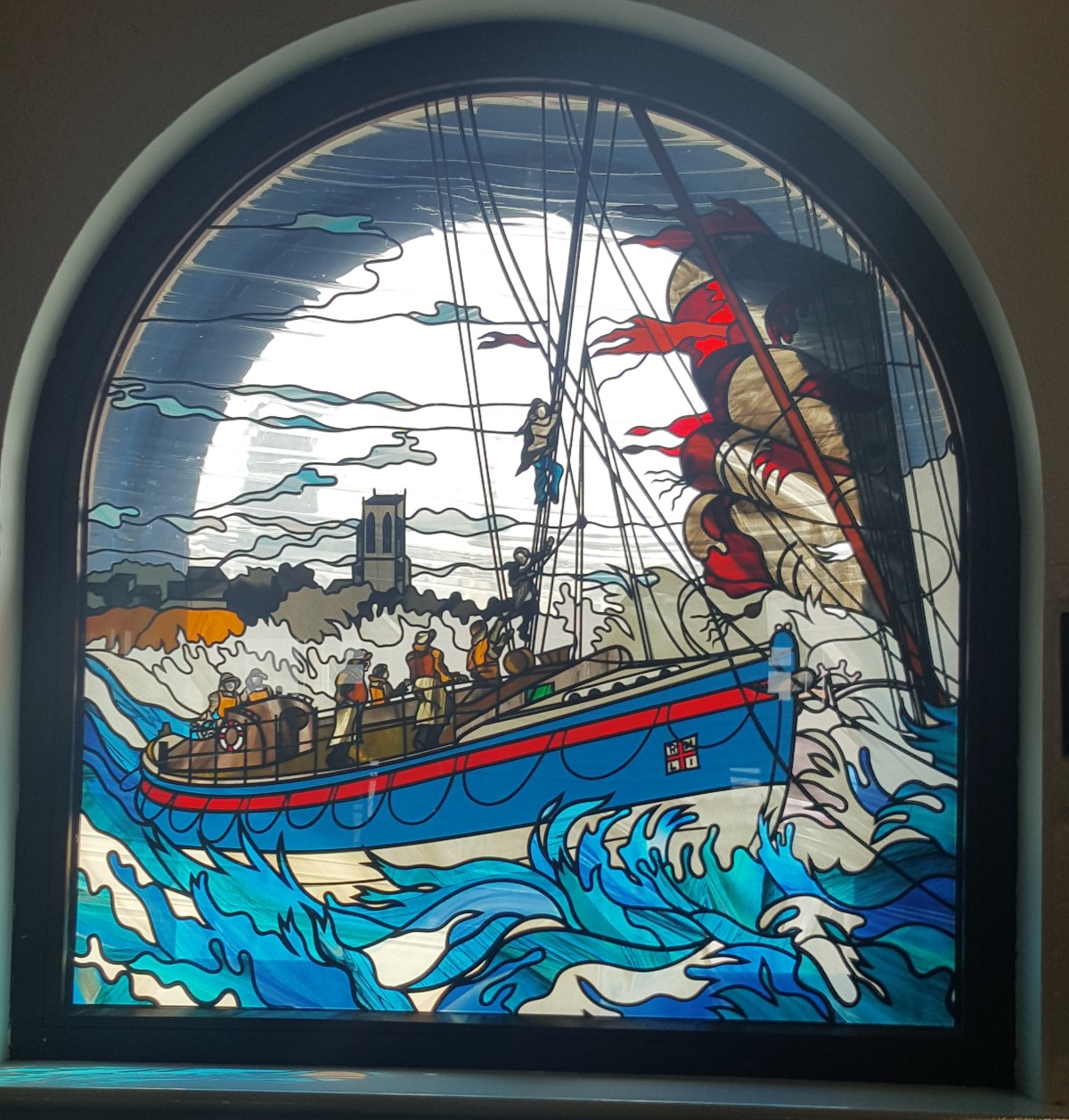
In the course of the week, I (we) met four people who were all volunteer workers in their respective organisations.  Philip, an ‘ambassador’ (according to the badge he wore) was very amusing in his telling of Blickling Hall’s history, Margaret, a volunteer encouraged us to participate in Blickling’s ‘The Word Defiant’ participative art installation. Roger educated us, in the most delightful way on Cromer’s RNLI (Royal National Lifeboat Institute) station and Shelia co-hosted the Freedom from Torture, Write to Life group’s summer party.

They told us the ‘party-line’ story that they were there to tell – for example, Philip talked about the history of Blickling Hall, told us why some of the buildings had chimneys and some didn’t and gave us various other info snippets.   The fun thing was he did so in an uninhibited, involving, humorous way that left us asking each other if in his non-volunteer role he was a comic actor or had been an eccentric history teacher (or both) – he gave people a toffee if they could answer one of his questions correctly.

In telling their ‘required’ story the volunteers also told different story about their organisations – almost as an unconscious variant of that left-hand column right hand column exercise.  Margaret, for example, said that ‘Head Office’ was expecting the volunteers to encourage Blickling House visitors to interact with the Defiant activities ‘Head Office thinks it’s a good thing so we have to do it.’   She expressed amusement tinged with bemusement as visitors, prompted by her in a kind, considerate, way busily redacted words from a copy of a page of Northanger Abbey to create a sentence about their experience of the exhibition from the words they left visible.

Roger was amazing in his knowledge of the RNLI and a passionate supporter of its principles.  He loved the way, as he put it, the organisation is run as efficiently as possible in a pragmatic/common sense way that gets the best from people.  He was a real champion of its value to communities and societies.

And Sheila was adamant that she wasn’t the Write to Life group’s ‘co-ordinator’.  She said she supported and facilitated what the group wanted to do, but it’s ‘their group.’

What I found strking about the four was they didn’t have any of the aura of  ’employees’. They loved what they were doing and that’s why they did it.  (Notice they are also not subject to the same organisationational stuff as employees, which may be what makes a difference).

Each gave us a rich and human glimpse of their organisations – a very different take from the sterile and impersonal ‘About’ pages that organisations have on their websites, or many employees give in the course of delivering ‘the customer experience’. All four were hugely enthusiastic, energetic, and involved in their first-hand ‘abouts’ of their organisations and the bit they worked in.  They were upbeat, positive, and dedicated to serving what they saw as the clear purpose of their organisations.

Contrast their attitudes with what Jeffrey Pfeffer would have us believe in his new book ‘Dying for a Paycheck’.  This ‘maps a range of ills in the modern workplace — from the disappearance of good health insurance to the psychological effects of long hours and work-family conflict — and how these are killing people’ or a similar book by David Graebner, Bullshit Jobs which examines the question, ‘Why are employers in the public and private sector alike behaving like the bureaucracies of the old Soviet Union, shelling out wages to workers they don’t seem to need?’

Neither book celebrates the joy of working that the volunteers demonstrated.  So now I’m wondering if volunteer work is ‘about’ enjoyment, purpose and contribution while paid employment is about meaningless jobs? It can’t be as clear cut as that.  Surely the people on the payroll of the RNLI, Blickling Hall, or Freedom from Torture don’t feel they are in bullshit jobs.  And what about people who are in paid jobs but are also volunteers in other organisations, or who participate in employer-led volunteer schemes?  How do they feel about working in the different contexts?

What is it about volunteers and their work that makes them about advocating for their organisations in a way that being a paid employee doesn’t?   If we could capitalise on their enthusiasm and commitment would our organisations, and their ‘about’ pages start looking and feeling like great places to work.  What can we learn from the volunteer experience that we could apply to our employed workforce?  Let me know.

Image: Stained glass window, Cromer Lifeboat Station


Think Banking

The phrase ‘think-tank’ is relatively familiar.  What a think-tank does, according to The Economist is ‘aim to fill the gap between academia and policymaking. Academics grind out authoritative studies, but at a snail’s pace. Journalists’ first drafts of history are speedy but thin. A good think-tank helps the policymaking process by publishing reports that are as rigorous as academic research and as accessible as journalism. (Bad ones have a knack of doing just the opposite.)’

But my interest today is not in think-tanks but in think banks.  Not the actual Think Bank accounts ‘mainly for customers with poor credit histories or who have struggled financially’ which changed its name in 2012 to Think Money,  but a think bank in terms of your own investment in your thinking.

Imagine we each had a think bank account.  We could then build up the capital gained from reflective conversations, questions and reading that were not aimed at ‘getting the world’s business done, or baking bread, or flying aeroplanes’.  Simon Blackburn in his book Think: A Compelling Introduction to Philosophy argues for the value of ‘reflecting on concepts and procedures and beliefs that we normally just use’.

Invested in well, our individual think bank accounts would have the same outcome as a think tank – a rigorous and accessible point of view/thought process that we could draw on, as Blackburn says, ‘when the going gets tough: when the seas of argument rise, and confusion breaks out’.

During last week I added three things to my think bank account. I’m not sure when I’ll draw on them but they’re there and maybe getting interest.  The first was on ‘additionality’.  That was a term new to me but it made perfect sense as the discussion unfurled.  The person I was talking with defined additionality as calling into being what didn’t exist as part of something and being able measure what value it added to the original thing.

This led me to looking up additionality, and I found a more formal definition than my colleague’s in the Additionality Guide, ‘Additionality is the extent to which something happens as a result of an intervention that would not have occurred in the absence of the intervention.’   The Guide itself offers ‘a standard approach to assessing the additional value of interventions’.

So now in my think bank is info on additionality to mull over + 3 questions to prompt reflection:  What does this Guide offer that could help us measure the effectiveness of organisation design work?  Is subtractionality (I’ve coined this word, I think) as useful a concept as additionality i.e. is what we take away in our organisation design work e.g. policies, or reduction of levels of hierarchy, a value add and thus additionality?  What else can I learn from concepts of additionality?

The second thing that I’ve added to my think bank is from the pull-out section in the Economist: ‘The World if’.  It’s an annual pull-out asking us to imagine various future possibilities.  (Take a look at the 2016 edition that ask the question ‘If Donald Trump was elected’ which came out several months before he was.)

This year there are 10 ‘If’s’ all worth reflecting on.  One that I’ve added to my think bank is ‘If companies had no employees’.  The scene is set in July 2030.  when ‘companies that embraced the shift away from having employees have reaped big gains. They no longer need to pay people to be in the office when demand is slack. They can find the worker with the perfect skills for a task, not just someone willing to have a go. Because individual workers’ output is finely measured, and their proficiency at completing a task becomes part of their online profiles, no one can be lazy and get away with it. Productivity growth has accelerated since the mid-2020s.  Many workers have also benefited. For those with sought-after skills, it can be far more lucrative to flit from contract to contract than to work for a single firm.’

How likely is this scenario, I’m wondering?  At the moment, I think it’s likely and I should be designing organisations to head in this direction, but maybe I should leave the question lying for the moment – banking it for when I have time and information to examine it more closely.  As a thought though – it could form a very good basis for a leadership discussion – if the leaders were willing to give time to it. Many find it difficult to give time to a reflective discussion, even if they know the value of doing so – you may be able to persuade them with some useful tips from How to Regain the Lost Art of Reflection.

The third thing I added to my think bank account was a question:  What effect do protests have?  This was prompted by seeing the placards of the Homes and Communities Agency Unite workers beginning a strike over pay,  seeing the tens of thousands in London attending the anti-Trump demonstration, and reading, again in ‘The World If’,  If Martin Luther King had not been assassinated.  A group of us – with varied views – were wrestling with this question and it’s one that’s again relevant to organisation design – could organisational protests spark organisational change and redesign?

There seems to be some evidence that they can spark policy change – but maybe only in the wider societal context? (Think LGBT, or gender equality, for example).   Or maybe there isn’t any real evidence?  I’m not sure, and again it’s in my think bank for investing in further.

Those were the three major deposits into my think bank this week.  But I made a couple of smaller ones.  After a tech conversation I had with someone, he sent me info on Digital Humanism which sounds worth investing thought into as we work with more and more organisational technology and automation.

I got into a further discussion on why we have difficulty with systems thinking (ref my blog last week) and I’m still investing in that one.  Then I read a review plus sample chapter of Matt Haig’s book Notes on a Nervous Planet.  In the book he talks about fear and the way it manifests in society.   Fear is often present in organisations – particularly in risk averse cultures where people fear doing the wrong thing even if there are organisational mantras like ‘fail fast and learn’.  This led me to a question, what to do when I observe that tension in play?

So quite a few think bank deposits this week to ponder, reflect on, and invest in for future returns.  What have you added to your think bank this week?  Let me know.

PS    Thanks to James for the concept of a think bank.

Image: Ancient Roman Banking

A big issue

John Bird presents a stirring case for tackling poverty.  ‘To me the really big thing in the world today that needs to be done is that we have to stop seeing things as ‘things in themselves’. We have to stop being separators of life into categories. That if you want to solve poverty, which I am rantingly struggling to do, you can’t separate poverty out into separate things. You have to hit poverty square in the eye. You have to give a cocktail of solutions to it, like you might zap a cancer. Yet the world is always dividing poverty up into different parts: literacy, housing, work, wellbeing, health … the world of thinking, of society, of government, always breaks things up into things’.

This ‘thingifyíng’ of issues – trying to tackle them separately rather than interdependently, collaboratively and/or as complex problems is a big issue – because people in organisations I work with ‘get’ interdependence in theory and understand that linear and cause/effect thinking won’t address re-ordering the tangle of variables that constitute the ‘design’ of the organisation.  Yet they are unable to work with this in practice and continuously retreat to the organisation chart as the way to solve many organisational issues.  (See a Q5 Partners short video Forget Personality: a thinkpiece of restructuring teams, that warns against an ‘org chart first’ approach, and goes down well when I’ve shown it).

I’ve had several different conversations during the past week on interdependence and the tendency to ‘thingify’.   Various possibilities were put forward for the inability of organisational leaders to engage with complex, interdependent and problematic organisational design situations and address them systemically or holistically, rather than individually and in compartments.  Among the reasons we discussed for the tendency to reach for the organisation chart, three came up in all the conversations:

1.  The ‘tyranny of metrics’ (see my blog on this)  that is performance targets that attempt to measure elements of a system’s performance, rather than the outcome of the performance.  This frequently leads to gaming behaviour as organisational members try to reach the target rather than the intended outcome.  An example of this is described in Max Moulin’s article Flawed targets and the ambulance service – is there a happy ending? which leads to questioning, ‘traditional assumptions about measurement, impact, and relationships’.  There’s also a recent report that looks at flawed performance targets in the public sector A Whole New World — Funding and Commissioning in Complexity.

2.  Believing that organisation design work is complicated rather than complex.  David Snowden, explains the difference: ‘In a complicated context, at least one right answer exists. In a complex context, however, right answers can’t be ferreted out. It’s like the difference between, say, a Ferrari and the Brazilian rainforest. Ferraris are complicated machines, but an expert mechanic can take one apart and reassemble it without changing a thing. The car is static, and the whole is the sum of its parts. The rainforest, on the other hand, is in constant flux—a species becomes extinct, weather patterns change, an agricultural project reroutes a water source—and the whole is far more than the sum of its parts. This is the realm of “unknown unknowns,” and it is the domain to which much of contemporary business has shifted.’  Organisations are complex.  Trying to redesign them as if they are complicated doesn’t work.

3.  The almost impossibility of changing the infrastructure, systems and processes that have been set up over decades to reflect a mechanistic/deterministic view of an organisational universe.  As Professor Karen Carr  states: ‘The challenge is to implement a systems world view from within organisations that have evolved from deterministic world views. … making it difficult to take a systems approach. Issues such as health, training, leadership and information management are addressed within different partitions …. Finding a way to get these different areas to interact in an organic manner is in itself a problem, given the [organisational] political, social and economic contexts.

Other reasons we discussed for the lack of systems thinking included: power dynamics (‘my bit is ok, why should I worry about yours?’), financial/resource constraints leading to prioritising some parts over others without thinking through the consequences, and short-term thinking – ‘let’s fix this fast and now’, and not knowing how to apply systems thinking.

Going back to the issue of tackling poverty, John Bird tells us, ‘We cannot simply carry on in this brainless, unconverging bit here and bit there’, and it’s the same for organisational issues.  How do we then create the conditions for systems and complexity thinking to become a natural part of the way we look at problems?

Answering this question as if it were a complicated problem yields a bits and bobs answer for example, send leaders and managers on systems thinking programmes (look at the Open University’s courses Systems Thinking in Practice,  or discuss and then pin up the poster Habits of a Systems Thinker,  show David Snowden’s video ‘How to organise a children’s party’ that shows ‘the promise of complexity theory for organizations and government alike’.

Answering the question as if it were a complex problem yields other responses.  Donella Meadows offers some thinking on how to do this in ‘Dancing with Systems’ (warning:  this is not written in standard management speak)  and in another Leverage Points: Places to Intervene in a System

Perhaps the most useful response to the question ‘how do we encourage organisational leaders to engage with complex and problematic organisational design situations and address them systemically or holistically, rather than individually and in compartments?’  is to do so in both a complicated and a complex way.  Maybe then we would see system thinkers emerging and a big issue would be resolved.  What’s your view?  Let me know.

Image: Systems thinking 101