The accountability conundrum (again)

Tomorrow’s Organization Design Forum’s peer-to-peer consulting session in which I’m in the hot-seat has been drifting to front-of-mind over the last couple of weeks: prompted by first, a coaching session on how to frame the question in a way that the peer group can tackle it, and then by getting a Zoom invite to the actual session that proved to me that I’m actually in the hot seat.

The way it works is rather like a fish-bowl exercise, but virtually.  I sit in the ‘middle’, and briefly outline my conundrum.   Five consultants the discuss it.  We follow the ‘Ace-It’ formula. Other people ‘watch’ the session in action, commenting only via the chat box.

The info that has gone to the five consultants says: ‘The ask for Naomi to hold this session came out of a high level of interest shared during one of our monthly virtual conversations (ODF Advisory Group) around an article she wrote Accountability – Is it a Design Concern? featured in EODF’s monthly newsletter.  People suggested that I do a follow-up blog but it turned into this live session instead.

The conundrum I’m posing to the consultants is:

Work process flows almost always cross organizational boundaries, either internal boundaries or between organization boundaries.  This can create difficulties, bottlenecks, and failure points at the intersects and hand-overs.   Assigning a single person accountability for the process flow does not allow for the fact that the accountable person may not have control over the people along the flow.  These people may be working on other flows, have different priorities, and different performance measures.  Along the flow, people may have the power to slow or stop the flow.

Imagine a design that assumed a collective accountability to maintain process flow.  How could this be designed?

Last week I wrote a blog and also ran a session on Hierarchies and Networks. In these two forums I asked whether ‘the very differently principled networks and hierarchies co-exist in one organization’?  I think they do, along with the informal networks that are in both.

In response to that blog Nicolay Worren sent me his excellent – still in draft – paper The “hidden matrix”: Reporting relationships outside the formal line organization. In this, he talks about some research in which he has found that ‘Even though the organization does not formally have a matrix organization, the decision rights have been distributed in such a manner that employees will require the approval of people who are not their line manager, who is outside their own department, and may not be hierarchically superior to themselves.’

He is wondering, similarly to me, about mixing of structures in one organization – one of which is often consciously designed (the hierarchy) and the other which equally formal but not usually consciously designed – the network or, in Worren’s case, the matrix.  He doesn’t speak much about the informal networks in both.

I’m intrigued to find that a network can be expressed mathematically as a matrix but I’m not going to pursue the difference between them in organizational design terms right now.  Another intriguing take is in the article To Matrix, Hierarchy or Network: that is the question.   It’s not directly about organization design but there are great parallels that might be usable in design work.

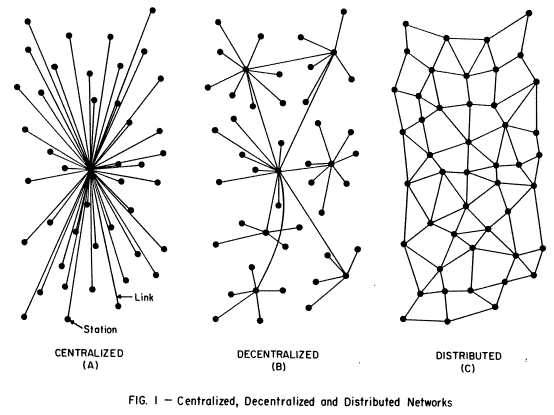
Pursuing the network route for now, RAND researcher, Paul Baran, began thinking about the optimal structure of the Internet. He envisioned a network of unmanned nodes that would act as switches, routing information from one node to another to their final destinations. Baran suggested there were three possible architectures for such a network —centralized, decentralized, and distributed.

He felt the first two —centralized and decentralized— were vulnerable to attack, the third distributed or mesh-like structure would be more resilient.  And this is what he designed.  The Internet is a network of routers that communicate with each other through protocols – which might be an organizational proxy for decision rights, approvals, and distributed accountability.

The mesh like structure is what I think of when I think of networks, and I dug out my blog Of Nets and Networks  and found that the metaphor of accountability exists in physical fishing nets.  Each knot in the net is ‘accountable’ for the success of each other part of the net.  The knots are representative of shared and distributed accountability.  The way the fishermen work with the nets represents the informal network.  But maybe I’m carrying that too far?

Then my brother sent me a snippet that seemed to perfectly describe organizational networks – formal and informal in one go.  Except it was referring to consciousness:

‘In our brains there is a cobbled-together collection of specialist brain circuits, which, thanks to a family of habits inculcated partly by culture and partly by individual self-exploration, conspire together to produce a more or less orderly, more or less effective, more or less well-designed virtual machine, the Joycean machine. By yoking these independently evolved specialist organs together in common cause, and thereby giving their union vastly enhanced powers, this virtual machine, this software of the brain, performs a sort of internal political miracle: It creates a virtual captain of the crew, without elevating any one of them to long-term dictatorial power. Who’s in charge? First one coalition, then another…’   It’s from Daniel Dennett, (1991) Consciousness Explained, Little, Brown and Co.

I’m not sure how all this rumination has progressed my thinking on organizational networks and distributed accountability, in a way that will make sense when I sit in the hot seat tomorrow.  But it’s been an interesting exploration.  Do you think networks distribute accountability?  Let me know.
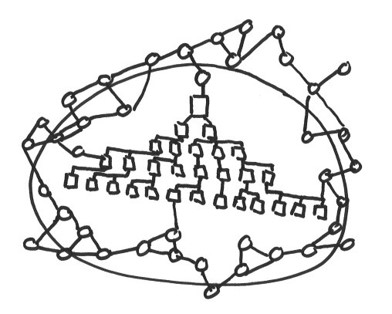
Image: How everything is connected to everything else

Hierarchies and networks

View at Medium.com

Oday Kamal observes that ‘The tension between hierarchy and networks is fundamental in charting the course of the future of work.’ And then asks several questions: ‘How can beneficial networks be nurtured in organizations? Where does a legacy hierarchical structure and a nascent network intersect and support each other? How can we determine if our organizations are choking the life out of potentially beneficial networks before they can really make a positive impact?’

He doesn’t answer these questions but they’re relevant to an introductory session I’m running this week on organizational hierarchies and networks and how work gets done, and I’ve been ruminating on them.

We seem to be moving towards the idea that networked structures are ‘a good thing’ in an age where hierarchies and ‘power over’ organizations seem to have had their day.

Amy Edmundson and Michael Lee describe hierarchies as being based on two principles a) A hierarchy of authority where individuals report to managers who have the authority to direct and prioritize the execution and allocation of tasks, review performance, and in many cases, hire and fire; b) A hierarchy of accountability—that is, work accountabilities roll up from direct reports to managers who hold ultimate accountability for the work of all those below in the organization chart.

They imply, as does Deloitte in the 2017 Human Capital Trends, that these organizational hierarchies are not fit for our digitized, networked age and that a more appropriate design is one thatradically decentralizes authority in a formal and systematic way throughout the organization,’

Networks fall into this category.  Jessica Lipnack and Jeff Stamps describe them as configurations ‘where independent people and groups act as independent nodes, link across boundaries, to work together for a common purpose; it has multiple leaders, lots of voluntary links and interacting levels.’  They’re based on the principles that

  • Authority is not from a hierarchy but from individual’s recognized knowledge and skill
  • Links are between people and teams across conventional boundaries (e.g. departments and geographies)
  • Members and structures adapt to changing circumstances
  • Management has a sense of mutual responsibility
  • People explore ways to work effectively
  • Teams are readjusted or disbanded needed

Can the very differently principled networks and hierarchies co-exist in one organization and would this resolve the tensions Oday Kamal observes?

John Kotter suggests so.  In his article Hierarchy and Network: Two Structures, One Organization, he tells us that:

The successful organization of the future will have two organizational structures: a Hierarchy, and a more teaming, egalitarian, and adaptive Network. Both are designed and purposive. While the Hierarchy is as important as it has always been for optimizing work, the Network is where big change happens.  … My idea of the Network is a system of teams with representatives from all divisions and all levels, who leave formal titles at the door to participate in a decidedly anti-hierarchical forum.  (See also his HBR article Accelerate)

But, not obvious in either the principles or the discussions of formal hierarchies and networks are the informal networks that exist within them – of friendship, influence, knowledge, etc. (Unless this is what Kamal means by ‘beneficial network’).

Organizational network mapping, of the type Rob Cross does, clearly shows us that informal networks of social connection and interaction are strong in all types of organizations and they can be very powerful influencers – beneficial or not –  of individual, team and organizational performance. (Watch the TED talk on the hidden influence of social networks.)

There may be tensions between hierarchies and networks, and they may be resolvable by having both present in one organization but only if the strength of the informal social network ties are identified and factored into the design thinking.  (Here’s a helpful Oxfam blog on getting started in social network mapping).

The informal, social networks are what make organizations work and they can’t be designed.  How can knowing more about them help us decide how to configure the formal hierarchies and networks either as independent forms or as integral forms?  Let me know.

Image Jakob Wolman

What are the ‘first principles’ of organization design?

I’ve found Mumsnet, I’ve read two ‘how to be a grandmother’ books, and I’ve looked at the bewildering array of baby products – My breast friend topping my list on this score!

My daughter now has a 6-week old baby, and I’m rapidly learning that everything I knew about bringing up two children myself – who have both turned into wonderful adults – has changed and I better get learning, rapidly.  Things are different now.    But surely, there are some first principles of child rearing – if so, what are they?  (Elon Musk says, “First principles are a kind of physics way of looking at the world. You boil things down to the most fundamental truths and say, ‘What are we sure is true?’)

This flashed through my mind when I was on a call to colleagues at the Organization Design Forum (ODF).  We were discussing 3 questions: ‘What are you noticing about the theory and practice of organization design today? What are the implications for practitioners? What can/should ODF be doing to help support practitioners given these trends?

These are three big questions to cover in an hour with about 15 people.  I found the call somewhat troubling and during it I was struggling to think why.   But now I’ve had some time to reflect it seems to be related to the child-rearing thought.

One of the early comments made by colleagues was that many people working in organization design don’t understand the ‘first principles’ of it.  I think they were thinking that there are some ‘fundamental truths’ from which to do organization design.  I’m not convinced that there are.

Similarly, I don’t think there are any ‘fundamental truths’ about child rearing.  For example, in the world of child-care there is no fundamental truth that ‘the baby’s sleeping position most always be with the head pointing due north’ although it was the way to do things in 1878.  And, funnily enough, we do seem to have the notion today that organizations must be guided by their ‘true north’– in both cases, these are fads determined by culture and context.

As practices, resources, research findings and theories evolve in child-rearing so they do in organization design, the idea that there are fundamental truths underpinning organization design is as much a fallacy as believing there are some fundamental truths in child-rearing.  (See the book Raising Children: Surprising Insights from other Cultures.)

Certainly, my child-rearing practices differed from my mother’s, as do mine from my daughter’s.  However, what I think my mother and I found helpful, and I suspect my daughter will too, was applying some guiding principles, e.g. that we should bring up healthy – mind, body, spirit –  children,  in the context of understanding that children have rights.

This combination of guiding principles (not fundamental truths) and children’s rights enabled us to child-rear effectively in a way that matched our particular time and place.

A similar approach could work for organization design.  There are already some principles around ‘good work’, see for example Good Work: When Excellence and Ethics Meet or Good work: the Taylor review of modern working practices that has just been published in the UK.

This report suggests that good work ‘is work that is engaging, gives people a voice, treats them fairly, is good for their wellbeing, and helps them to progress. It should be positive for individuals, but also lead to wider positive organisational and economic outcomes: higher levels of productivity and output, and greater innovation and adaptability.’

These are quasi principles that could be used in organisation design and these, combined with local employment rights, would give a useful framework for organisation design, leaving the way of doing it open to various approaches.  Alternatively, there are several sets of design principles for ‘good design’ we could use e.g. Dieter Rams’.

Returning to the three questions we were discussing, ‘What are you noticing about the theory and practice of organization design today? What are the implications for practitioners? What can/should ODF be doing to help support practitioners given these trends?’  I’m thinking that as there are no ‘fundamental truths’ about organization design we could propose some principles for good work or good design,  encourage organization designers to look at the ILO Declaration on Fundamental Principles and Rights at Work, help people look at organization design practice in new and innovative ways that make use of critical thinking and not faddism, and abandon some of our sacred cows around ‘how to do it’.

What’s your view?  Do you think there are fundamental truths around organization design?  Do you think there are ‘good work’ or design principles and employment rights the ODF could support practitioners using?  Let me know.

Image: http://bit.ly/2iMKvyk

What should future leaders be learning?

I had a conversation the other day with someone who asked ‘What should our management trainees be learning now, to equip and prepare them for leading 10 years out?’ He thought that if, 10 years ago, we’d been able to predict and teach them about design thinking, systems thinking, working with augmented/artificial intelligence, robots in the workplace, behavioural science, the ethics of technology – then they would be better able to manage the leadership roles they are now in.

It’s a good question, and one, I feel, is very hard to answer as what will be useful now in terms of leading ten years from now involves crystal ball gazing and futurology which do not always yield good yardsticks, as the Lyapunov exponent that I wrote about a couple of weeks ago, demonstrates.

But just to test this, I took a look at what The Economist was predicting for 2007.  They asked the question: What will be on the leader’s agenda?  Their answer: climate change, managing shifts in global power, ‘responding to a sense that, in crucial areas, progress that until recently had been taken for granted has stopped or even gone into reverse’, the internet’s transformation of business, the growing connectedness of people, and new tools to search for things.

Their predictions for 2017, ten years later, are very similar, but more pronounced: authoritarians will be ascendant, far-right parties will surge, ‘European politics will be dominated by scaremongering’, more terrorist attacks, financial shocks, and ‘Brexit negotiations will be slow, complicated and cantankerous’.  However, on the more optimistic side, ‘Technology is forging global connections whatever the backlash against migration or trade’

The Economist closes its 2017 predictions with a question: ‘The question is not whether the world will turn back towards openness, but how soon—and how much damage will be done in the meantime.’

What does this mean for future leaders? Should they be preparing for more of the same reversal of progress over the coming ten years, or for a growing return to open-ness?   As we talked this over we asked, what would give them ‘grip’ or enable them to get a grip on, a situation of either further closure and/or more open-ness, and manage it effectively?

Looking at the predictions for 2007 and 2017, it seems to me that rather than develop knowledge of  specific domain content, in order to be able to ‘get a grip’ management trainees should be developing timeless skills useful for pretty much any situation –practicing these through various methods, including scenarios, case studies, action learning, gaming and provocation sessions.

Four timeless skills I think would stand future leaders in good stead, gathered not from rigorous academic research, but from  my organizational experiences over many years, are: diplomacy, kindness, critical thinking, and curiosity.

Diplomacy:  ‘the art of advancing an idea or cause without unnecessarily inflaming passions or unleashing a catastrophe.  It involves an understanding of the many facets of human nature that can undermine agreement and stoke conflict, and a commitment to unpicking these with foresight and grace’.

Kindness  ‘the life lived in instinctive sympathetic identification with the vulnerabilities and attractions of others’ — is the life we are more inclined to live, and indeed is the one we are often living without letting ourselves know that this is what we are doing. … In one sense kindness is always hazardous because it is based on a susceptibility to others, a capacity to identify with their pleasures and sufferings. Putting oneself in someone else’s shoes, as the saying goes, can be very uncomfortable. But if the pleasures of kindness — like all the greatest human pleasures — are inherently perilous, they are nonetheless some of the most satisfying we possess.   (See a lovely poem on Kindness here).

Critical thinking: ‘that mode of thinking — about any subject, content, or problem — in which the thinker improves the quality of his or her thinking by skillfully analyzing, assessing, and reconstructing it. Critical thinking is self-directed, self-disciplined, self-monitored, and self-corrective thinking. It presupposes assent to rigorous standards of excellence and mindful command of their use. It entails effective communication and problem-solving abilities, as well as a commitment to overcome our native egocentrism and sociocentrism.’

Curiosity:   the a strong desire to know or learn; having an interest in a person, thing, or experience that leads to making an inquiry.  ‘Being curious can manifest itself in the activity of asking questions, but it can also be a position from which one approaches life.  It keeps us learning, helps in decision making and can be useful in navigating arguments or confrontations. Todd Kashdan, author of Curious? Discover the Missing Ingredient to a Fulfilling Life, believes that it is from our openness – and not our closedness – that we are able to develop ourselves and others.

How safe do you think it is to predict what leaders will be dealing with in the future – would we be better helping them develop timeless skills (which?) rather than specific domain knowledge?  Let me know.

Image: Reggio Emilia approach