
Internal consulting models

Here’s a brain-teaser that arrived in my in-box recently: ‘Today, some folks here were discussing the role of cluster leads, that we have in our organisational structure. Cluster leads were appointed when we started self-organizing, categorizing all work that came in into “projects”. Each cluster lead looks after a category/ group of projects and is supposed to integrate and find synergy among/between the projects.  Today, we evaluated that role and realised that the intended purpose has not worked well.  Have you any thoughts … about how to practically structure a way of working in, what I think of as, multiple dimensions?   We want to be able to:

  • Guide our customers/clients/end users (e.g. leaders or practitioners) in reaching the right person to respond to their needs
  • Enable internal sense-making, knowledge growth and information sharing across projects
  • Assess and anticipate the possible/likely future needs of our clients’

The question came from someone in a large enterprise’s internal consultancy.  The consultancy offers consulting, research, and leadership development around organisational change and transformation.   Any of these 3 service lines are delivered either within a particular business unit or across business units.

I’ve been noodling on the question since it came in.

It would be very hard to give ‘the answer’ to a question like this without knowing a lot more about the operational context and the more granular aspects of what isn’t working well (and what is working well).  However, I started to consider three angles on it:

  • The nature and structure of internal consultancies
  • The way ‘self-organising’ works and doesn’t work
  • The role of ‘cluster leads’ specifically their objective to integrate and find synergy between/among projects

The nature and structure of internal consultancies:  A research paper from Nick Wylie and Andrew Sturdy, Structuring Collective Change Agency Internally: Transformers, Enforcers, Specialists and Independents, discusses four types of internal change agency unit.

The question I got came from a change agency unit that closely resembles Wylie and Sturdy’s ‘Independents’.  This type of unit is established, ‘Where organisations identify the need for the persistent presence of a more generalist change delivery unit.’ The authors note that ‘The impact scope of these units tends to be localised as they deliver change through specific, often small, projects within business units.  At the same time, Independents are detached from core structures and operational areas and so operate largely outside of managerial hierarchies. In this way, Independents most closely resemble external consultancies because they are required to source their own work and often to be self-funding.’ In their structure ‘Independents can combine former external consultants and managers from within the organisation in an attempt benefit from both the exotic-outsider status and detailed insider-knowledge’.

Additionally, ‘they are sometimes involved in creating and managing links to external consultancies’.

The challenges that Wylie and Sturdy report that Independent units face are, the need to guarantee a pipeline of projects, loss of credibility over time and a great deal of their role being involved with relationship management activity.

With this information my questioner can follow some lines of enquiry that could work towards a structure and way of working that delivers more of what they want.  Questions I suggest are:

  • What can we learn from external consultancies on pipeline, credibility and relationship management? (Go back to their question at the top of this piece and you’ll see that these are the three things they want to be able to do, albeit expressed in slightly different words).
  • Are there things in the other three consulting models we could consider, learn from, migrate towards to achieve our objectives?

The way ‘self-organising’ works and doesn’t work: In my blog Self Organising Volunteers I talk about four conditions for self-organising

  • Understanding the concepts of self-organising
  • Agreeing authority level of the self-organising team
  • Selecting the individuals who will comprise the team
  • Ensuring you have the ‘appropriate conditions’ for self-organising

I won’t go into the detail of all of these here as that blog has the discussion plus links to other resources on each of the four conditions.   But it’s worth looking more closely here at the authority levels condition.  In his book, Leading teams: Setting the stage for great performances J. R. Hackman’s presents an Authority Matrix: 4 levels of team self-management.  He describes four team functions: executing the task, monitoring and managing work process and progress, designing the team and its organisational context, setting overall direction.  Depending on who has the authority for each function results in four levels of team organization.

  • Manager led teams who only have authority for executing the task
  • Self-managing teams whose members have responsibility not only for executing the task but also for monitoring and managing their own performance.
  • Self-designing teams whose members have the authority to modify the design of their own team or aspects of the organizational context or both.  Managers set the direction for such team but give members full authority for all other aspects of the work.
  • Self-governing teams whose members have responsibility for all four major functions:  team members decide what is to be done, structure the unit and its context, manage their own performance, and actually carry out the work.

My questioner could investigate how their self-organising stacks up against the authority matrix as it might be that there is something in the authority levels that is mitigating against their achieving their objectives.

The role of cluster lead: I haven’t seen a role description for a cluster lead, and it’s not a role I’m familiar with.  I found that cluster leads are fairly common in the humanitarian aid field.  The World Health Organisation has a detailed description of both clusters and cluster leads.  There a cluster lead ‘commits to take on a leadership role within the international humanitarian community in a particular sector/area of activity, to ensure adequate response and high standards of predictability, accountability and partnership.  Their key responsibility is to ‘ensure that humanitarian actors build on local capacities and maintain appropriate links with Government and local authorities, State institutions, civil society and other stakeholders.  … cluster leads have mutual obligations to interact with each other and coordinate to address cross-cutting issues.’  Substitute the labels around ‘humanitarian’ with a label representing my questioner’s organisation.  The questioner could then compare the two role descriptions (theirs and the WHO’s) and see if they could learn anything from that comparison.

In summary:  before heading for a ‘solution’ to a perceived issue, I suggest following some lines of enquiry to determine what the underlying causes may be.  It’s possible that some small adjustments to the existing model will make it workable.  On the other hand, the investigation may suggest a more radical rethink.  One of the points I make on organisation design training programmes is not to ‘solutionise’ to start.  It may seem like time is wasted in investigation and enquiry, but it is an investment worth making.

How would you advise the questioner?  Let me know.

Image: Internal Teams Need Better Positioning

Ambiguity anxiety

Ambiguity anxiety may be replacing change resistance as something managers must learn to deal with.  How to we recognize it, how do we cope with it?   I ask, because it’s come up in several meetings this week.  No, it’s not just in relation to Brexit.  It’s about reporting lines, accountabilities, client/customer single point of contact, ‘what are we doing here?’ and so on.  I’ve heard it in statements like ‘People want clarity, they don’t like ambiguity’ and ‘At the end of the day they just want an org chart to see who they’re reporting to’.   Ambiguity has come up in some emails too:

‘At tomorrow’s team meeting we will be thinking a bit about how we work through ambiguity and how we can make it easier for the team to deal with uncertainty. If you’ve got any ideas or thoughts in this area it would be helpful if you could come prepared to share them.’  And from another team ‘At this week’s team meeting we talked about dealing with ambiguity and if there is anything more we can be doing to deal with that.’

Ambiguous is the ‘A’ in the now well-known acronym VUCA (Volatile, uncertain, complex, ambiguous).  On VUCA there is plenty of guidance in how to lead through it, what it means for you, the competences you need for it, etc.  A lot of it is in lists which seem, to me, to be completely obvious and not specifically helpful.  For example, Leading in a VUCA World requires:

  1. Developing a shared purpose
  2. Learning agility
  3. Self-awareness
  4. Leading through collaboration and influence
  5. Confidence to lead through uncertainty

There’s nothing there peculiar to a VUCA world, or that that develops new thinking about the VUCA context or useful ways of ‘managing’ it.  On that last, I hope we don’t fall into the trap that we did with ‘change’ that the VUCA world can be ‘managed’ as if it were a tractable thing.

Focusing on ambiguity and you find less guidance than on working in the VUCA world, and what guidance there is, is often a similar level of list as for VUCA.  For example, in Leading Effectively in a VUCA Environment: A is for Ambiguity we learn ‘three ways to lead more effectively in an ambiguous environment’.  They are:

  1. Listen well
  2. Think divergently
  3. Set up incremental dividends

There’s not much in the lists that give practical and usable information on how to do the item listed.  How do you actually learn to ‘think divergently’, for example?  If you could – would it help assuage any anxiety when faced with ambiguity?

A better list comes from Colin Shaw in Dealing with Ambiguity: The New Business Imperative.  He has items including, Understand that some of your decisions will be wrong.’ And ‘Realize there is not a defined plan you need to follow.’  But again, this advice not easy to put into practice.

What I’ve noticed, in the articles and in the discussions/emails is the lack of definition around what ‘ambiguity’ actually is.  I think people use the word ambiguity when they actually mean ‘uncertainty’.  David Wilkinson makes a good distinction between the two in a short video, The Difference Between Ambiguity and Uncertainty. Ambiguity is a situation in which something has more than one possible meaning and may therefore cause confusion.  Wilkson illustrates by means of a single image that can be seen as either a rabbit or a bird.  Uncertainty is the feeling of not being sure what will happen in the future.  If you’re looking for further detail on VUCA definitions, Jeroen Kraaijenbrink does a nice job distinguishing, defining and visualising them.

Maybe it doesn’t matter too much which word people use because, in general, it’s the anxiety about not knowing that is the issue.  And if we could learn to live with not knowing – perhaps getting to the point when we enjoy, or at least accept, not knowing – we could discard anxiety.  Milton Glaser and Rebecca Solnit both offer that perspective:

 ‘Graphic designer Milton Glaser thinks that being uncertain is a good way to be.  “Certainty is preposterous,” says Milton Glaser. “Fundamentally, one cannot be certain about anything.” Glaser, who doesn’t shy away from speaking plainly, prefers a mindset that embraces ambiguity. For the 86-year-old, this is “a basic tool for perceiving reality” — and a driving force throughout his storied career.’

Rebecca Solnit, in her inspiring and wonderful essay, Hope in the Dark feels similarly, saying:

‘‘Hope locates itself in the premises that we don’t know what will happen and in that spaciousness of uncertainty is room to act. When you recognize uncertainty, you recognize that you may be able to influence the outcomes — you alone or you in concert with a few dozen or several million others. Hope is an embrace of the unknown and the unknowable, an alternative to the certainty of both optimists and pessimists.’

So, what could we do to accept ambiguity/uncertainty anxiety (beyond learning to do stuff on the numbered lists above – if we think these are both do-able and useful)?  The suggestions made by Robert Leahy, Director of The American Institute for Cognitive Therapy NYC, in an article  Accepting Anxiety are helpful, because they provoke thought:

  • First, ask yourself “What are the advantages in accepting some reasonable uncertainty?”
  • Second, ask yourself “What uncertainty do you already accept?”
  • Third, ask yourself “Third, do you know anyone who has absolute certainty?”
  • Fourth, flood yourself with uncertainty.

He discusses each of these, making the point that, ‘You can remind yourself that uncertainty is inevitable and that accepting uncertainty allows you to live your life more fully.’

These approaches of seeing uncertainty as helpful, may not wash in organisations where people are looking for the answer to ‘How do we fix ambiguity anxiety?’  Or, in organisations where there’s an assumption that ‘Leaders must provide clarity so that work assignments and goals are not as ambiguous as the environment.’

But because we are living in the VUCA world maybe it’s time to move away from a traditional response of trying to fix what appears to be an issue and try a different approach of seeing the opportunity and value in it.

Another approach to ambiguity anxiety is a project management one, described in ‘Characterizing unknown unknowns’.  The authors of the paper provide and talk through a model that ‘helps identify what had been believed to be unidentifiable or unimaginable risks. Finding more unknown unknowns means converting them to known unknowns so that they become manageable using project risk management’. Following their detailed method, you might be able to mitigate the risk of people getting ambiguity anxiety in the first place.

What’s your view of ambiguity anxiety?  Should we embrace it as an opportunity, see it as a risk to be managed, or take another view of it?   Let me know.

Image:  Spaces of Uncertainty


Scrambling to respond to change

The question of the week is: ‘I’m dealing with rapidly shifting needs and priorities, while working with limited resources.  The traditional change management approaches don’t seem to recognise this.  What are the must do things I need to support my team in this situation?’

I got the impression from this manager that she’s in a constant scrambling to respond to changing situations – rather like being in a small ship at sea in a storm with critical equipment failing, and the crew flagging under pressure.

This thought led me to look at what sailors do in that situation and ask can we take any lessons from them?  First, I looked at Yachting World’s piece ‘15 things you should know when planning an Atlantic crossing’, it says ‘In most cases, the crossing is the culmination of years of planning and preparation’, this is exactly what traditional change management seeks to do – plan the change, then deliver the change, then embed the change.  Or as Prosci says Prepare for Change, Manage Change, Reinforce Change.

This is precisely what the questioner says is not workable in her situation – she has no time for planning and she is in a continuously turbulent environment where she has to deliver change at a moment’s notice, and then deliver the next change without any embedding of previous change.   So, drawing on that article didn’t work too well.  Except for one point:

‘A smart crossing is all about consistent speed, 24 hours a day. The key is not to have downtime.’  Well I agree change is all about consistent speed, but not with the point about no downtime. Downtime for people in changing situations is critical to give space for review and reflection.  Read this article Resilience Is About How You Recharge, Not How You Endure.

However, I was already immersed in Yachting World, and in danger, of drifting aimlessly through its blogs, articles and offers when I spotted info on what can go wrong crossing the Atlantic: ‘We issued the 290 yachts sailing in the 2016 ARC and ARC+, transatlantic rallies with a survey to detail their breakages and solutions’.

It has some interesting stats: ‘The first thing you notice from the results is that there were few empty columns for yachts without problems. In total, 167 yachts, or nearly 60 per cent of the fleet, had a breakage.’   Taking an organisational equivalent to ‘breakage’ e.g. relationships breaking down, equipment failures, wrong decisions, financial loss, sudden context shifts, risk aversion, or any of the myriad things that happen that managers have to deal with in our VUCA world and 60% seems like quite a low number.

Reading on, I found many useful ideas to help the questioner:

‘Problems are of course to be expected, but breakages can spoil voyages. One of the best ways to avoid them is to learn from others’ mistakes.’   On dry land, Torben Rick has a list of 20 change management mistakes we can learn from. Several of them are to do with lack of employee involvement – a mistake I see being made over and over again.

‘The most common casualties were ripped sails and breakages caused by chafe – which, going on past feedback, is nothing new.’   I checked the work ‘chafe’ and found that ‘Chafing is irritation or damage caused by friction – friction is resistance caused by rubbing.  Chafing worsens with excessive pressure.’   Isn’t ‘caused by chafe’ a terrific phrase to describe the way people feel in changing situations – irritable, resistant to pressure, torn or damaged?  Managers who are alert to signs of chafe in their workforce can take some steps to curb it.

‘Thirteen yachts had batten problems or breakages (mainly from flogging in light winds) … The simple message coming from the majority of these cases is to carry spares!’  I hope there’s not too much organisational equivalent of ‘flogging in light winds’ but there’s a warning there to not drive employees too hard in business as usual work – aim for good enough, so there’s spare goodwill and capacity/energy for dealing with the ongoing changes.

‘There were multiple failures to preventers, blocks, and furling lines … The trend here showed a lack of routine maintenance’.  I stopped to think on this one.  There are multiple things in office life that fail because of lack of routine maintenance – photocopiers, staplers without staples, lifts, people unthanked, team spirit, etc.  Community Toolbox has a very good resource on Day-to-Day Maintenance of an Organization together with a checklist.  Making sure the routine maintenance is in place will help in turbulence.

‘The gooseneck bolt broke “Nothing alarming or special happened during that moment or just before. The grinding and wear and tear had somehow loosened the nut on the bolt and then the bolt dropped off its position. … the biggest take-home lesson is “to inspect critical points more often.”  Another good point for managers in stressful times – identify the critical points and keep an eye on them.’   Each fast-paced change context is likely to have different critical points for maintaining delivery, but typically critical points are: enough skilled people (have you got cover if people move on/get sick?), few but sufficiently good metrics to provide actionable info, frequent/truthful communication that builds trust and involvement.  Project Laneways offers a course in Rapid Agile Change Management that appears covers the typical critical points. (Only available in Australia?).

‘Both the gooseneck and vang mast fittings broke aboard the 72ft Southern Wind Far II Kind. Skipper Will Glenn said in hindsight they should have checked that the riggers did what was asked of them properly – and that they should have trialled the boat in stronger winds.’ Another good point for managers – have you checked people’s capacity to learn and change, are you progressively trying out and developing their skills to deal with more complex or even faster-paced change, and trying these skills out?  There are five suggested ways for doing this in the blog 5 Ways Leaders Strengthen And Prepare Their Teams For Change.

‘What would you do if hardware, hatches or fittings ripped out of the deck or rig? When the mainsheet track car broke on Harmony 38 Oginev, the crew was quick to jury rig solutions.’  (Jury-rig = makeshift repairs made with only the tools and materials at hand). Most of us have to be able to find ingenious solutions to problems we face in everyday organisational life with no extra or special resources to do so, often they are called ‘work-arounds’.  The HBR Working Paper,  ‘Fostering Organizational Learning: The Impact of Work Design on Workarounds, Errors, and Speaking Up About Internal Supply Chain Problems’ has ideas on how to develop both work-around skills and the skills/designs for having to work-around in the first place.   (There are some interesting examples of community action jury rigging here)

Thanks to Yachting World I now have 8 points that could help the manager with ongoing change turbulence, summarising these:

  1. Allow reflection and review time – it’s worth the investment
  2. Learn from other’s mistakes – in particular make sure you involve your workforce in the change decisions/work
  3. Do routine maintenance
  4. Be alert to signs of chafe in your workforce
  5. Aim for good enough
  6. Inspect critical points often
  7. Develop people’s capacity to learn and change
  8. Develop both work-around/jury-rigging skills (and the skills/designs for not having to do work-arounds in the first place).

Looking at the list, it’s more about ensuring you get the context for change right.  Then, even though it may not be all plain sailing, at least you will have the ability to handle what comes up.

What advice would you give the manager who doesn’t have time to plan change but just has to do it?  Let me know.

Image: Whitbread Round the World Race

Davenport & Kirby, McGrath, Mintzberg

Somewhat before Christmas 2018, I took a free, online Coursera course – Bridging the Gap Between Strategy Design and Strategy Delivery.  It’s managed by the Brightline™ Initiative ‘a coalition led by the Project Management Institute together with leading global organizations dedicated to helping executives bridge the expensive and unproductive gap between strategy design and delivery’.  (See my blog on it)

I can’t now remember how I found the course, or what was going on at the time that prompted me to enrol on it.  However, I was in the first cohort of participants.   A few weeks after completing, I got a cheerful email from the Brightline Initiative, saying ‘as a token of appreciation for successful completion of the course Turning Ideas into Results: Bridging the Gap Between Strategy Design and Delivery. You can win three books authored by leading strategy experts – some featured in this course! Brightline is covering the cost of the books and shipping.’ The way of ‘winning’ was to fill in a form saying which books you wanted to receive.  No contest involved.

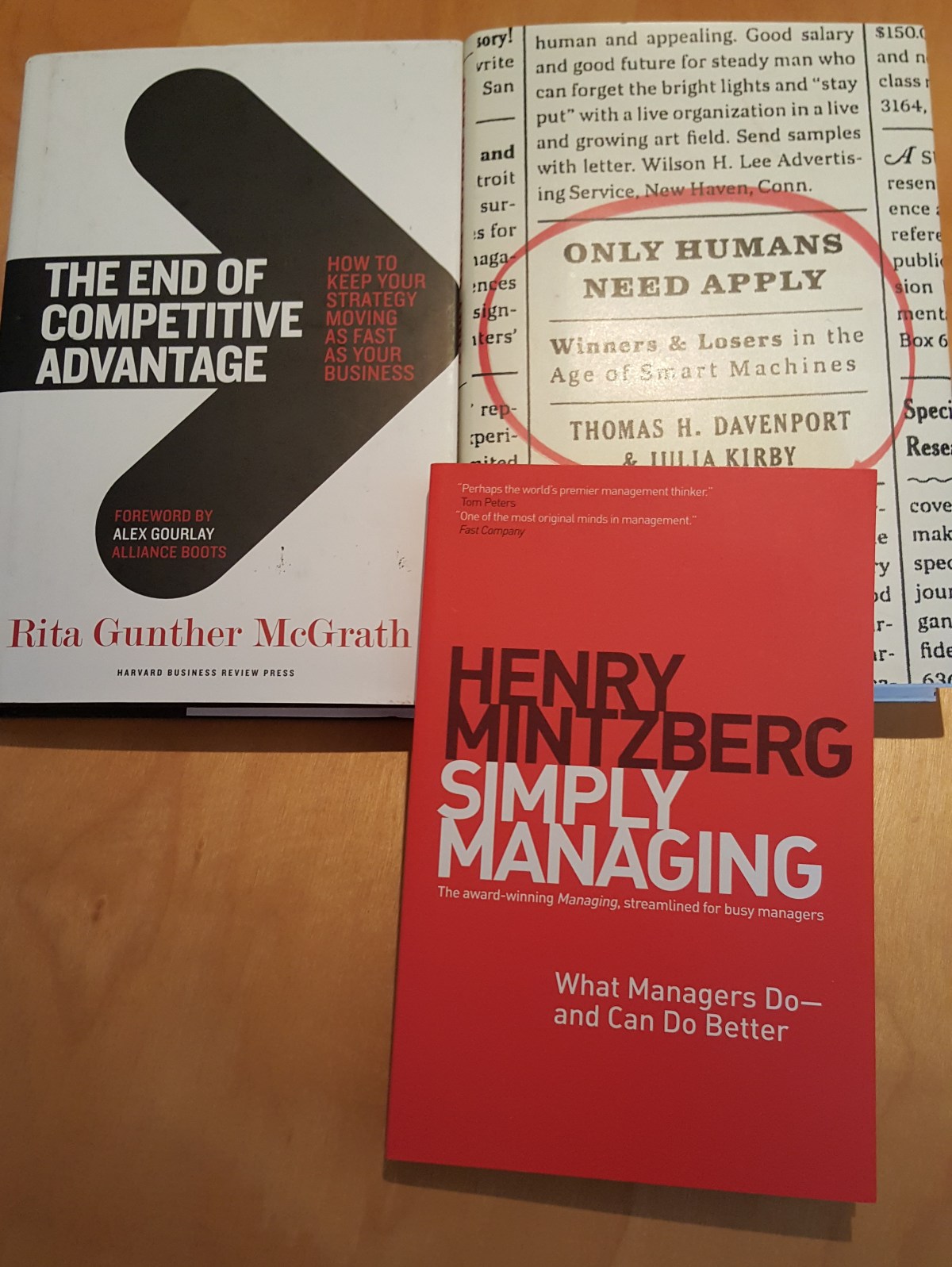
I’m not sure of the money and motivation behind this largesse but this week my three chosen books arrived: Only Humans Need Apply, The End of Competitive Advantage , Simply Managing.  All I have to do now is read them.

But before doing that I took a look at what they have in common.  Superficially, they have a colon after the main title followed by an explanatory phrase.  They are written by well-known American academics over the age of 60.  They have a detailed reference list.  They have ‘how to’ sections.

I decided not to go down the route of addressing the questions that these observations led me to – Why do book titles go for a colon? Are these books American centric?  How does the experience of academics over 60 inform current thinking?  Which of the references should I pursue?  Should I adopt any of the how-to suggestions?  And so on.  I can’t remember (and the list is no longer available to look at) if there were any non-American, non-academic writers on the list of books to choose from, but another question would be ‘why did I choose these three books?’

Turning to the books’ content, what follows is a bit about each, not from a detailed reading, but from a couple of hours spent flicking through them, landing on various pages and seeing what I found out ‘how to …’.

Davenport & Kirby (2016) ‘Only Humans Need Apply: Winners and Losers in the Age of Smart Machines’.  Davenport and Kirby’s primary idea is based on the question how to take seriously the threat of ‘computers coming after your job’.   They tell us that ‘instead of asking what work will machines take away from us next, we need to start asking what work will machines enable us to take on next?’  This type of work they describe as ‘augmentation of human work by machines … in which humans and computers combine their strengths to achieve more favourable outcomes than either could alone.’  They say that ‘augmentation spots the human weakness or limitation and makes up for it … without pain to the worker.’   (Take a look at the test at Ford of exoskeletons)

In the chapter ‘Don’t Automate, Augment’, they advocate five strategies – stepping up, stepping aside, stepping in, stepping narrowly, stepping forward – for ‘humans who are willing to work to add value to machines, and who are willing to have machines add value to them’.  They illustrate the five steps by looking briefly at how insurance underwriters, teachers and financial advisors are taking them, before moving to a full chapter on each step.  They argue that complacency in the face of machines is not an option. ‘But despondency isn’t required either’:  there is a role for individuals to take decisions on how to deal with advancing automation, and a role for ‘governments, other convening bodies, and the experts who advise them’ to do similarly for society.  This is an upbeat book and I’d like to believe that the dedication their book opens with comes to fruition.  ‘Both us dedicate this book to our kids’ – Julia’s ‘who will make the world a better place’ and Tom’s who will ‘continue to find interesting and useful work’. We all need to help them make it so.  I’ve learned how to feel a bit more optimistic about automation.

Mintzberg, (2013), Simply Managing: what managers do and can do better This book is a ‘substantially condensed and somewhat revised version’ of Mintzberg’s 2009 book Managing. It’s in large print with wide line spacing, lots of sub-headings and bold type sentences that ‘summarize the key points in this book and so serve as a running commentary throughout’.  So excellent for someone who doesn’t really want to (or have time to) read much. Fortunately (or unfortunately depending on your point of view) the sections do not have an estimated read time.

There are 6 chapters covering: managing beyond the myths; managing relentlessly; managing information, people, action; managing every which way; managing on tightropes; managing effectively.  I felt exhausted just skimming the chapter headings.  However, I plunged into the section ‘The Enigma of Order’ (in the chapter on tightropes) which considers the conundrum, stated in bold type, ‘How to bring order to the work of others when the work of managing is itself so disorderly?’ Mintzberg’s advice is that managers deal with this ‘by nuancing its two sides.  They have to weave back and forth between letting the chaos reign and reigning in the chaos.’  OK good.  Mintzberg briskly moves on to the next section.  ‘The Paradox of Control’.  I turn to McGrath’s book.  I’ve learned how to convert a thorough book into a soundbite book.

McGrath (2013), The End of Competitive Advantage.  The opening pages of this are devoted to 11 people (10 men/1 woman) praising the book.  Point taken, it must be worth reading.  McGrath ‘takes on the idea of sustainable competitive advantage’ in its place she offers ‘a perspective on strategy that is based on the idea of transient competitive advantage’ together with ‘a new playbook for strategy’.  Wisely, she tells us that ‘The ability and willingness to seek out actual information, confront bad news, and design appropriate responses is critical’… ‘The learnability principle emphasises continual investment in people, even if one doesn’t know exactly what they will be doing.  And combating the tendency to seek only positive news that confirms existing assumptions is critical’ (too).

She is of the view that we need to rethink all the assumptions we hold around organisations being ‘long-lived and their advantages sustainable’.  She offers practical advice to individuals who agree with her that we are in a ‘transient-advantage’ economy.  Take a look at her checklist for preparing yourself for the transient-advantage economy.  It appears as a quiz in her book, along with a discussion of the questions.   If you don’t want to read the book, you can listen to a 60-minute webinar of her talking about it.  I’ve learned more on how to question organisational assumptions around sustainability and got some helpful tools/resources to do this as well.

Have you read any of the three books?  What’s your view of them?  Let me know.

Tribalism

‘Britain is Merging BOAC and BEA as a Giant Airline’, read headlines in 1974. More than 15 years after that merger, I joined British Airways. Even after all that time people described themselves as ‘I’m BEA’ or ‘He’s BOAC’ as if that explained more or less anything – good or bad.  I was struck by that loyalty to … well, what exactly?  And I’ve seen it a lot in organisational life. Over the years, I’ve come to think of it as tribalism.

Kevin deLaplante, in a video ‘The Dangers of Tribalism’ describes a tribe as ‘a group of people that feel connected to each other in a meaningful way because they share something in common that matters to them. The connection can be based on just about anything kinship, ethnicity, religion, language, culture, ideology favourite sports team whatever.

What matters is that this connection binds individuals into a group that allows them to make a distinction between us members of the group and those who are not members of the group. When we talk about tribalism what we’re really talking about is a pattern of attitudes and behaviours that human beings tend to adopt when we come to identify with our tribes. In a nutshell we use the us/them distinction defined by tribal boundaries to make normative judgments: we’re good, they’re bad, we are right they’re wrong.’ (deLaplante’s video is excellent and he has an extensive list of references on the topic on his blog).

Tribal members share (or have shared in the past) a ‘collection of habits, practices, beliefs, arguments, and tensions that regulates and guides [them]’. Guidance comes from many sources ‘narratives, holidays, symbols and works of art that contain implicit and often unnoticed messages about how to feel, how to respond, how to divine meaning.’ (The quotes are from David Brooks, The Social Animal) the members benefit in some way – intrinsically or extrinsically – by virtue of their participation in the groups.

I see many tribes in organisations. They include profession tribes, team tribes, social group tribes, interest group tribes and prior organisation tribes. Often members indicate their tribal affiliation through symbols like lanyards and lapel pins. In some organisations ‘tribe’ is part of the vocabulary – look at Spotify’s Squads, Tribes, Chapters model. Like deLaplante, Mary McCrae, of the Tavistock Institute, notes that tribe membership brings many positives – ‘a sense of belonging, comfort and security for its members.  Those who belong commit themselves to the beliefs and values of the tribe.  Loyalty to the tribe stems from the sense of belonging to a familiar, like minded, and caring group’.

We touched on tribes and tribalism last week in a workshop I was facilitating. Afterwards a participant, emailed me, saying he thought tribalism was a particular issue in the organisation ‘because we have brought together different tribes and are trying to create one organisation’ (The organisation I am currently working with was formed from a mash-up of parts of various other organisations, plus a lot of newcomers who have no experience of the other organisations that now form part of the mix).

The discussion highlighted the downsides of tribalism which McCrae sees as ‘competition between groups for power and control over resources, roles of authority, boundaries, and policies that govern institutions.’ These are the ‘particular issues’ that the person who emailed me had in mind. It’s not an option to ignore these, neither is trying to form one organisation if that means aiming to eradicate tribes.

Robert Kovach, writing in the Harvard Business Review lists four downsides to tribalism:

  • Rock-throwing. Where teams are blaming each other, unjustly criticizing the others’ work or continually throwing rocks at one another.
  • Blaming the customer. Blaming the customer or end consumer occurs all too frequently, and can be another sign that inter-team rivalry is spiralling out of control.
  • Pushkin did it.” In Russia, when you don’t know who did something it is common to say “Pushkin did it.” The Dutch have something similar with the saying, “It was the dwarves.”
  • Refusal to work together. This is perhaps the most severe case of tribalism. When whole departments or organizations refuse to cooperate with one another.

I’ve also noticed

  • Turf defending. This is described brilliantly in Annette Simmon’s book, Territorial Games. I have a handout I use in workshops listing the 10 territorial games she discusses. I ask people to discusses whether they play that game, whether their peers do, whether their boss does, and if they’ve been a victim of someone playing that game on them. Games include ‘Information Manipulation’ and ‘Shunning’, that is ‘subtly (or not so subtly) excluding an individual in a way that punishes him or her; orchestrating a group’s behaviour so that another is treated like an outsider.’
  • Polarization. That stems from perceiving differences between tribes. This can lead to a (false) sense of superiority, and sometimes exclusion, bullying and discrimination.

Rosabeth Moss Kanter asks if the negative aspects of tribalism are inevitable and is optimistic that they are not, saying ‘Tribes are a source of identity, but when people belong to many overlapping groups, they are more likely to think broadly, as cosmopolitans. When they work together in mix-and-match structures and depend on the performance of people from other groups for their own success, they are more likely to empathize with differences rather than mistrust them. … Tribalism is not inevitable. We can civilize tendencies toward discrimination. But leaders must make it a priority.’

She offers some suggestions on how they might do this:

  • Make structural changes that eliminate silos, and non-diverse groups. (Watch the video A Tale of O on diversity)
  • Foster cross boundary interdependence ‘a shared task that all parties care about replaces tribal instincts with other motivations.’
  • Encourage cross-tribe coalition building in order to combine resources for mutually-beneficial initiatives, and a flow of people across them, so that everyone in the organization has multiple affiliations and has worked on numerous cross-sectional teams.
  • Find a common purpose that is inspiring and motivating, helping people transcend their differences. When backed up by incentives for achieving common goals, a sense of community helps override selfish interests.
  • Establish codes of conduct specifying community norms that should not be violated regardless of local traditions.
  • Encourage identification across the widest possible range of tribes/groups, rather than focused on a small closed group: think about how ‘products or pronouncements will be experienced by diverse constituencies and multiple ethnicities. It is hard to remain tribal when trying to be national, regional, and global.’

What’s your experience of tribalism in organisations? Is it something we should resist, eradicate, work with or embrace? Let me know.

Image: Tribalism

Leadership and culture

Thanks to a chance conversation I had in the week, someone pointed me towards Edgar Schein talking about ‘cultural islands’.  Schein says,

‘To help leaders deal with multi-cultural teams … two things need to happen – leaders have to become much more humble and learn how to seek help, because the subordinates under them will be much more knowledgeable than they, and secondly leaders will have to create cultural islands where people from differently occupational and national cultures can spend suspend some of the rules and talk to each other more directly, for example, about how they view trust, how they view authority, or how they deal with bosses that make mistakes. If leaders can’t create those kinds of cultural islands, they won’t be able to create teams that can actually work.’

This idea was useful to me on two counts – first because I am working on a culture audit testing a hypothesis that we will find different cultures at different locations and in different functions and we need to develop an approach that honours what Schein calls the micro cultures within the macro culture.  (Schein talks about macro and micro cultures which is similar to my thinking on culture as a climate metaphor).

In the fifth edition of his book Organisational Culture and Leadership Schein says ‘I have emphasized that every organizational culture is nested in other, often larger cultures that influence its character; and every subculture, task force, or work group is, in turn, nested in larger cultures, which influence them. I have enhanced the discussion of how one can begin to work across national culture divides.  (5th edition)’

Second the idea of cultural islands was useful,  because in a workshop we were discussing organisation structures and networks, and I was showing the Rob Cross slide (see image at top of this blog) which shows the traditional organisation chart compared with its network analysis.  As Cross says, ‘Organizational network analysis (ONA) can provide an x-ray into the inner workings of an organization — a powerful means of making invisible patterns of information flow and collaboration in strategically important groups visible.’

One of the group, who I was showing the image to to exclaimed ‘Cole is the leader’.   You’ll see in the ONA side of the image, as Cross points out the ‘central role that Cole played in terms of both overall information flow within the group and being the only point of contact between members of the production division and the rest of the network.’

What the workshop participant’s statement did was start a discussion on leaders.  I think the implication in Schein’s book is that leaders are those with positional/hierarchical power.  Schein remarks,  ‘In an age in which leadership is touted over and over again as a critical variable in defining the success or failure of organisations it becomes all the more important to look at the other side of the leadership coin – how leaders create culture and how culture defines and creates leaders.’ (3rd edition)

I may be wrong, because I see he’s written another book (2018) Humble Leadership – which I haven’t yet read, that tells us ‘The more traditional forms of leadership that are based on static hierarchies and professional distance between leaders and followers are growing increasingly outdated and ineffective.’ He calls ‘for a reimagined form of leadership that coincides with emerging trends of relationship building, complex group work, diverse workforces, and cultures in which everyone feels psychologically safe.’ But is he still talking about CEOs, senior managers, team leaders, and so on.  Or is he verging into the territory of ‘everyone a leader?

In the 1986 edition of Images of Organisation (Figure 6.2 – I have an ancient photocopy!) Gareth Morgan lists fourteen of the most important sources of power.  Formal authority is the first one.  Others are:

  • Control of scarce resources
  • Use of organizational structure, rules and regulations
  • Control of decision processes
  • Control of knowledge and information
  • Control of boundaries
  • Ability to cope with uncertainty
  • Control of technology
  • Interpersonal alliances, networks and control of ‘informal organization’
  • Control of counter-organizations
  • Symbolism and the management of meaning
  • Gender and the management of gender relations
  • Structural factors that define the stage of action
  • The power one already has

You can see each of these with an explanation, developed by Changing Minds

If we assume that leadership involves control of a power source (or having the means to control a power source) as Cole in the organisational network map may do, does that mean that there are many types of leadership power and control that influence the culture?  Isn’t it a reality that ‘leaders’ with positional power, are not the only, or even key, influencers of culture.  Culture influence is the realm of anyone who has any type of power.

Perhaps the strongest influencers of culture are those who use the power they already have (the last item on Morgan’s list) – just being in the culture wielding our behaviours and personalities could be enough to influence it.   Schein says (again 5th edition) ‘our own socialization experiences have embedded various layers of culture within us. The cultures within us need to be understood because they dominate our behavior and, at the same time, provide us choices of who to be in various social situations. These choices are only partially attributable to “personality” or “temperament”; rather, they depend on our situational understandings that have been taught to us by our socialization experiences. ‘

However Schein goes on to talk about this only in relation to ‘leadership’,  saying,  ‘I have introduced as an important element for leadership choices a description of the social “levels of relationship” that we all have learned as part of our upbringing. We can be formal, personal, or intimate and can vary that behaviour according to our situation. In that way, recognizing and managing the cultures inside us becomes an important leadership skill. (5th edition)’

If we were all more aware of the various types of power we all have access to, including our own personal power,  then we could use this (hopefully wisely) to  positively influence culture and our cultural islands.  We’d reach a position where developing healthy organisational cultures – micro and macro –  becomes everyone’s conscious responsibility and is not delegated to positional leaders.

Do you think the culture is shaped by everyone, on their different cultural islands, or by some groups over others on them?  Let me know.

Tech, humans and organisation design

Tomorrow there’s an Organisation Design Forum (ODF) discussion on Organisation Design Trends and Implications.  Panel members – I am one – have been asked to consider the question ‘What’s the big deal about technology and organisation design?’ together with four related questions:

  • Does technology impact the theory and practice of org design, and if so in what way?
  • What are the implications for the designer?
  • Can optimally functioning organisations be designed by AI?
  • Tech has the possibility to augment human capabilities and also replace human capabilities via robotics and AI.  How might organization designers impact this evolutionary process in a positive way…versus being limited to the clean-up activities as organizations shrink and/or people are displaced?

I can’t answer any of these questions off the top of my head so, knowing they were coming – but only about a week ago – I’ve been seeing if I can form a point of view by reading on the topic.  The difficulty is – where to start?  Tech and humans are the stuff of endless consulting company papers.  Look, for example at Deloitte’s,  Intelligent interfaces: Reimagining the way humans, machines, and data interact  where we learn that ‘Thermal imaging technologies can detect changes in shoppers’ heart rates. A variety of wearables ranging from today’s smartwatches to tomorrow’s augmented-reality goggles capture a wearer’s biofeedback. Smartphone data captured in real time can alert retailers that customers are checking online to compare prices for a specific product, suggesting dissatisfaction with store pricing, product selection, or layout.’

Accenture leaders Paul R. Daugherty and H. James Wilson, authors of Human + Machine, ‘show that the essence of the AI paradigm shift is the transformation of all business processes within an organization–whether related to breakthrough innovation, everyday customer service, or personal productivity habits. As humans and smart machines collaborate ever more closely, work processes become more fluid and adaptive, enabling companies to change them on the fly–or to completely reimagine them. AI is changing all the rules of how companies operate.’

What’s striking about the language of Deloitte and Accenture is the impersonality of it.  Where is the human experience, emotion and feeling that is integral to tech deployment in organisations?  How will humans feel when their work processes are changed ‘on the fly’?   The human/machine interface is the critical element in answering the ODF questions.  But humans, with all our complex emotions and responses, don’t show up in a rich, human way in articles and white papers on digital and tech transformation.  They are secondary to the work processes and the tech.

Making an assumption that humans will continue to be part of organisational functioning, I’m wondering how we can elevate their status in discussions, so that designers are not concentrating only on the tech systems, structures and processes but also on the humans and their feelings.

What’s captured my interest are people who look at the human/machine interface both curiously and critically from perspectives that I am unfamiliar with.  From the handful of material that caught my attention comes a common thread – that we will be dangerously exposed if we focus on the machine over the human.

There’s a book Robots and Art: Exploring an Unlikely Symbiosis, that is a collection of chapters by various people.   Amy M Youngs’ chapter ‘Embracing Interdependencies: Machines, Humans and Non-humans‘ opens with the abstract:

‘As a creator of interactive, constructed ecosystems, I discuss my artistic practice as a way to experience self as interdependent and to re-engineer relationships between humans and other species. Technologically enhanced mirroring, participation, re-programmed elements and designing for non-humans are examined as techniques that entangle the audience within the fabricated systems. Re-configuring the human participant as one element enmeshed within a system that equally includes technology, industry, waste streams and other living things, I work towards new models of collaboration and shared world building.’ It’s powerful in its statement that ‘technology is no longer thought of as a rational, controllable element. … We are in it, not necessarily in control of it.’

This point is taken further by Jamie Susskind in his book Future Politics where he says ‘Relentless advances in science and technology are set to transform the way we live together … We are not yet ready – intellectually, philosophically, or morally – for the world we are creating.’

In the hard to read, ‘A Cyborg Manifesto’ Donna Haraway explores the relationship between tech and humans, saying ‘By the late twentieth century, our time, a mythic time, we are all chimeras, theorized and fabricated hybrids of machine and organism – in short, cyborgs.’  I found an interview with her which was easier to grasp than the manifesto. The interviewer says ‘If we’re going to build a humane techno-culture, instead of a Kafkaesque nightmare, we would do well to listen to what she [Haraway] has to say.’  And what she says is:  ‘Technology is not neutral. We’re inside of what we make, and it’s inside of us. We’re living in a world of connections – and it matters which ones get made and unmade.”

Then I came across the piece ‘Hunting for life in the machine’ the by-line reads ‘Get it wrong and living with smart machines will be hell’.  The piece looks at the work of designer Yamanaka Shunji whose ‘projects include beautiful prosthetics and life-like robots that re-examine the relationship between humans and machines.’  (See image above).

Beyond the warnings we organisation designers can learn more about the tech/human interface from designers in other fields.  Designer and weaver, Anni Albers talking in 1937 says ‘Life today is very bewildering.  We have no picture of it which is all-inclusive. … We have to make a choice between concepts of great diversity.  And as a common ground is wanting, we are baffled by them. … For we are overgrown with information, decorative maybe, but useless in any constructive sense.  We have developed our receptivity and have neglected our own formative impulse.’  Albers commentaries on her  lifetime of weaving materials that  bridged the technology/human interface hold insights for organisation designers that are as applicable now as they were then.

Taking weaving into a different sphere,  Weave: the Social Fabric Project at the Aspen Institute ‘is building connection where there was no connection, creating relationships where there were no relationships, weaving thick neighborhoods where there were thin neighborhoods.’  It is a version of Facebook but without the mediation of technology and with greater human benefit.  (A research project designed to test what happened when people turned off their Facebook accounts for a month found that ‘Leaving Facebook boosted self-reported happiness and reduced feelings of depression and anxiety).

I read Singapore’s Digital Government Blueprint.  In the centre of it is the strapline Digital to the Core + Serve with Heart.  I liked that apparent intention.  But I wonder – is it feasible to design organisations that combine a tech-human exchange that is intellectually, philosophically, and morally thought through – digital + heart?  Let me know.

Image: Ready to Crawl,  Yamanaka Shunji

Everyone a change manager

On Saturday my plan was to run the ParkRun, starting at 09:00 and then continue with what I’d planned to do.   I got to the underground station in time, a train pulled in.  I got on.  The train didn’t move.  Some 5 or so minutes later the driver told us there was a signal failure.  He couldn’t say when we’d depart.  Hmm – a change to my plans.  I managed that change.   My view is that everyone is a change manager and we can all do it well enough.

But this goes unrecognised in the received wisdom that change fails.  I googled the phrase ‘Why does change fail?’ and got 613,000,000 links.  Quite a few then.   I decided not to trawl through all of these to find out why.  Instead I randomly picked a 2013 Strategy&/Katzenbach Center survey of global senior executives on culture and change management, which found (as most surveys of change do) that the success rate of major change initiatives is only 54 percent.  The survey suggests 3 reasons for the failure:

‘The first—no surprise—is “change fatigue,” the exhaustion that sets in when people feel pressured to make too many transitions at once.’

The second ‘because companies lack the skills to ensure that change can be sustained over time.’

The third, ‘is that transformation efforts are typically decided upon, planned, and implemented in the C-suite, with little input from those at lower levels.’

Even though the article citing these reasons for failure offers ‘10 guiding principles for change can help executives navigate the treacherous shoals of transformation in a systematic way’, 2 years later McKinsey confidently says, ‘We know, for example, that 70 percent of change programs fail to achieve their goals, largely due to employee resistance and lack of management support.’  In 2017 we were still being fed a diet of ‘change fails’, for example,   ‘Corporate transformations still have a miserable success rate, even though scholars and consultants have significantly improved our understanding of how they work. Studies consistently report that about three-quarters of change efforts flop—either they fail to deliver the anticipated benefits or they are abandoned entirely.’

Can we believe that this level of change effort ‘fails’?  If so, it makes one wonder how most organisations stagger on.  One researcher doubts these reports of failure.  He asks the question ‘Do 70 Per Cent of All Organizational Change Initiatives Really Fail?’   In a well-argued piece, he concludes: ‘whilst the existence of a popular narrative of 70 per cent organizational-change failure is acknowledged, there is no valid and reliable empirical evidence to support such a narrative.’

If we take that line, we might be able to change our perspective on change.   Suppose we discovered that most people, for the most part were pretty good at change in their daily lives.  In fact, they often seek it out – they move house, take a holiday to a different place, try out a new food, get married or divorced, have a baby … and so on.  And when it is imposed on them – missing a bus, breaking a limb, suffering a bereavement – they work through it, sometimes describing a disastrous change as the best thing that happened to them.

With that discovery we could dream that everyone is a change manager.  We often hear the phrase ‘everyone a leader’, but how often do we hear the phrase ‘everyone a change manager’.  It’s rare, but as Carsten Tams points out in Everybody Is A Change Agent, ‘The understanding of human nature proposed by Bandura and McGregor construes employees as vital change agents, rather than as reluctant implementers or outright resisters in need of conversion.’ Tams suggests we should be ‘motivating employees to implement predefined changes and toward creating an environment in which employees can fully actualize their potential as self-initiating change agents.’

We’ve reached that point in a piece of work I’m engaged in.  Believing that everyone is change capable, we are involving people in designing a series of activities, events, learning topics that we hope will switch the perspectives from the popular view that change fails and people resist it to the confident view that change isn’t a succeed or fail event,  it is a continuous process of enabling and developing people’s  resilience,  trust, and belief in their agency that they can handle whatever the situation demands, co-creating the environment which supports this.  Like Carsten Tams, we believe our role as organisation designers is ‘to design the organization in a way that enables continuous adaptation to an ever-evolving environment.’  (Tams has a series of five blogs on the topic of rethinking change).

Whether or not you go along with another popular view that it is imperative to become an ‘agile’ organisation,  if we are all confident that we can manage change well enough, that we do it all the time in our non-work lives, and that the skills are transferable and can be adapted to our work and work lives, it will help us go some way to building the capabilities of an agile organisation:

·         Where people understand that they are part of a wider system and what happens in their part impacts another part

·         Where leaders ‘focus on building the context and organization needed for a system to emerge instead of working in sometime heroic attempts to fix the problems herself or coordinate actions of subordinates by detailed command and control.’

·         We are willing an able to work with continuous learning from experiments and apply the precepts of ‘intelligent failure’.

·         Where there is a genuinely open and collaborative and open communication style

Whether our destiny is to get to this state or whether it will be a continuous process of trying to get there we don’t know yet – either way changing the story from ‘change fails’ to ‘everyone a change manager’ will be a good learning journey to be on.  (And, yes I’ve used the 4 Ds of Appreciative Inquiry to shape this piece).

Do you think everyone is a change manager?  Let me know.

Image:  Agents of change

Interfaces and interdependencies

The phrase ‘interfaces and interdependencies’ is one I hear more and more in organisation design work.  Last week someone asked me what the difference is between them, why they’re linked and do they require different design considerations?

Looking purely at definitions it’s relatively easy to see the difference between the two concepts:

Interface: Common boundary where direct contact between two different cultures, devices, entities, environments, systems, etc., occurs, and where energy, information, and/or material is exchanged.

Interdependence:  Dependence of entities such as people or countries on each other.

The linkage of interface and interdependence comes into play, particularly in work-flows, because there are handover points in most flows and these handover points are at a common boundary.

Imagine a relay team, racing.  The first runner carries the baton.  At a determined point he/she hands the baton to the next runner, and so on.  The team’s success is down to each runner’s ability to maintain speed and efficient handovers.  The team members are interdependent in their ability to win the race. Their skill at managing the interface – the point of passing the baton – can give them a critical advantage.  Watch an excellent TED talk on issues around creating smooth interfaces in an interdependent process:  too often we try and put controls around them when encouraging co-operation would yield better results.

The increasing references to interfaces and interdependencies are due to four factors:

First, erosion of hierarchical siloed ways of thinking about organisations. See, for example Stanford Business School’s blog Rethinking Hierarchy in the Workplace, which tells us ‘When you look at real organizations, having a clear hierarchy within your firm actually makes people turn on each other when they face an outside threat.’

Second, acceleration of tech enabled networks of connected individuals, communities, organisations and societies that help us navigate and manage the complexities of our world.  Look at the 10-minute RSA Animate, The Power of Networks for more on this.   The ideas in the Animate are taken in a different direction in Ranjay Gulati’s Harvard Business Review piece.  He says, ‘With the explosive growth of the internet and social media, people now enjoy innumerable channels for sharing concerns and ideas in their personal lives. Compared with these expansive platforms for self-expression, the workplace can feel downright stifling. The freedom of the outside world is banging at the corporate door, demanding to come inside.’

Third, recognition that customers want a seamless end to end service (customer journey). This means carefully designing the flow of work processes that cross organisational boundaries, either within an organisation or across multiple organisations – as often happens in the delivery of citizen services,  where, for example ‘separate teams are often responsible for different chunks of a full end-to-end journey like becoming a childminder or setting up a company.’

Fourth, development of tech/human interactions which are becoming increasingly common and give rise to multiple complex questions.  On this read, for example, a research paper Robots Working with Humans or Humans Working with Robots? where researchers state that ‘When developing and designing the intuitive interfaces for industrial robots, such as hardware, software and system integration, robot experts in the manufacturing industry usually do not clearly recognize the “social” implications of their concepts. The relation between intuitive design, and the possibility to enable and improve the qualification of workers operating the equipment is still large unknown.’

Designing organisations grappling with these four factors inevitably means learning how to design with a focus on the interfaces and interdependencies.  There is no single ‘how to guide’ for this.  But there are some useful pointers, some with a focus on interdependencies, others with a focus on interfaces, and others combining discussion of both.   Beyond the resources mentioned above, here are ten others that I’ve found helpful:

Nicolay Worren has an interesting slide share on interdependencies, suggesting five dimensions of interdependency.

A paper Project interfaces and their management, by Alan Stretton.  He has reviewed some key writers on organisational interfaces and from this ‘Over thirty project interfaces are identified, and are broadly classified and accumulated into a table. This could be seen as a basic checklist for project managers who are establishing and/or managing this component of project integration.’

In a blog Harold Jarche (drawing on Curtis Ogden’s work) explains four attributes of networked thinking saying ‘Network thinking can fundamentally change our view of hierarchical relationships.’

A research article Coactive Design: Designing Support for Interdependence in Joint Activity  explains that ‘Coactive Design is a new approach to address the increasingly sophisticated roles that people and robots play as the use of robots expands into new, complex domains. The approach is motivated by the desire for robots to perform less like teleoperated tools or independent automatons and more like interdependent teammates. In this article, we describe what it means to be interdependent, why this is important, and the design implications that follow from this perspective’.

The book The DNA of Strategy Execution is about ‘the modern PMO’ and has a whole section (7) ‘Connect’, that discusses networks, silos, interfaces and interdependencies, including a piece on pooled, sequential and reciprocal workflows and a useful template for managing interfaces and interdependencies.

I’ve often recommended A bridge too far? How boundary spanning networks drive organizational change and effectiveness .  This paper explores boundary spanning and networks, the authors saying –  ‘Just as our understanding of informal networks has grown in the past decade, so has our interest in a closely related area: boundary spanning.  Boundary spanning leadership is defined as the capability to create direction, alignment, and commitment across boundaries in service of a higher vision or goal.

If you want a theory read the blog on modularity theory and why it matters, ‘Modularity Theory (also known as the Theory of Interdependence and Modularity) is a framework for explaining how different parts of a product’s architecture relate to one another and consequently affect metrics of production and adoption.’ …

An article on project interdependency management, gives down to earth advice:  ‘Contrary to the opinion of some project managers, no project is an island unto itself. Like it or not, most projects depend on other projects or initiatives to deliver some enabling capabilities that are essential to their successful implementation. Most also contribute some enabling capabilities to other projects or initiatives.’

The HBR article How to Make Sure Agile Teams Can Work Together which is much less about ‘agile’ and much more about collaborative working,  discussing cross-functional teams  that ‘often bump up against misaligned incentives, hierarchical decision-making, and cultural rigidities, causing progress to stall or action to not be taken at all.’

If you’re a project manager, the study –  Management of Project Interdependencies in a Project Portfolio which finds that ‘project portfolio management is acknowledged by both theory and practice to be a highly challenging task which is even amplified by the presence of project interdependencies. Managing project interdependencies is found to be an area of weakness for contemporary portfolio management, which so far remains under investigated but emergent field within general portfolio management theory. … The study examines the benefits of project interdependency management, the negative effects of failed project interdependency management and the related challenges.’

What are your shareable resources on interfaces and interdependencies?  Let me know.

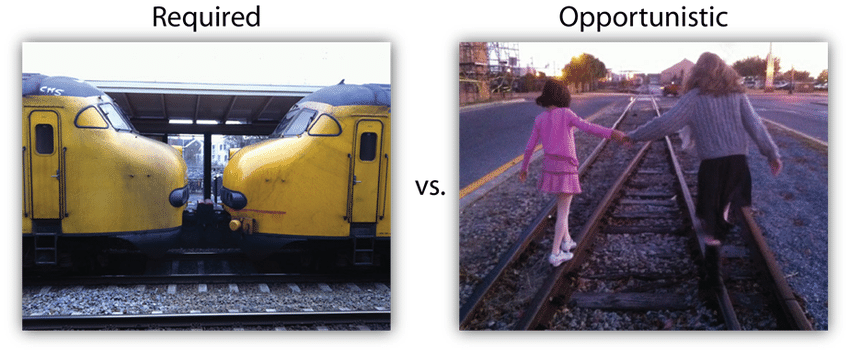
Image: Hard (required) versus soft (opportunistic) interdependence relationships


Habits of a systems thinker

‘Not mincing words here, developing an organizational habit of systems thinking is challenging and a lot of work. It requires investments in time, money and people. One can certainly utilize books, articles and courses to build an awareness of systems thinking. Training someone to use systems thinking in their day-to-day management requires focus, and it is something best done through broad experiences.’   Knowing all this colleagues and I are still going to try out developing  systems thinking across the organisation.

Why?  Because we go along with the view that ‘the larger the business, the more complex the interactions. It is paramount to be able to evaluate the interrelations of systems, comprehend the forces that are at work on the business and subsequently choose changes that result in improved production both in the near-term and in the long-term [in order to improve business performance]’   Quotes above from: Amplify Your Leadership Effectiveness: Apply Systems Thinking

We’re starting small – by simply providing some resources to provoke discussion and see where that takes us.  But even a this point we can illustrate a systems thinking concept.

In Thinking in Systems author Donella Meadows wrote, ”If you understand the dynamics (behavior over time) of stocks and flows, you understand a good deal about the behavior of complex systems.” In describing stocks and flows, Donella Meadows stated, “A system stock is just what it sounds like: a store, a quantity of material or information that has built up over time.  It may be a population, an inventory, the wood in a tree, the water in a well, the money in a bank…Stocks change over time through the actions of flows, usually actual physical flows into or out of a stock–filling, draining, births, deaths, production, consumption, growth, decay, spending, saving.  Stocks, then, are accumulations, or integrals, of flows.”

I’m building up a set of resources to support the systems thinking programme.  It struck me that the resources are the stock and the people who take the programme are the flow – they’re ones who will, through their participation, change stock over time.  They’ll add to the resources, take stuff out to use, amend things, comment on items – keeping the accumulation up to date and useful.

The programme is hung on the Waters Foundation poster ‘Habits of a Systems Thinker’.  There are 14 habits and my colleague has organised them into 5 categories.  Each two weeks we will facilitate a group discussion/learning session that covers the habits in that category.  In between each of the sessions participants will have something to read, watch or think about related to one of the habits in the category.  We’re also planning to invite a speaker to each session to give case study input to the topic.

Here’s the initial stock:

Module 1:  Big picture thinking 

Habit:  Seeks to understand the big picture.  Resource: White paper The Dawn of System Leadership, Peter Senge, Hal Hamilton, & John Kania

Habit: Changes perspectives to increase understanding.  Resource: White paper  Taking Organisational Complexity Seriously Chris Rodgers

Habit: Observes how elements within systems change over time, generating patterns and trends.  Resource: 10-minute video: Systems theory of organisation

Module 2: Thinking about thinking

Habit: Surfaces and tests assumptions. Resource:  8-minute video, Why challenging assumptions is the way to go.

Habit:  Considers how mental models affect current reality and the future. Resource: Blog,  The “Thinking” in Systems Thinking: How Can We Make It Easier to Master?

Habit: Considers an issue fully and resists the urge to come to a quick conclusion. Resource: 5-minute TEDed  Rethinking thinking, Trevor Maber,

Module 3: Cause and effect

Habit:  Identifies the circular nature of complex cause and effect relationships. Resource: 4- minute video Introduction to causal loops

Habit: Recognises the impact of time delays when exploring cause and effect relationships.  Resource:  Article (academic) Understanding the causes and consequences of disruption and delay in complex projects: how system dynamics can help

Module 4: System acupuncture

Habit: Recognises that a system’s structure generates its behaviour. Resource: Book chapter System behaviour and causal loop diagrams

Habit: Uses understanding of system structure to identify possible leverage actions. Resource:  Blog,  Leverage Points: Places to Intervene in a System

Habit: Makes meaningful connections within and between systems.  Resource:  Guide, Project Interdependency Management

Module 5: Organisational learning

Habit: Considers both short and long term consequences of actions. Resource: Report, Short-termism in business: causes, mechanisms and consequences

Habit: Finds where unintended consequences emerge.  Resource: 3-minute video:  Great moments in unintended consequences

Habit: Checks results and changes actions if needed: ‘successive approximation’. Resource: Blog,  Successive Approximations: What the Berimbolo Taught Me About Learning

What resources would you add to the list to illustrate each of the habits of a systems thinker?  Let me know.