The accountability conundrum (again)

Tomorrow’s Organization Design Forum’s peer-to-peer consulting session in which I’m in the hot-seat has been drifting to front-of-mind over the last couple of weeks: prompted by first, a coaching session on how to frame the question in a way that the peer group can tackle it, and then by getting a Zoom invite to the actual session that proved to me that I’m actually in the hot seat.

The way it works is rather like a fish-bowl exercise, but virtually.  I sit in the ‘middle’, and briefly outline my conundrum.   Five consultants the discuss it.  We follow the ‘Ace-It’ formula. Other people ‘watch’ the session in action, commenting only via the chat box.

The info that has gone to the five consultants says: ‘The ask for Naomi to hold this session came out of a high level of interest shared during one of our monthly virtual conversations (ODF Advisory Group) around an article she wrote Accountability – Is it a Design Concern? featured in EODF’s monthly newsletter.  People suggested that I do a follow-up blog but it turned into this live session instead.

The conundrum I’m posing to the consultants is:

Work process flows almost always cross organizational boundaries, either internal boundaries or between organization boundaries.  This can create difficulties, bottlenecks, and failure points at the intersects and hand-overs.   Assigning a single person accountability for the process flow does not allow for the fact that the accountable person may not have control over the people along the flow.  These people may be working on other flows, have different priorities, and different performance measures.  Along the flow, people may have the power to slow or stop the flow.

Imagine a design that assumed a collective accountability to maintain process flow.  How could this be designed?

Last week I wrote a blog and also ran a session on Hierarchies and Networks. In these two forums I asked whether ‘the very differently principled networks and hierarchies co-exist in one organization’?  I think they do, along with the informal networks that are in both.

In response to that blog Nicolay Worren sent me his excellent – still in draft – paper The “hidden matrix”: Reporting relationships outside the formal line organization. In this, he talks about some research in which he has found that ‘Even though the organization does not formally have a matrix organization, the decision rights have been distributed in such a manner that employees will require the approval of people who are not their line manager, who is outside their own department, and may not be hierarchically superior to themselves.’

He is wondering, similarly to me, about mixing of structures in one organization – one of which is often consciously designed (the hierarchy) and the other which equally formal but not usually consciously designed – the network or, in Worren’s case, the matrix.  He doesn’t speak much about the informal networks in both.

I’m intrigued to find that a network can be expressed mathematically as a matrix but I’m not going to pursue the difference between them in organizational design terms right now.  Another intriguing take is in the article To Matrix, Hierarchy or Network: that is the question.   It’s not directly about organization design but there are great parallels that might be usable in design work.

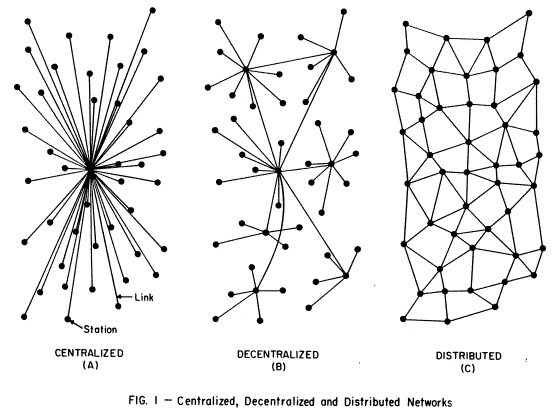
Pursuing the network route for now, RAND researcher, Paul Baran, began thinking about the optimal structure of the Internet. He envisioned a network of unmanned nodes that would act as switches, routing information from one node to another to their final destinations. Baran suggested there were three possible architectures for such a network —centralized, decentralized, and distributed.

He felt the first two —centralized and decentralized— were vulnerable to attack, the third distributed or mesh-like structure would be more resilient.  And this is what he designed.  The Internet is a network of routers that communicate with each other through protocols – which might be an organizational proxy for decision rights, approvals, and distributed accountability.

The mesh like structure is what I think of when I think of networks, and I dug out my blog Of Nets and Networks  and found that the metaphor of accountability exists in physical fishing nets.  Each knot in the net is ‘accountable’ for the success of each other part of the net.  The knots are representative of shared and distributed accountability.  The way the fishermen work with the nets represents the informal network.  But maybe I’m carrying that too far?

Then my brother sent me a snippet that seemed to perfectly describe organizational networks – formal and informal in one go.  Except it was referring to consciousness:

‘In our brains there is a cobbled-together collection of specialist brain circuits, which, thanks to a family of habits inculcated partly by culture and partly by individual self-exploration, conspire together to produce a more or less orderly, more or less effective, more or less well-designed virtual machine, the Joycean machine. By yoking these independently evolved specialist organs together in common cause, and thereby giving their union vastly enhanced powers, this virtual machine, this software of the brain, performs a sort of internal political miracle: It creates a virtual captain of the crew, without elevating any one of them to long-term dictatorial power. Who’s in charge? First one coalition, then another…’   It’s from Daniel Dennett, (1991) Consciousness Explained, Little, Brown and Co.

I’m not sure how all this rumination has progressed my thinking on organizational networks and distributed accountability, in a way that will make sense when I sit in the hot seat tomorrow.  But it’s been an interesting exploration.  Do you think networks distribute accountability?  Let me know.
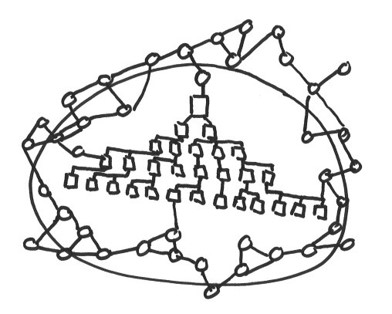
Image: How everything is connected to everything else

Hierarchies and networks

View at Medium.com

Oday Kamal observes that ‘The tension between hierarchy and networks is fundamental in charting the course of the future of work.’ And then asks several questions: ‘How can beneficial networks be nurtured in organizations? Where does a legacy hierarchical structure and a nascent network intersect and support each other? How can we determine if our organizations are choking the life out of potentially beneficial networks before they can really make a positive impact?’

He doesn’t answer these questions but they’re relevant to an introductory session I’m running this week on organizational hierarchies and networks and how work gets done, and I’ve been ruminating on them.

We seem to be moving towards the idea that networked structures are ‘a good thing’ in an age where hierarchies and ‘power over’ organizations seem to have had their day.

Amy Edmundson and Michael Lee describe hierarchies as being based on two principles a) A hierarchy of authority where individuals report to managers who have the authority to direct and prioritize the execution and allocation of tasks, review performance, and in many cases, hire and fire; b) A hierarchy of accountability—that is, work accountabilities roll up from direct reports to managers who hold ultimate accountability for the work of all those below in the organization chart.

They imply, as does Deloitte in the 2017 Human Capital Trends, that these organizational hierarchies are not fit for our digitized, networked age and that a more appropriate design is one thatradically decentralizes authority in a formal and systematic way throughout the organization,’

Networks fall into this category.  Jessica Lipnack and Jeff Stamps describe them as configurations ‘where independent people and groups act as independent nodes, link across boundaries, to work together for a common purpose; it has multiple leaders, lots of voluntary links and interacting levels.’  They’re based on the principles that

  • Authority is not from a hierarchy but from individual’s recognized knowledge and skill
  • Links are between people and teams across conventional boundaries (e.g. departments and geographies)
  • Members and structures adapt to changing circumstances
  • Management has a sense of mutual responsibility
  • People explore ways to work effectively
  • Teams are readjusted or disbanded needed

Can the very differently principled networks and hierarchies co-exist in one organization and would this resolve the tensions Oday Kamal observes?

John Kotter suggests so.  In his article Hierarchy and Network: Two Structures, One Organization, he tells us that:

The successful organization of the future will have two organizational structures: a Hierarchy, and a more teaming, egalitarian, and adaptive Network. Both are designed and purposive. While the Hierarchy is as important as it has always been for optimizing work, the Network is where big change happens.  … My idea of the Network is a system of teams with representatives from all divisions and all levels, who leave formal titles at the door to participate in a decidedly anti-hierarchical forum.  (See also his HBR article Accelerate)

But, not obvious in either the principles or the discussions of formal hierarchies and networks are the informal networks that exist within them – of friendship, influence, knowledge, etc. (Unless this is what Kamal means by ‘beneficial network’).

Organizational network mapping, of the type Rob Cross does, clearly shows us that informal networks of social connection and interaction are strong in all types of organizations and they can be very powerful influencers – beneficial or not –  of individual, team and organizational performance. (Watch the TED talk on the hidden influence of social networks.)

There may be tensions between hierarchies and networks, and they may be resolvable by having both present in one organization but only if the strength of the informal social network ties are identified and factored into the design thinking.  (Here’s a helpful Oxfam blog on getting started in social network mapping).

The informal, social networks are what make organizations work and they can’t be designed.  How can knowing more about them help us decide how to configure the formal hierarchies and networks either as independent forms or as integral forms?  Let me know.

Image Jakob Wolman

Maybe, I’ve left it too late

A one-hour introduction to design thinking can’t be designed in 5 minutes or in an hour.  I’m feeling the pressure, with very little time to go before I have to facilitate the session and only the barest outline of what to cover that is high-quality, engaging, informative, useful and quick to design.  Maybe, I’ve left it too late to do a good design job.

Years ago, when I first got involved in the world of computer based training I read somewhere that it took 40 hours of designing to get 1 hour of instructional material ready to deliver.  Now, with so many channels of delivery – omni-channels, even – has this estimate increased or decreased?  I don’t know, and thinking about it is taking away from the time that I have – closer to 40 minutes than 40 hours –  to design the one hour I am facilitating next week.

So, what to do? How can I accelerate the design of my workshop in the time I’ve got on the train, where there is very limited internet access to pull up resources?  I definitely do not have the time to go through the 5-step design thinking process – empathize, define, ideate, prototype, test – that will result in a brilliantly designed session.  Not good role-modeling here.

Maybe I can do a 60-minute version of the 90-minute Stanford D-School virtual crash course in design thinking? It’s got a facilitator guide, video and worksheets.  Presumably the course has been through the design thinking process itself.

And that takes me to Natasha Zen’s argument that ‘Design thinking is bullshit’.  She makes the case that formalising and commoditising a 5-step process that has underpinned design work over ages is limiting. As the blurb says, ‘In her provocative 99U talk, Jen lobbies for the “Crit” over the “Post-It” when it comes to moving design forward.’

She has a point on this.  ‘Design thinking’ could be on the verge of being dismissed as a fad as it has been hyped so much in the last few years.

Perhaps going down a ‘principles’ approach would be more fruitful?  That avoids the predictability of following a 5-step process and there are some interesting design principles to critique.  I already have them on my laptop which makes things easier.  Dieter Rams’s, John Maeda’s and the Global Agenda on Design Council’s.  We could critique them in relation to some objects participants have with them in the room – a pen or a pencil?

I’m still undecided.  I’ve now got several ideas, and others have just landed in my in-box via LinkedIn’s Design Thinking Community.  Someone is looking for some good tips on ‘quick, 5 min fun activities or games that could be conducted to introduce design thinking to a diversified audience (divided into very small clusters, as small as 1-3)’, and others have weighed in with suggestions.   I like the piece on questions from Mastermindset.

Good, I’m forming a bit of a sequence and an outline.  I can start off with a definition of design, then do a short activity where they critique an object against one of the sets of design principles.

I’ll then move on to a short video on design thinking.  There are two I’ve used before that give good summaries: one Design Thinking by Daylight Design, a 4 minute intro video and the other a trailer for a film Design & Thinking.

From this we can go into the 5-phase method and do a variant of the crash course when the participants design something relevant to them as users.  The thing that springs to mind is a better room booking experience – maybe because I’ve just been bumped from a booked room with no warning or explanation.

I’ll ask a couple of colleagues if they think that will work, give it a go as a minimum viable product, and learn from what happens.

How would you design an hour’s introduction to design thinking?  Let me know.

Image from: Margaret Kagan, Open Law Lab

Metaphors and a speak up culture

Last week the UK’s Institute of Business Ethics (IBE) published a Good Practice Guide, Encouraging a Speak Up Culture.  They are clear that is it not only about whistleblowing – explained by Gov UK as:

You’re a whistleblower if you’re a worker and you report certain types of wrongdoing. This will usually be something you’ve seen at work – though not always. The wrongdoing you disclose must be in the public interest. This means it must affect others, e.g. the general public.

But,  IBE says,  also about ‘speaking up’ – a language shift that ‘can mark the beginning of fostering an open culture’.  The guide tells us that:

‘managers at all levels are responsible for nurturing a Speak Up culture – a culture of integrity and openness – where ethical dilemmas are discussed and debated and employees feel supported to ask questions and raise concerns.  A healthy, trustworthy culture is the basis of a sustainable organization in the long-term’.

In this it extends ‘speaking up’ beyond the bounds of whistleblowing into the arena of ‘employee voice’ which the UK’s CIPD, says is  ‘the means by which people express their opinions and have meaningful input into work-related decision-making.

(As one of their seven layers of workplace productivity Acas has ‘strong employee voice:  informed employees who can contribute and are listened to.’)

A speak up culture embraces both whistleblowing and employee voice and, as Courageous HR suggests,  ‘Maybe the way forward is to work with organizations and managers in particular, to treat whistleblowing as an aspect of employee voice.’

That’s a laudable suggestion, but is still treating the concept of speaking up in constrained, organization as machine, terms – with policies, formalities, forums, and what the CIPD in their Factsheet actually calls the Mechanisms of Employee Voice, explaining, ‘There’s a range of different and often complementary mechanisms for employee voice. We distinguish two groups: upward problem-solving and representative participation.’

Trying to address issues and opportunities of whistleblowing, employee voice, and a speak up culture from a machine metaphor is not getting us very far.  A 2013 UK survey of UK businesses’ whistleblowing ‘found that despite over 90% of companies adopting formal whistleblowing policies, 1 in 3 think their whistleblowing arrangements are not effective.’

Typically, and perhap unconsciously, we use the organization as machine metaphor in many of our organizational constructs, (e.g. employees being ‘cogs in wheels’, concepts of efficiency, pipelines, toolkits, etc).   If we used a different metaphor, from the machine one, to encourage a speak up culture then maybe we’d come up with a different, more effective, approach to designing one.

Gareth Morgan, in his book Images of Organization offers eight metaphors of organization – one of which is the machine. The others are brain, psychic prison, political system, flux and transformation, instrument of domination, living organism, and culture.

Supposing, for example, we explored the brain metaphor to consider a speak up culture – where would that lead us? Morgan, in his 2011 article,  says:

‘When you view organizations as brains, you find yourself thinking about information  processing systems, learning capacities and disabilities, right and left brain intelligence, holographic capacity distribution, and a host of images that can take brain-like thinking beyond the spongy mass of material that comprises an actual brain.’

For a moment forget about whistleblowing and employee voice and just consider a typical business meeting where usually only a handful of people present speak – why are the others not?  Using the brain metaphor raises interesting questions, for example: Are some participants having difficulty processing the discussion? Are they picking up signals of micro-inequities that constrain them?  Have they learned that the views of those with hierarchical power win or dominate, regardless of other views?   Is their cognitive capacity diminished by being in a small group, or their perceived lower status in the group?  On this last see some fascinating neuro behavioural research.  (Or if you want the easy version look here)

Perhaps if we understood, via the brain metaphor, why people did or did not speak up in meetings which are part of the daily operation of organizations, we might get some insight into why they do or do not speak up about ethical and moral concerns, which takes equal or more courage than speaking up in meetings.

Viewing the problem of not speaking up from a different metaphor could well lead to new ways of encouraging a speak up culture and yield innovative ways to do this.

What other ways are there of encouraging a speak-up culture beyond the mechanistic ways, or using metaphors?  Let me know.

NOTE: See also the CIPD publication Alternative forms of workplace voice: positioning report (September 2017)

Speed the what

I subscribe to number of email updates – each day of the week I get around 45 – they’re from various organizations I visit on my travels through the internet in the course of my work.  In a way, they’re like ‘the olden days’ postcards, friendly reminders of what’s happening from a different part of the world in that moment and many of them pique my interest.

Yesterday I got one from ‘The Ready’.  I was immediately intrigued by their listing of Yves Morieux’s ‘TED talk on how an overload of rules, processes and metrics prevents us from doing our best work.’

It’s a topic that I’m working on and I’d already spent an hour or so reviewing an organizational policy,.  As an antidote I listened to Morieux’s view.   He boldly tells us that:

 ‘the holy trinity of efficiency: clarity, measurement, accountability. They make human efforts derail.’ He makes the strong point that ‘All the human intelligence put in organization design — urban structures, processing systems — what is the real goal? To have somebody guilty in case they fail. We are creating organizations able to fail, but in a compliant way, with somebody clearly accountable when we fail. And we are quite effective at that — failing. … And as performance deteriorates, we add even more structure, process, systems. People spend their time in meetings, writing reports they have to do, undo and redo.’

 And so on.  You get the picture.   (See the Bain brief ‘Four paths to a focused organization’ for a similar perspective).

 As an alternative to clarity, measurement, and accountability which lead to organizational failure (in his view), he offers ‘co-operation’.  He proposes that where it is in people’s personal interest to cooperate then they will do so.  In situations where clarity, accountability and measurement focus on individual performance they will not co-operate. He urges us to:

‘Remove the interfaces, the middle offices – all these complicated coordination structures. Don’t look for clarity; go for fuzziness. Fuzziness overlaps. Remove most of the quantitative metrics to assess performance. Speed the “what.’

 His analogy was a relay race and passing the baton.

I was quite taken with this thinking – in any business process flow the handover points are the most vulnerable to failure.  I run a whole masterclass on boundaries and linkages at handover points – the baton passing moment in a relay race.  It started me wondering if it was a workable analogy that I could use.

It turns out that ‘the relay race is often won in the exchange zones, so drills to increase a team’s baton-passing efficiency are vital to success in the sprint relay.’ That sounds sensible and translatable into an organizational context.  As I just said, in organizations, it’s at the handover points – between parts of organizations, between IT systems, between in-tray and next-step that things go wrong.

Knowing that the handover points are vulnerable is the first step to making them less so – in relay circles by having coaches who ‘select their relay runners with an eye for athletes who can exchange the baton smoothly, and at full speed, in addition to being strong sprinters.  Then the coach must train the team, through its drills, to hone its passing technique into a smooth-running operation.’

Additionally the team must know the rules of the race e.g. the baton has to be passed within the yellow ‘exchange’ box, and the terms of optimum co-operation e.g. runners have to agree the handoff process.They also have to practice, practice, practice.  Even so there can be mistakes and errors which they use to learn from, without blaming an individual.

Translating the relay race to an organizational context suggests that to get good handovers we need to work on:

  1. Having and developing a very highly skilled workforce with each person being able and willing to be a fully contributing team member, to be coached for improvement, and to have the capacity to keep on practicing ways and means of improving, especially at the handovers.
  2. Introducing and maintaining a reward system that develops and sustains co-operation, trust and a collective aim for excellence (rather than individual competitiveness) both at the handover points and along the value chain or process cycle.
  3. Being clear and simple on the rules, measures and accountabilities of co-operation.  Here I disagree with Morieux’s video statement, ‘Don’t look for clarity; go for fuzziness. Fuzziness overlaps. Remove most of the quantitative metrics to assess performance.’  Relay teams and team members are clear on what they have to do, they are assessed on performance, and they are accountable for both their individual and their collective actions.

I do go along with his underlying premise that in many organizations the reporting and compliance requirements mean that ‘employees are often misdirected and expend a lot of effort in vain.’ And on this, in a different article,  Morieux offers six rules to reduce complexity and encourage co-operation.

Do you think that handover points are the vulnerable ones in organizations?  If so, how would you design them to work?  Let me know.

Image: Relay race

What are the ‘first principles’ of organization design?

I’ve found Mumsnet, I’ve read two ‘how to be a grandmother’ books, and I’ve looked at the bewildering array of baby products – My breast friend topping my list on this score!

My daughter now has a 6-week old baby, and I’m rapidly learning that everything I knew about bringing up two children myself – who have both turned into wonderful adults – has changed and I better get learning, rapidly.  Things are different now.    But surely, there are some first principles of child rearing – if so, what are they?  (Elon Musk says, “First principles are a kind of physics way of looking at the world. You boil things down to the most fundamental truths and say, ‘What are we sure is true?’)

This flashed through my mind when I was on a call to colleagues at the Organization Design Forum (ODF).  We were discussing 3 questions: ‘What are you noticing about the theory and practice of organization design today? What are the implications for practitioners? What can/should ODF be doing to help support practitioners given these trends?

These are three big questions to cover in an hour with about 15 people.  I found the call somewhat troubling and during it I was struggling to think why.   But now I’ve had some time to reflect it seems to be related to the child-rearing thought.

One of the early comments made by colleagues was that many people working in organization design don’t understand the ‘first principles’ of it.  I think they were thinking that there are some ‘fundamental truths’ from which to do organization design.  I’m not convinced that there are.

Similarly, I don’t think there are any ‘fundamental truths’ about child rearing.  For example, in the world of child-care there is no fundamental truth that ‘the baby’s sleeping position most always be with the head pointing due north’ although it was the way to do things in 1878.  And, funnily enough, we do seem to have the notion today that organizations must be guided by their ‘true north’– in both cases, these are fads determined by culture and context.

As practices, resources, research findings and theories evolve in child-rearing so they do in organization design, the idea that there are fundamental truths underpinning organization design is as much a fallacy as believing there are some fundamental truths in child-rearing.  (See the book Raising Children: Surprising Insights from other Cultures.)

Certainly, my child-rearing practices differed from my mother’s, as do mine from my daughter’s.  However, what I think my mother and I found helpful, and I suspect my daughter will too, was applying some guiding principles, e.g. that we should bring up healthy – mind, body, spirit –  children,  in the context of understanding that children have rights.

This combination of guiding principles (not fundamental truths) and children’s rights enabled us to child-rear effectively in a way that matched our particular time and place.

A similar approach could work for organization design.  There are already some principles around ‘good work’, see for example Good Work: When Excellence and Ethics Meet or Good work: the Taylor review of modern working practices that has just been published in the UK.

This report suggests that good work ‘is work that is engaging, gives people a voice, treats them fairly, is good for their wellbeing, and helps them to progress. It should be positive for individuals, but also lead to wider positive organisational and economic outcomes: higher levels of productivity and output, and greater innovation and adaptability.’

These are quasi principles that could be used in organisation design and these, combined with local employment rights, would give a useful framework for organisation design, leaving the way of doing it open to various approaches.  Alternatively, there are several sets of design principles for ‘good design’ we could use e.g. Dieter Rams’.

Returning to the three questions we were discussing, ‘What are you noticing about the theory and practice of organization design today? What are the implications for practitioners? What can/should ODF be doing to help support practitioners given these trends?’  I’m thinking that as there are no ‘fundamental truths’ about organization design we could propose some principles for good work or good design,  encourage organization designers to look at the ILO Declaration on Fundamental Principles and Rights at Work, help people look at organization design practice in new and innovative ways that make use of critical thinking and not faddism, and abandon some of our sacred cows around ‘how to do it’.

What’s your view?  Do you think there are fundamental truths around organization design?  Do you think there are ‘good work’ or design principles and employment rights the ODF could support practitioners using?  Let me know.

Image: http://bit.ly/2iMKvyk

What’s in a conference?

Who would have thought that a conference could be energising, fun, and generative?  Often, they’re over-powerpointed, drab affairs (albeit well-organized) in windowless ballrooms of chain hotels.  This European Organization Design Forum one was different.

Why?   Like classic conferences it had keynote sessions – five over the two days – so not much difference there.  But then it also had three per day concurrent interactive learning sessions, and two streams per day of open space sessions.  Plus, it was held in the magnificent DASA museum of work:  its past, present and future.  If ever a venue matched the conference theme – next generation organization design – this was it.

Even better, the keynotes took place in the light, bright, Energie Hall – we were enveloped with information, artefacts and interactive displays on generating energy. We couldn’t not feel energetic.   We felt the power of physical design and environment on productivity and motivation.

DASA was open to the public as well as to the conference and seeing the child ‘brikkies’ outside doing a very realistic house building job – a terrific exhibit – as we walked to and from the various session rooms was fun, as was the naming of rooms – for the conference only – after organization design luminaries: Edgar ScheinJay Galbraith, Peter Senge and so on (Note: where are the women?).

I noticed a lot of laughter during the two-days. That’s not something you typically associate with a workplace. Here, people really seemed to be enjoying meeting old friends, exchanging notes, meeting new people, telling stories and learning from each other in a relaxed convivial way.

What makes for that, I wondered?  Clearly, the setting was a contributory factor. Watch colleagues become part of a radio antenna, or  play Brainball to see a whole playful side of people you wouldn’t normally see.

Could we replicate that style in a workplace and still meet the objectives and targets we are expected to?  It’s not as if the conference had no objectives –  we were there ‘strengthening our practice’ as one participant put it.  And we did this whilst having fun.  It’s the first conference I’ve come away from thinking I must change my sock purchase habits. Both days we were shown the latest sock choices – brightly coloured, rich design, etc – of the facilitators. Maybe it’s something to adopt as a small gesture of workplace rebellion against suits, ties and ‘business dress’.  (However, see what one style guide says).

Onto the keynotes. They’re hard to get right.  None of the five speakers revealed the inevitable trade-offs, down-sides, politics and stumbling blocks that beset organization design work.  (Or am I making an assumption on this and, for some, it really is as smooth and glossy as the presentations portrayed?)

Nevertheless, it was good to hear Rudolf Stark Head, Transmission Business Unit-Powertrain Division at Continental AG say that changing a business model meant all the interdependencies changed, and Chris Worley clearly define ‘agility’ and reduce some of the confusion that this word causes as we try to design ‘agile organizations’.

Of the six interactive sessions on offer, I spent my two choices on digitalization – one on digitalization of the book industry and the other on digitalization in relation to organization design approaches.  Both sessions made use of a ‘digitalisation canvas’, inviting us to discuss the classic (traditional org), combined (classic+some digital org) and digital (pure digital org).

It was great to come away with some ideas, tool and lines of exploration on whether/how/if classic organizations can become truly digital.

The open space slots enabled anyone to propose and lead sessions and the range of topics put forward by participants was wonderful, 18 contending topics – meaning 15 you couldn’t get to as they ran concurrently across three time slots.   They illustrated the breadth of a community of organization designers united by a common ‘discipline’ but with not a trace of group-think on what it is or how to do it.  In my three session choices: on ethics in organization design, on scaling organization design, and on design innovation, the diversity of perspectives, insights, reflection and interests made for depth and richness of discussion that is often missing from my day to day work.

What did I come back with?  Feeling refreshed by a stream of new ideas I can play around with, and buoyed up knowing there is a community of enthusiastic, creative, challenging and supportive practitioners – willing to lend a hand to others in the field.

How important is a community of practitioners in your field to you? Would you go to a conference to meet them? Let me know.

What should future leaders be learning?

I had a conversation the other day with someone who asked ‘What should our management trainees be learning now, to equip and prepare them for leading 10 years out?’ He thought that if, 10 years ago, we’d been able to predict and teach them about design thinking, systems thinking, working with augmented/artificial intelligence, robots in the workplace, behavioural science, the ethics of technology – then they would be better able to manage the leadership roles they are now in.

It’s a good question, and one, I feel, is very hard to answer as what will be useful now in terms of leading ten years from now involves crystal ball gazing and futurology which do not always yield good yardsticks, as the Lyapunov exponent that I wrote about a couple of weeks ago, demonstrates.

But just to test this, I took a look at what The Economist was predicting for 2007.  They asked the question: What will be on the leader’s agenda?  Their answer: climate change, managing shifts in global power, ‘responding to a sense that, in crucial areas, progress that until recently had been taken for granted has stopped or even gone into reverse’, the internet’s transformation of business, the growing connectedness of people, and new tools to search for things.

Their predictions for 2017, ten years later, are very similar, but more pronounced: authoritarians will be ascendant, far-right parties will surge, ‘European politics will be dominated by scaremongering’, more terrorist attacks, financial shocks, and ‘Brexit negotiations will be slow, complicated and cantankerous’.  However, on the more optimistic side, ‘Technology is forging global connections whatever the backlash against migration or trade’

The Economist closes its 2017 predictions with a question: ‘The question is not whether the world will turn back towards openness, but how soon—and how much damage will be done in the meantime.’

What does this mean for future leaders? Should they be preparing for more of the same reversal of progress over the coming ten years, or for a growing return to open-ness?   As we talked this over we asked, what would give them ‘grip’ or enable them to get a grip on, a situation of either further closure and/or more open-ness, and manage it effectively?

Looking at the predictions for 2007 and 2017, it seems to me that rather than develop knowledge of  specific domain content, in order to be able to ‘get a grip’ management trainees should be developing timeless skills useful for pretty much any situation –practicing these through various methods, including scenarios, case studies, action learning, gaming and provocation sessions.

Four timeless skills I think would stand future leaders in good stead, gathered not from rigorous academic research, but from  my organizational experiences over many years, are: diplomacy, kindness, critical thinking, and curiosity.

Diplomacy:  ‘the art of advancing an idea or cause without unnecessarily inflaming passions or unleashing a catastrophe.  It involves an understanding of the many facets of human nature that can undermine agreement and stoke conflict, and a commitment to unpicking these with foresight and grace’.

Kindness  ‘the life lived in instinctive sympathetic identification with the vulnerabilities and attractions of others’ — is the life we are more inclined to live, and indeed is the one we are often living without letting ourselves know that this is what we are doing. … In one sense kindness is always hazardous because it is based on a susceptibility to others, a capacity to identify with their pleasures and sufferings. Putting oneself in someone else’s shoes, as the saying goes, can be very uncomfortable. But if the pleasures of kindness — like all the greatest human pleasures — are inherently perilous, they are nonetheless some of the most satisfying we possess.   (See a lovely poem on Kindness here).

Critical thinking: ‘that mode of thinking — about any subject, content, or problem — in which the thinker improves the quality of his or her thinking by skillfully analyzing, assessing, and reconstructing it. Critical thinking is self-directed, self-disciplined, self-monitored, and self-corrective thinking. It presupposes assent to rigorous standards of excellence and mindful command of their use. It entails effective communication and problem-solving abilities, as well as a commitment to overcome our native egocentrism and sociocentrism.’

Curiosity:   the a strong desire to know or learn; having an interest in a person, thing, or experience that leads to making an inquiry.  ‘Being curious can manifest itself in the activity of asking questions, but it can also be a position from which one approaches life.  It keeps us learning, helps in decision making and can be useful in navigating arguments or confrontations. Todd Kashdan, author of Curious? Discover the Missing Ingredient to a Fulfilling Life, believes that it is from our openness – and not our closedness – that we are able to develop ourselves and others.

How safe do you think it is to predict what leaders will be dealing with in the future – would we be better helping them develop timeless skills (which?) rather than specific domain knowledge?  Let me know.

Image: Reggio Emilia approach

Business capabilities – addressing three confusions

Not for the first time in my career, I’ve come across a bit of confusion, in the last week or so, on the term ‘business capabilities’.   People are confused on:

  • how to interpret a business capability ‘map’- they assume it depicts the organization’s structure
  • the connection between business capabilities and individual capabilities
  • the value of looking at business capabilities at all

When I mentioned this, someone pointed out to me that ‘Business capability is a very academic topic for most people and is likely to lead to confusion and a feeling that by working with them the programme team is insufficiently rooted in reality.’  They were arguing that business capabilities are the kind of internal workings that people didn’t need to know about, and should be ‘hidden’.   My view is that having a good grasp of what business capabilities are and how they can be used acts to reduce the confusion.

Business capabilities are described as the ‘what’ of the organization.  The Open Group defines them as follows:  (Thanks to Tom Graves for alerting me to this)

‘A business capability represents the ability for a business to do something. A more formal definition is as follows: A business capability is a particular ability or capacity that a business may possess or exchange to achieve a specific purpose or outcome.’

You can watch a presentation on business capabilities from Open Group or download their whitepaper on the topic by creating an account.

Having identified an organization’s business capabilities, it is up to others – including organization designers – to convert the ‘what’ into ‘how’.  As Open Group says ‘Critically, a business capability delineates what a business does without attempting to explain how, why, or where the business uses the capability.’

In trying to represent the ‘what an organization does’  the choice of business capabilities over value chain or process mapping, for example, is based on the premise that business capabilities are more stable than these other approaches (which also are more related to the ‘how’).

Typically, business architects develop capability maps.  (Although I heard today that enterprise architects do too.  But I’m not going to be drawn on the difference between business and enterprise architects).

For the most part business architects consider each capability as comprising a combination of strategy, process, people, information and technology.  (Note that some architects use different elements and combinations of them).  Developing the capability map can be a complex process – unless you buy off the shelf ones –  involving close partnering with stakeholders and numerous iterations.  (See one method for developing capabilities here, and look at Captera’s examples of a capability map here).

It is these maps that lead to the first confusion.  The maps cluster the capabilities into what can be interpreted as a structure/organization chart, but the map is not the org chart. Open Group explicitly states that:

‘A common mistake is to transpose the organizational chart onto the frame of the business capability model itself. Quite often, multiple business units are involved in creating or delivering a single business capability. Organizational structures are also far more transient by nature than business capabilities. Avoid where possible a tight alignment between the functional names that denote business units, and the top-level business capabilities.’

A capability map is not the org chart because a capability is a ‘what’, and the org chart is part of the ‘how’.  Take a capability like Recruitment Management, described, in Open Group’s paper,  as ‘The ability to solicit, qualify, and provide support for hiring new employees into the organization.’  This capability (the what), can be operationalised (the how) in a multitude of different ways via various permutations of people, process, information and technology – depending on the organizational resources and strategy.

The ‘how’ do we do what we do is another set of discussions, decisions, choices and trade-offs from which an organization chart is one element that will ultimately emerge.

The second confusion is a related one – often an individual employee’s skills/competences are described as ‘capabilities’.  Where you have a business capability of Recruitment Management, for example, remembering that the capability is a combination of people, process, technology and strategy – what exactly are the people’s capabilities required to work that business capability?

There isn’t a related individual capability of ‘recruitment management’, the individual capabilities are a bundle of  things like  social media savvy, networking, etc.

This confusion can be resolved by changing the language of the organization, to make it perfectly clear that capability refers to business capability and  that competence, or skills, or attributes (not capability) refers to individuals.

The third confusion about why are we looking at capabilities when they are academic, theoretical, and hard to understand leads to other suggestions – can’t we just map processes, or value streams?  The point here is that they are not either/or – they are different ways of looking at an organization.  If you think of the capability as being relatively stable or static, but the process you use for delivering it as changing over time then you need both.  Take recruitment management again.  The ‘how’ it is done changes over time, but the what it does stays the same.  William Ulrich explains the relationship between different organizational views very neatly.

Once the confusions are addressed,  business capability maps can be a useful addition to an organization designer’s practice.   Where do you stand on doing your organisation design work using business capabilities?   Let me know.

Image: Capabilities Banner


Transitions and liminal periods

You know those diagrams that have ‘as-is’ written in a little circle on the left, and ‘to-be’ in a little circle on the right with the word ‘gap’ in an arrow heading hopefully between the two circles?   Well I was thinking about them this week as the word ‘transitions’ came up many times in the week.

There seem to be some beliefs in play – that you can describe the ‘as-is’, that you can head towards a pre-defined ‘to-be’, and that you get from left to right by planning and undertaking activity that carries you across the gap.  It’s rather like looking across a canyon and being able to sling a tightrope across it and successfully walk from one side to the other.

That activity looks straightforward – just walk across the gap. In the case of the tight rope walk there is a clear as-is and a clear to-be.  You can see from one side of the canyon to the other and you know what you need to do to get safely across.  Even so there are mishaps and unforeseen things to work through.

The film ‘The Walk’ shows what it took for expert tightrope walker, Philip Petit to get from ‘as-is’ to ‘to-be’ as he crossed the Twin Tower gap. ‘Guided by his real-life mentor, Papa Rudy, and aided by an unlikely band of international recruits, Petit and his gang overcome long odds, betrayals, dissension and countless close calls to conceive and execute their mad plan.’

Organizational life is not as straightforward as a complicated as-is/to-be tightrope walk, even if the diagrams make it look so.   In organizations, we can’t meaningfully describe the as-is although we have a go.  We can often create sentence or two describing a ‘vision’ of the ‘to be’ but this is usually couched in what amount to non-actionable terms.  But, with these two elements ‘done’ we think we can work out the gap closing activity, present it in a plan and then action it.

However, this is overly simplistic and is a likely contributor to things not working out well.  Suppose, instead, we considered the gap from ‘as-is’ to ‘to-be’ as a form of liminal period like the traditional ‘rite of passage’ from one identity or state to another.

This would yield a very different approach to gap closing.  We know, as one writer says, that ‘Liminal times of the day and year have particular significance in many different stories and cultures. They lack fixed definition and thus a greater range of possibilities exists — possibilities that often violate or stretch our notions of reality.’

If we considered ‘gap closing’ in organization design work, as a liminal period with the attendant ‘range of possibilities’, we could then develop the threshold skills and concepts needed to work through the ‘messy journeys back, forth and across unknown terrain’ in an unstable space in which the travellers may ‘oscillate between old and emergent understandings’.

(There’s a whole body of research on ‘threshold concepts’ that came from the work of Erik Meyer and Ray Land in the early 2000s.  See a useful introduction here.)

What’s interesting about the concepts of liminality and threshold is that they are recognized as being between ‘normal ordered cultural states’, which as one commentator says ‘raises the possibility of standing aside from social positions (while increasing the danger of a potentially unlimited series of alternative social arrangements).’  This seems to be encouraging exactly what we are looking for in organization designs aimed at ‘transformation’.

Some organizations are cited as succeeding with working with liminality concepts to achieve transformation.  Read the HBR article Leadership in Liminal Times. The proposal there is ‘that many leaders themselves will need to experience liminality.  If they are truly interested in seeing their organizations accomplish great things, many will have to make a transition from an immature mode of invoking hierarchy, territorial ownership, and formal positional power, to a more mature phase of gathering and channeling group energies with influence, engagement, and other elements of what I call open leadership.’

Do you think replacing the concept of ‘gap closing’ with its connotations of predictability and orderly progression with the concept of ‘liminality’ and that working with the HBR recognition that ‘times of liminality are disconcertingly chaotic’ would make a more successful transition from the as-is to the to-be?  Let me know.


Image:  Liminality, Iyvone Khoo.